Buying Near Jaipur: Land Conversion, JDA Approval and Apna Khata
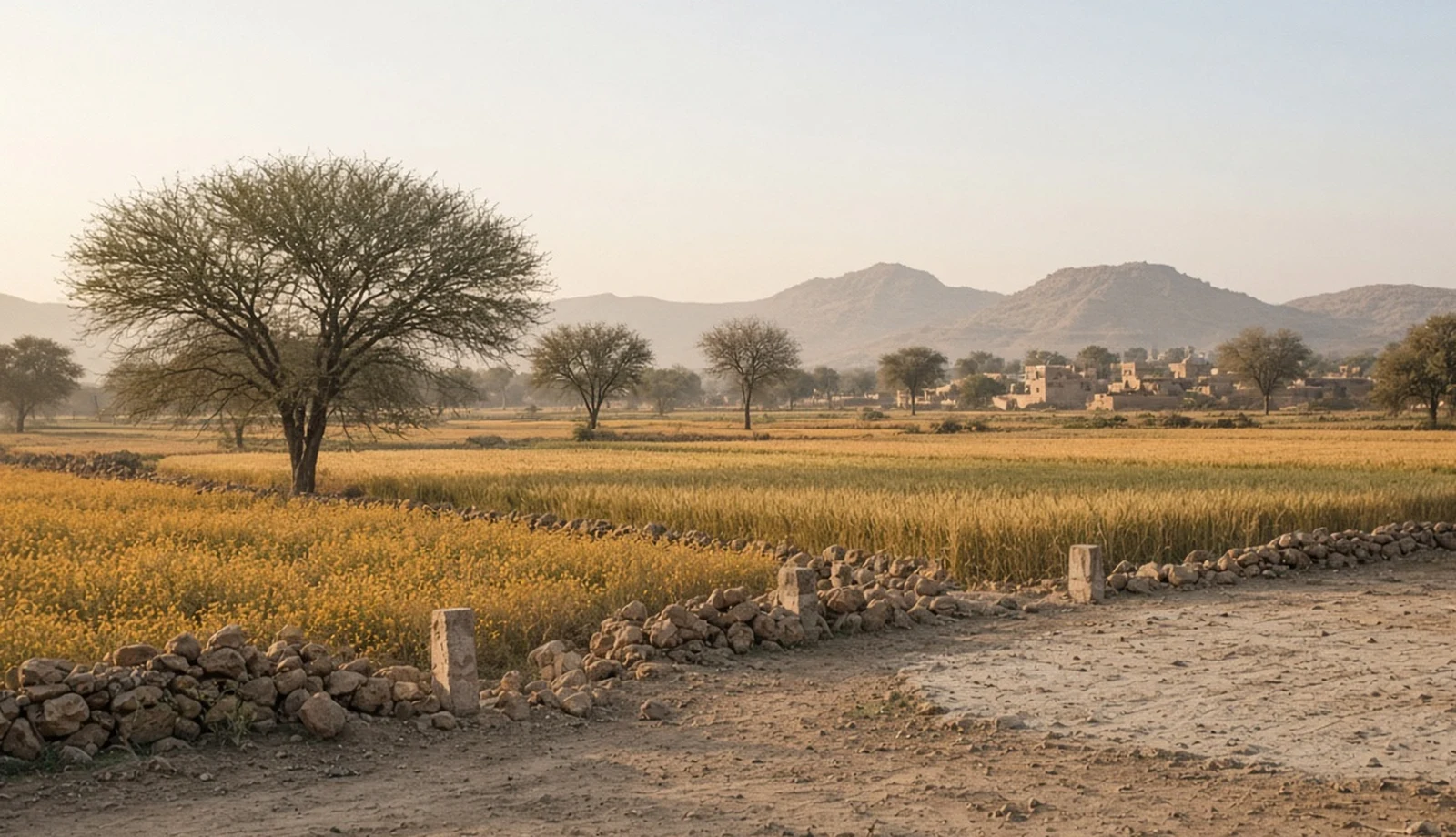
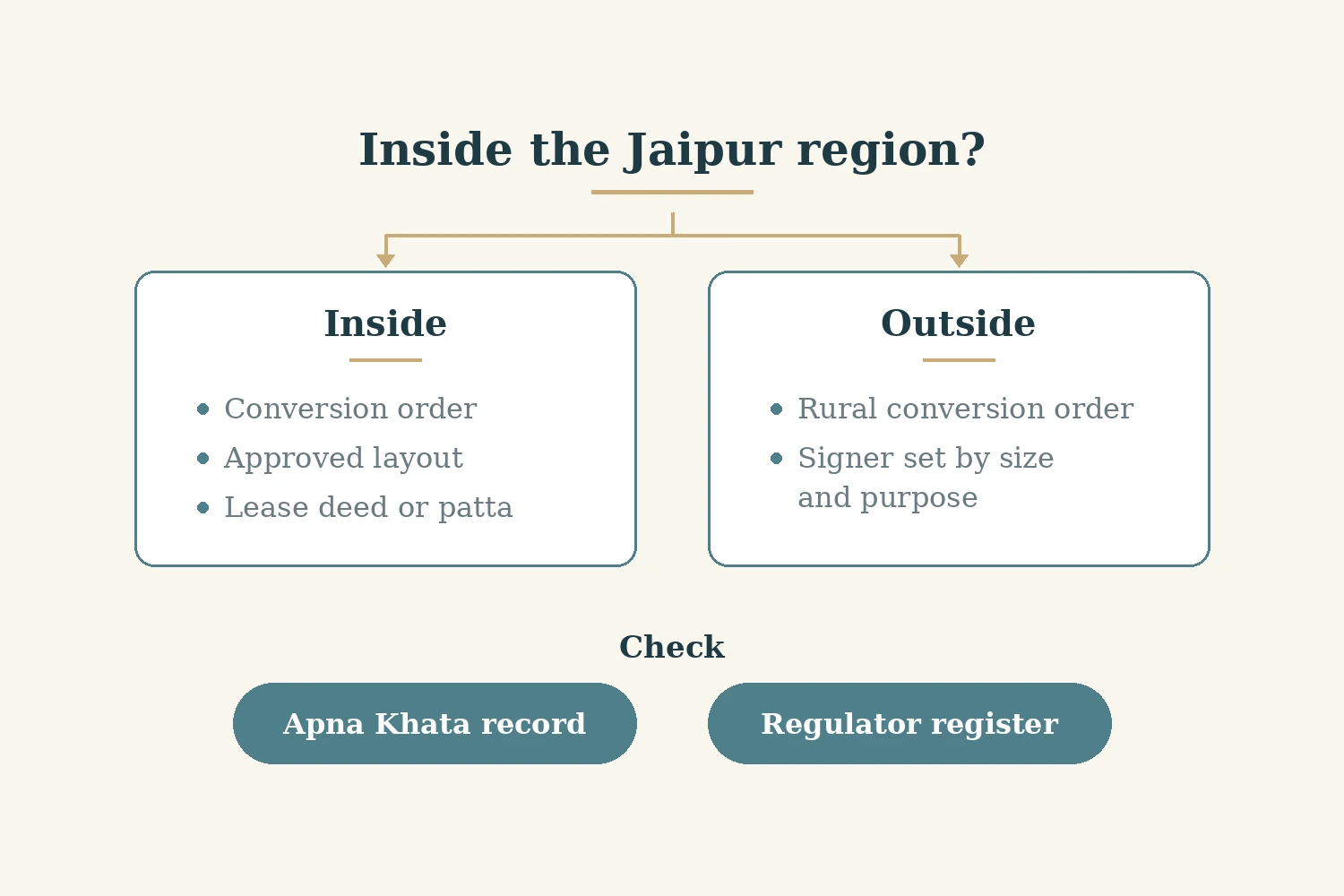
If you live in Delhi or Mumbai and are looking at a weekend villa or a plot on the edge of Jaipur, the first question to ask is not whether the land has been converted. It is which side of the Jaipur region line the plot sits on, because that decides which paper proves it. Inside the region, conversion takes the land out of the farmer's hands and puts it with the Jaipur Development Authority (JDA), which then grants it back by lease deed or patta. Outside it, a separate set of rural rules applies and the farmer keeps the land. This guide walks a high-net-worth individual (HNI) buyer, or a Non-Resident Indian (NRI) checking from abroad, through the papers for each case, using official sources we read on 31 October 2026. It is general information, not legal advice.
Farmland is the default, and section 90-A is the gate
In Rajasthan, land held for agriculture stays agricultural until the state says otherwise. Section 90-A(1) of the Rajasthan Land Revenue Act, 1956 says no person holding land for agriculture, and no transferee of that land, may use it for any other purpose, by building on it or otherwise, without the state government's written permission, and then only on the terms of that permission (Rajasthan Land Revenue Act, read 31 October 2026). Under section 90-A(2) to (4), the holder applies in the prescribed manner, the state makes an inquiry and either refuses or grants permission, and a grant makes the holder liable to pay an urban assessment, a premium, or both.
Skipping this step is serious. Under section 90-A(5), if land is used without permission, against its conditions, after a refusal, or without the payments, the original holder and every later transferee are deemed trespassers and liable to ejectment under section 91 (read 31 October 2026). The state may instead let them keep the land and use it for a non-agricultural purpose, on paying a prescribed penalty in addition to the urban assessment and premium, but that is its choice, not the buyer's. So a buyer of a plot can inherit the problem from the seller.
Section 90-A(5A) lets the state prescribe non-agricultural uses that need no permission. We could not confirm from an official source which uses have been prescribed under it, so do not assume any exemption covers your plot. Rajasthan's mechanism is its own; our guide to farmland contracts and land law by state explains why state rules differ.
First find out which side of the Jaipur region line the plot sits on
The same section draws the line that matters. Its explanation (b) defines an "urban area" as including the Jaipur region as defined in section 2(8) of the Jaipur Development Authority Act, 1982, along with the Jodhpur region, municipal areas and other notified areas (read 31 October 2026).
The region is wider than the city. The JDA's Development Promotion and Control Regulations for the Master Development Plan (MDP) 2025 say they apply to the entire Jaipur region, and list urbanisable areas U1 to U3, an eco-sensitive area, an agriculture zone, an ecological zone and a rural area within it (JDA MDP-2025 regulations, read 31 October 2026). So a plot that looks rural, in an agriculture zone, may still be inside the Jaipur region.
We could not confirm from an official source whether any particular village, or the location of any listing, falls inside the region. You have to check it. The JDA website links to the Master Development Plan 2025, a "Know Your Zone" tool and a geographic information system (GIS) map of the plan (JDA website, read 31 October 2026). Search the village and khasra number, which is the survey number of the field, before you look at any other paper. Our Jaipur guide covers the city.
Inside the region: conversion hands the land to JDA, and JDA hands back a lease deed
Section 90-A(6), added in 2012, says that inside an urban area permission is granted only if the use is allowed under the law of that area and is in keeping with the master plan or other development plan in force (read 31 October 2026). Then comes the surprise. Under section 90-A(8), from the date the permission order is passed for land in an urban area, the holder's tenancy rights are extinguished and the land is deemed to be placed at the local authority's disposal. It is then available for allotment back to the person who got permission, or their successors, assignees or transferees, on payment of the urban assessment or premium.
The Rajasthan Urban Areas (Permission for use of Agricultural Land for Non-agricultural Purposes and Allotment) Rules, 2012 set out the sequence (2012 urban rules, read 31 October 2026):
- Rule 4(b) requires the khasra boundaries to be superimposed on the layout plan.
- Rule 7(1): the authorised officer is to decide the application within forty-five days and, if accepted, issue permission in Form-11.
- Rule 7(3): a copy goes to the tehsildar, the revenue officer for the area, to mutate the land in the revenue record in favour of the local authority within seven days, and copies go to the local authority and to the person whose khatedari, or tenancy, rights are extinguished.
- Rule 8: the applicant then gets the layout plan approved by the local authority.
- Rule 11(1): once permission is granted, premium and urban assessment are paid, the layout is approved with its charges, and development charges are paid, the local authority allots the land and issues the lease deed or a single patta within fifteen days. These rules have been amended since 2012, and we could not confirm from an official source the current premium rates or timelines in those amendments, so we give none.
Outside the region: the 2007 rural rules and who signs
Outside urban areas, the Rajasthan Land Revenue (Conversion of agricultural land for non-agricultural purposes in rural areas) Rules, 2007 apply, in the version the revenue department marks as updated till December 2023 (2007 rural rules, read 31 October 2026). Here the khatedar applies for conversion and keeps the land; there is no hand-over to a development authority.
Who signs depends on purpose and size. Under the schedule of prescribed authorities, conversion for a residential unit is signed by the tehsildar up to 4,000 square metres. For a residential colony or project, the Sub Divisional Officer (SDO) signs where the total area does not exceed 10,000 square metres, the collector where it does not exceed 50,000 square metres, and the state government above that. Check that the signature matches the size.
For residential colonies in rural areas, the rules reserve forty per cent of the total land for public facilities including roads, and the remaining sixty per cent for the colony, including five per cent of the total for commercial and institutional use. Conversion charges are due on the total area. Our Alwar guide and Neemrana guide cover places where buyers meet both rural and urban paperwork; we could not confirm from an official source which side of any line specific villages there fall on.
Reading Apna Khata, and what the record should say
The Board of Revenue's Apna Khata portal, also called e-Dharti, lets anyone look up land records online. Its services include the bhu-naksha (the cadastral map), the mutation report, a copy of the jamabandi (the record of rights), applications for mutation and demarcation, and girdawari details (the crop inspection record) (Apna Khata, read 31 October 2026).
The portal's own notice, in Hindi, matters as much as the records. In our translation, it says the information is for general information only, that some mutations are not updated immediately, and that the online copy therefore cannot be used as a certified or authorised copy in any court or office; for a certified copy, apply at the designated kiosk. So treat the online jamabandi as a starting point and get a certified copy before you pay. The same pattern, where the online record is not the certified record, runs through our guides to patta, chitta and encumbrance checks in Tamil Nadu and coastal land checks in Dapoli.
Put the pieces together and a plot inside the Jaipur region should leave a trail you can follow. It starts with a farmer recorded as khatedar in the jamabandi. Next comes a section 90-A permission order naming that land. After that, the revenue record should show the land mutated in favour of the local authority, which for this region is the JDA. Then there should be an approved layout plan with the plot on it, followed by a JDA lease deed or patta to the developer or to the first buyer. Only after all that should there be a registered sale to you.
The common gap is in the middle. A seller who shows a jamabandi still in a farmer's name together with a letter saying conversion is done is showing you the start of the chain, not the end. If the order was passed, the record should have moved to the local authority; if it has not, ask why. Our guide to villa checks near Hyderabad uses the same logic of making three papers match.
Checking the scheme: JDA's lists and the Real Estate Regulatory Authority register
The JDA publishes material that a buyer can search directly. Its property services site carries a Rejected Scheme List giving the zone, whether the developer is the JDA or private, the developer's name, the scheme name and the status; when we read it, it included private and niji khatedar (individual landholder) schemes (JDA Rejected Scheme List, read 31 October 2026). The JDA website also links to minutes of its land conversion committee.
Search the scheme name and the developer's name in both before paying a token. A match is a reason to stop; no match is not proof of approval. Take the papers to the site with our plot site visit checklist.
For plotted projects, under section 3(2)(a) of the Real Estate (Regulation and Development) Act, 2016, often called RERA, no registration is required where the land to be developed does not exceed five hundred square metres or the apartments do not exceed eight, including all phases, though a state may lower that threshold (RERA Act 2016, read 31 October 2026). We could not confirm from an official source whether Rajasthan has set a lower threshold.
The Rajasthan Real Estate Regulatory Authority's project search and project pages would not load in a readable form for us on 31 October 2026, so we could not confirm their registration number format, search filters or the documents they show. Search the register yourself and compare what it shows with your papers. A number printed in a brochure, or on a listing, is not a check. Our guides to reading project status and buyer protection for under-construction homes explain what registration does and does not cover.
The cost line at registration
Rajasthan's stamp and registration department publishes a fee table "as applicable on 10-03-2025" (stamp duty and registration fee detail, read 31 October 2026). For a sale deed it shows stamp duty of six per cent of market value for the general category and five per cent for a woman other than in the Scheduled Caste, Scheduled Tribe or below poverty line (BPL) categories, a surcharge on stamp duty of thirty per cent, and a registration fee of one per cent. The surcharge is charged on the stamp duty, not on the property value. So for the general category, thirty per cent of six per cent is one point eight per cent of market value, which brings stamp duty and surcharge to seven point eight per cent; adding the one per cent registration fee gives eight point eight per cent. For a woman at five per cent, the surcharge adds one point five per cent, making six point five per cent, and with registration seven point five per cent.
The same table treats an allotment letter or patta given with possession, or with a promise of possession, as a conveyance for stamp duty. There is a discrepancy to check: the e-Panjiyan registration portal's frequently asked questions say in one answer that sale deed stamp duty is currently five per cent, and four per cent for women, while the table on the same page shows six per cent and one per cent registration (e-Panjiyan, read 31 October 2026). Confirm the figure at registration. Our guide to stamp duty and registration by state has no Rajasthan section yet, and our guide to plot loans covers how lenders view these costs.
Who this is not for
This is not legal advice, and it does not replace a local lawyer who can read the certified records. It does not cover other urban areas, regularisation of older unauthorised use, or the JDA Act's own provisions, which we could not confirm from an official copy. It gives no conversion premium figures and makes no claim about roads, transport or other infrastructure.
Where that leaves you
Around Jaipur, start with the map, not the brochure. Find out from the JDA's maps whether the plot is inside the Jaipur region. Inside it, expect a section 90-A order, mutation to the local authority, an approved layout and a JDA lease deed or patta before your sale deed. Outside it, expect a conversion order signed by the authority the 2007 rules name for that size and purpose. Check a certified copy of the record, search JDA's lists and the RERA register yourself, and budget for stamp duty with surcharge plus registration. We have six listings in Jaipur and nine in Rajasthan in all, as listed on avacasa.life on 31 October 2026; our Udaipur guide covers the one listing there. This is general information, not legal advice.
Sources
- Rajasthan Land Revenue Act, 1956 (Revenue Department consolidated copy)
- Rajasthan Urban Areas (Permission for use of Agricultural Land for Non-agricultural Purposes and Allotment) Rules, 2012
- Rajasthan Land Revenue (Conversion of agricultural land for non-agricultural purposes in rural areas) Rules, 2007, updated till December 2023%20Rules,%202007.%20updated%20till%20dec%202023.pdf)
- JDA: Development Promotion and Control Regulations, MDP-2025
- Jaipur Development Authority website
- Rajasthan GIS: Master Development Plan citizen map
- JDA: Rejected Scheme List
- Apna Khata (e-Dharti), Board of Revenue Rajasthan
- Real Estate (Regulation and Development) Act, 2016 (UP RERA copy)
- Stamp Duty and Registration Fee Detail, as applicable on 10-03-2025
- e-Panjiyan frequently asked questions
Ready to find your next holiday home?
Browse our curated collection of vacation homes and managed farmland across India and beyond.