Tamil Nadu Land Papers: Patta, Chitta and the Encumbrance Certificate

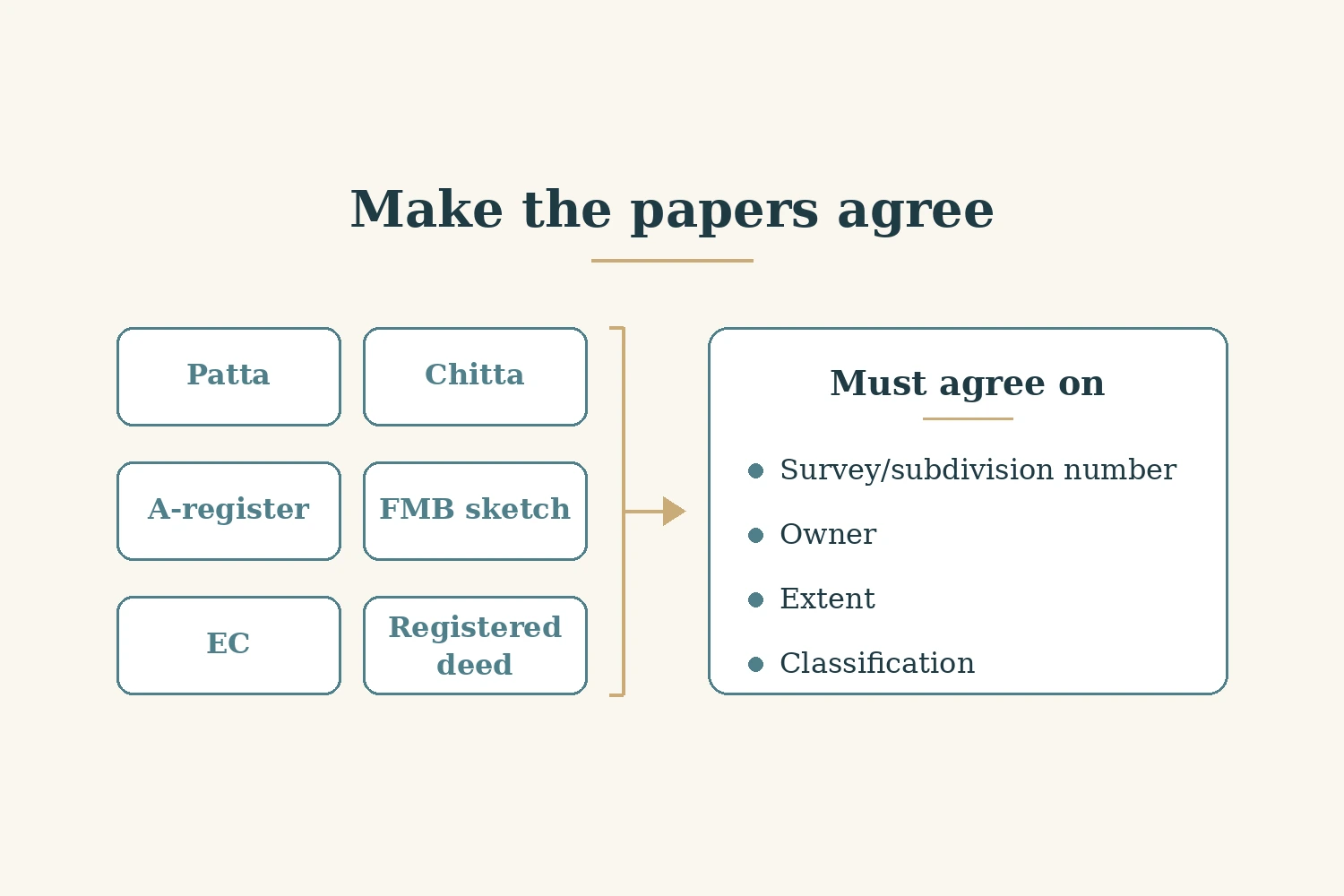
If you have bought land in Karnataka or Maharashtra, Tamil Nadu's papers can look familiar and still catch you out. There is no single document that proves a seller owns what they are selling. The revenue records say who the state records as holding the land and what shape and class it is. The Encumbrance Certificate (EC) lists what has been registered against it. The sale deed is what actually transfers it. Problems tend to live in the gaps between them: a patta in a different name from the seller, a deed describing more land than the survey sketch shows, or an EC searched for the wrong period or the wrong survey number. So the job before you pay is not to collect documents but to make them agree on one survey number, one owner, one extent and one classification. Official points below were read on 28 October 2026, the English is our paraphrase where the source is in Tamil, and this is not legal advice.
Why one paper is never enough
Tamil Nadu's land papers come from two different systems. The Revenue and Disaster Management Department keeps the land records: patta, chitta, the A-register and the Field Measurement Book (FMB) sketch, published through its "E-Services of Land Records" portal. The Registration Department keeps the record of registered documents, from which the EC is drawn. The sale deed and the earlier deeds behind it, the parent documents, sit with the seller.
Each answers a different question, and none answers all of them. The revenue records do not tell you whether the land has been mortgaged. The EC does not tell you whether the land is classified as government land. Neither tells you what has been agreed but never registered. That is why the checks below work as a set. Our list of questions to ask before signing a land deal covers the wider points to raise with any seller.
Patta: who the state records as holder
The patta is the revenue record of who holds the land, against a survey number and subdivision number, with the extent recorded. The state's E-Services of Land Records portal (eservices.tn.gov.in, read 28 October 2026) lets anyone view patta, chitta and FMB details for rural and natham (village settlement) land, view a patta copy, check whether a patta or chitta is authentic, and see town survey records in urban areas. The portal says land details are updated online in real time, so a visit to the revenue office is not needed to see them.
Two practical points from the portal itself. First, names are shown in Tamil, and the portal warns against using browser translation, because a translated name may not match the record. Compare the Tamil spelling on the patta with the Tamil spelling on the deed, not two translations. Second, patta transfer after a purchase is applied for online, including through any Common Service Centre (CSC) in the state, with a processing fee of 60 Indian rupees (Rs 60), whether or not the land is subdivided (fee details as cited by the portal to Government Order (G.O.) (Ms) No. 370 of the Revenue and Disaster Management Department, 21 July 2020). The portal also lists a separate per-page or per-subdivision fee schedule under that G.O.; we do not characterise it further here.
If you have read a Maharashtra 7/12 extract, the patta plays a broadly similar role in recording the holder; our guide to reading a 7/12 extract explains that system.
Chitta, the A-register and government land
The same portal publishes A-register details for rural and natham land, and lets you view details of government poramboke land, meaning land recorded as belonging to the government. How classification appears on the current online extracts, and how the chitta differs from other village accounts, is not something we could confirm from an official page, so we keep this general: read the classification shown for your survey number and subdivision, and make sure it fits the use you intend.
The single most important check here is whether any part of the land is recorded as government land. Land recorded as government poramboke should not be in a private sale. If the A-register or the portal's poramboke view shows your survey number or subdivision, stop and take legal advice. Goa has its own equivalent records; our guide to Goa's Form I and XIV shows how another state handles the same question.
The FMB sketch: the shape of the land
The FMB sketch is the survey map of a field: its shape, boundaries and measurements. The portal allows FMB copies to be downloaded free of cost, and also offers an F-line (field boundary) measurement service, with a Rs 60 processing fee for the application.
Download the FMB for the survey number and compare it with the boundaries and extent described in the deed schedule. Then compare both with what you see on the ground. If the deed describes a piece of land that does not match a subdivision on the FMB, or the boundaries on site differ from the sketch, resolve it before paying. Our plot site visit checklist covers what to look for on the ground.
The encumbrance certificate: what it shows and what it cannot
The EC is drawn from the Registration Department's records and lists the registered transactions on a property for the period you search. The department's Right to Information (RTI) handbook advises buyers to get an EC before deciding to purchase, to see what transactions have been registered on the property (read 28 October 2026). Its fee schedule is an application fee of Re 1 (one rupee), a search fee of Rs 15 for the first year and Rs 5 for every additional year, with an additional Rs 100 at some offices and double fees for urgent ECs in offices that are not computerised. The handbook is undated, so treat these as the published schedule rather than a quote. The department's policy note for 2023-24 adds that an EC can be viewed and downloaded through its portal without cost, and applied for online (read 28 October 2026).
To show the scale, an illustrative over-the-counter search covering 20 years would cost Re 1 + Rs 15 + (19 x Rs 5) = Rs 111 under that schedule, or Rs 211 if the additional Rs 100 applies.
What period should you ask for? Buyers are commonly advised to search 30 years. That is common practice, not a legal rule. A better test is to search back at least to the date of the oldest parent deed you are relying on, and up to the latest available date. We could not confirm from an official source how far back the online records go.
Just as important is what the EC cannot show. It lists registered documents only. Agreements that were never registered, court cases, unpaid revenue dues and tenancy are not on it. A lawyer's title search and local enquiries cover those.
The sale deed, the registrar's checks and registration costs
The sale deed is the document that transfers the land, and it is the one you register. We could not load the official text of the Registration Act, 1908 today, so we do not paraphrase its sections here; ask your lawyer which of your documents must be registered.
Tamil Nadu's Registration Department describes several checks it makes at registration. Its policy note for 2023-24 says that, to curb fraudulent registration, the previously registered original document is checked; if it has been lost, the seller must produce a police non-traceable certificate and a newspaper advertisement; for ancestral property, the owner must produce the patta, tax receipts and similar proof; and an EC up to 10 days before registration is checked (read 28 October 2026). That is the department's description as of that note; confirm current practice at the sub-registrar's office. The same note says guideline values are fixed by survey number in rural areas and by street in urban areas, and published on the department's website.
On cost, the department's policy note for 2024-25 says that from 1 April 2023 the registration fee on sale, exchange, gift and settlement among non-family members was reduced from 4% to 2% (read 28 October 2026). On an illustrative value of Rs 50,00,000, that is Rs 1,00,000 (50,00,000 x 2%). We have not confirmed the stamp duty rate on an official page today; our guide to stamp duty and registration by state covers what we could confirm.
Making the papers agree: a cross-match checklist
This is the heart of the exercise. Before you pay a token, check that:
- The survey number and subdivision number are identical on the patta, the A-register, the FMB, the EC search, the deed schedule and every parent deed. A new subdivision on the deed with no matching patta subdivision means stop and ask why.
- The patta holder is the seller, or the chain explains why not, for example an inheritance or a recent purchase with patta transfer still pending. Compare Tamil spellings, not translations.
- The extent in the deed schedule is no more than the patta extent for that subdivision, and the FMB shape fits the boundaries in the deed and on site.
- The classification fits your intended use, and no part of the land is recorded as government poramboke.
- The EC covers the period back to the oldest parent deed you rely on, and is pulled again close to registration.
- Every registered transaction on the EC fits the chain of title in the deed, any mortgage has a registered release, and there is no later sale by the seller to someone else.
- The seller holds the original parent deed, or the lost-document steps above have been followed.
- For a plot in a layout, the approval number on the brochure matches the record of the Directorate of Town and Country Planning (DTCP) or the local planning authority. We could not confirm the approval process from an official source, so ask for the approval document and check it with the authority. Where the project needs registration with the Tamil Nadu Real Estate Regulatory Authority (TNRERA), look it up yourself on the TNRERA portal, which lists registered building and layout projects, rejected, withdrawn and returned projects, and a public caution notice of projects in which promoters are not authorised to sell (read 28 October 2026).
- After registration, you apply for patta transfer and track it on the portal.
Our guides to negotiating a land price and financing a plot cover the money side, and our Tamil Nadu guide, Hosur guide, Denkanikottai guide and Mahabalipuram guide describe the places.
Who this is not for
This is not a substitute for a lawyer's title search: the papers above narrow the questions, but they do not answer all of them. It does not cover apartments, where the developer's title and approvals matter more than the patta for a single plot. It does not cover state amendments to the Registration Act or court cases on them, and it makes no claim about what any land might be worth in future. Non-Resident Indians (NRIs) face the same checks; our NRI land documentation checklist and power of attorney guide cover buying from abroad.
Where that leaves you
In Tamil Nadu, the patta, the A-register, the FMB sketch, the EC and the deed each answer a different question. Most of them can now be seen online, the EC for a few rupees or less, so there is little reason to skip any of them. Make them agree on one survey number, one owner, one extent and one classification before you pay, cover what the EC cannot show with a lawyer's search, and apply for patta transfer once the deed is registered. If the papers do not agree and nobody can explain why in writing, that is your answer.
Sources
- Tamil Nadu Revenue and Disaster Management Department: E-Services of Land Records
- Tamil Nadu Registration Department: RTI handbook
- Tamil Nadu Commercial Taxes and Registration Department: policy note 2023-24, stamps and registration
- Tamil Nadu Commercial Taxes and Registration Department: policy note 2024-25, stamps and registration
- Tamil Nadu Real Estate Regulatory Authority
Ready to find your next holiday home?
Browse our curated collection of vacation homes and managed farmland across India and beyond.