Managed Farmland by State: What the Contract Gives and What the Land Law Says

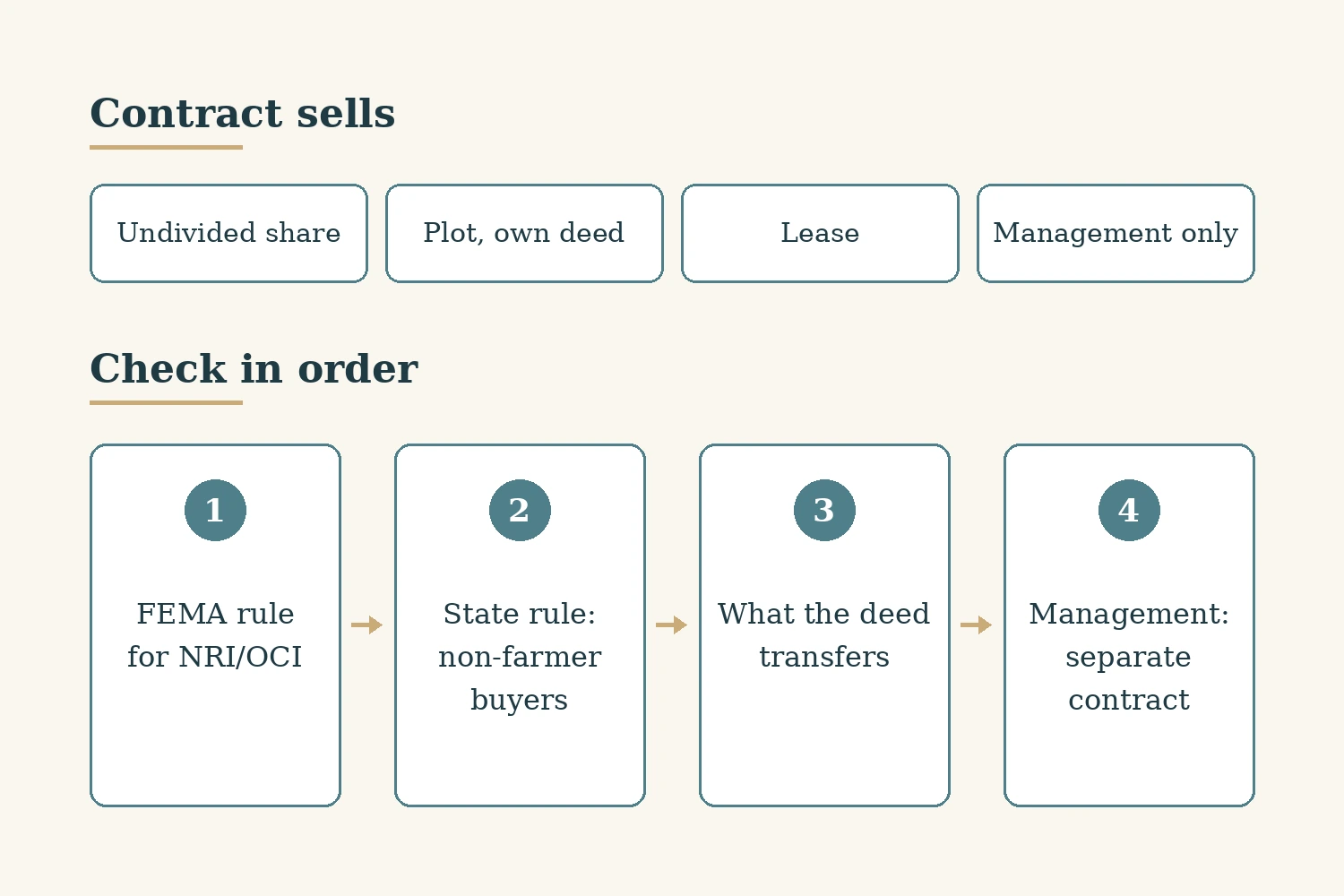
A managed farmland brochure sells you a farm. The contract may sell you something quite different. Depending on the paperwork, you might be buying an undivided share in a larger parcel, a marked-out plot with its own sale deed, a lease, or nothing more than a service agreement under which someone else farms land you do not own. Which of these you get is set by the documents. Whether you can legally hold it at all is set by the law of the state where the land sits, and by who you are. This guide takes those questions in the order that matters: who you are under foreign exchange law, what the state's land law says (as far as we could confirm it from official sources), what the deed actually conveys, and how to read the management agreement. Where we could not confirm a state rule from an official source, we say so and stop. Statutory points below were read on 26 October 2026, and the English is our paraphrase. This is not legal advice.
The four things a managed farmland contract can sell you
Start with the draft sale deed and its schedule of property, not the brochure. Broadly, the documents will describe one of four arrangements:
- An undivided share in the whole parcel, with no specific piece of ground identified as yours.
- A demarcated plot, with its own boundaries and survey details set out in a sale deed in your name.
- A lease, under which you hold the land for a term but do not own it.
- A management or service agreement only, with no transfer of land to you at all.
The schedule of property usually tells you which it is. If it describes a fraction of a larger survey number with no boundaries, you are looking at an undivided share. If it gives boundaries and a separate area for your plot, it is closer to a demarcated plot. We found no official state rule written specifically for undivided shares in managed farmland, so treat the differences as questions for your lawyer rather than settled law. Ask how each structure would work if you wanted to sell, to borrow against the land, or to pass it to your heirs, and get the answer in writing. Our guide to what "fully managed" really means covers what the operator usually takes on.
Why the land law is the floor, not the contract
A contract cannot give you more than the land law allows. Rules on who may buy agricultural land, and how much of it, attach to the land and to the buyer. If the state's law does not let you hold the land, a well-drafted agreement does not change that. That is why the order of checks matters: first whether you can hold agricultural land at all, then what the deed gives you, and only then the management terms. Our questions before signing a land deal and total cost of ownership guide cover the wider checks.
NRIs and OCIs: the FEMA question comes first
For a Non-Resident Indian (NRI) or an Overseas Citizen of India (OCI), the first answer comes from the Foreign Exchange Management Act (FEMA), not from any state. Rule 24 of the Foreign Exchange Management (Non-Debt Instruments) Rules, 2019 (NDI Rules) governs how an NRI or OCI may acquire and transfer property in India. According to the Reserve Bank of India's (RBI) frequently asked questions on the subject (read 26 October 2026), in our paraphrase:
- An NRI or OCI may purchase immovable property other than agricultural land, a farmhouse or plantation property.
- They may receive property as a gift from a relative only if it is not agricultural land, a farmhouse or plantation property.
- They may inherit immovable property, including agricultural land.
- They may sell or gift agricultural land only to a person resident in India.
The RBI also said in a press release of 29 December 2021 that NRIs and OCIs do not need prior RBI approval to acquire or transfer immovable property in India other than agricultural land, a farmhouse or plantation property, under Chapter IX of the NDI Rules dated 17 October 2019 (RBI press release, read 26 October 2026). The same FAQ says a spouse who lives outside India and is not themselves an NRI or OCI may acquire one property jointly with their NRI or OCI spouse, subject to the conditions in rule 25, again other than agricultural land, a farmhouse or plantation property.
So for an NRI or OCI, a managed farmland purchase that conveys agricultural land stops here, whatever the contract says. Our guides to NRI, OCI and PIO definitions, inheritance and succession for NRIs and foreign property ownership explain the categories and the inheritance route.
Karnataka: what we could and could not confirm
Karnataka's rules on who may hold agricultural land sit in the Karnataka Land Reforms Act, 1961 (KLR Act). We could not confirm its current text, or the current ceiling, from an official Karnataka host such as the state e-gazette or the Department of Parliamentary Affairs and Legislation (DPAL) by our deadline, so we state no current rule or ceiling figure here.
What that means for you is simple: before buying agricultural land in Karnataka, ask your lawyer to confirm, from the current official text of the KLR Act, whether you as a buyer are eligible to hold the land, whether the land is subject to any transfer restriction, and whether your total holding stays within the ceiling. Our Karnataka guide and Coorg guide describe the places.
Maharashtra: section 63 and its exceptions
In Maharashtra, the Maharashtra Tenancy and Agricultural Lands Act, 1948 (MTAL) is the starting point. Its section 63(1), in our paraphrase, says no sale, gift, exchange or lease of land, or of an interest in land, and no mortgage that gives the lender possession, is valid in favour of a person who is not an agriculturist, or an agriculturist who would then hold land above two-thirds of the ceiling area, or who is not an agricultural labourer. The Collector or an authorised officer may grant permission for such a transfer, on prescribed conditions (Law and Judiciary Department text as on 27 November 2025, read 26 October 2026).
Section 63(1C) carves out exceptions. In our paraphrase, sub-section (1) does not apply to land within the limits of a municipal corporation or municipal council, within the area of a Special Planning Authority or New Town Development Authority, or to land allocated to residential, commercial, industrial or other non-agricultural use in a draft or final Regional Plan or Town Planning Scheme. A provision attached to it requires a non-agriculturist who acquires land for a non-agricultural use to put it to that use within five years of the transfer, with an entry of that condition in the record of rights, and allows a further extension on payment of charges.
For a non-farmer buying agricultural land in Maharashtra to hold or farm it, one of two things must usually be true: the land falls within one of the section 63(1C) exceptions, or the Collector has granted permission. Ask to see which, in writing, before you pay. Our guides to the Maharashtra Land Revenue Code (MLRC), agricultural to non-agricultural conversion and checks before you pay in Maharashtra cover the land records and conversion steps, and our Maharashtra guide and Karjat guide describe the places.
Tamil Nadu and Andhra Pradesh: where we stop
Both states have land ceiling laws. We could not confirm the current ceiling limits in either state's law from an official host by our deadline, so we give no figures. We also could not confirm, from an official source, whether either state currently restricts transfers of agricultural land to buyers who are not farmers.
So the check in both states is the same: ask a local lawyer for a written opinion on whether you can hold the land, whether any transfer restriction applies, and whether your holding would exceed the ceiling, citing the current official text. Our Tamil Nadu guide and Andhra Pradesh guide describe the places.
The management agreement is a separate contract
Once the land question is settled, read the management agreement as what it is: a service contract between you and the operator. The law does not promise any income from it, and this guide makes no claim about what any agreement pays. The points to read are:
- The term, and how either side can end it.
- What the operator does, and what it charges for.
- Who owns the produce, and who keeps and shares the accounts.
- What happens to the land, the plantings and your access if the operator exits, sells the business or stops trading.
- Whether the management agreement is tied to the sale deed, so that ending one affects the other.
The operator's history matters as much as the wording: our guide to checking a developer's track record applies here, and our power of attorney guide covers signing through someone else.
Who this is not for
This is not for an NRI or OCI hoping to buy agricultural land through a managed farmland scheme: the FEMA position above comes first. It is not a state-by-state legal opinion: where we could not confirm a rule from an official source, we have said so rather than filled the gap. It does not cover farmhouses, plantations or non-agricultural plots, and it says nothing about returns, which we do not discuss.
Where that leaves you
The land law is the floor; the contract cannot lift you above it. Before you sign:
- Confirm your own status under FEMA. If you are an NRI or OCI, agricultural land is outside what you can purchase.
- In Karnataka, Tamil Nadu and Andhra Pradesh, get a written legal opinion on eligibility, transfer restrictions and the ceiling, from the current official text.
- In Maharashtra, see which section 63(1C) exception applies, or the Collector's permission.
- Read the schedule of property to see which of the four arrangements you are buying, and ask how resale, borrowing and inheritance would work.
- Read the management agreement as a separate service contract, with its exit terms.
If any of these cannot be answered in writing, you have learned what you need to know before paying.
Sources
- Reserve Bank of India: FAQ, purchase of immovable property in India by non-resident individuals
- Reserve Bank of India: press release of 29 December 2021 on acquisition of immovable property by NRIs and OCIs
- Maharashtra Law and Judiciary Department: Maharashtra Tenancy and Agricultural Lands Act, text as on 27 November 2025
Ready to find your next holiday home?
Browse our curated collection of vacation homes and managed farmland across India and beyond.