PBG and SLF: Building Permits in Indonesia, Explained
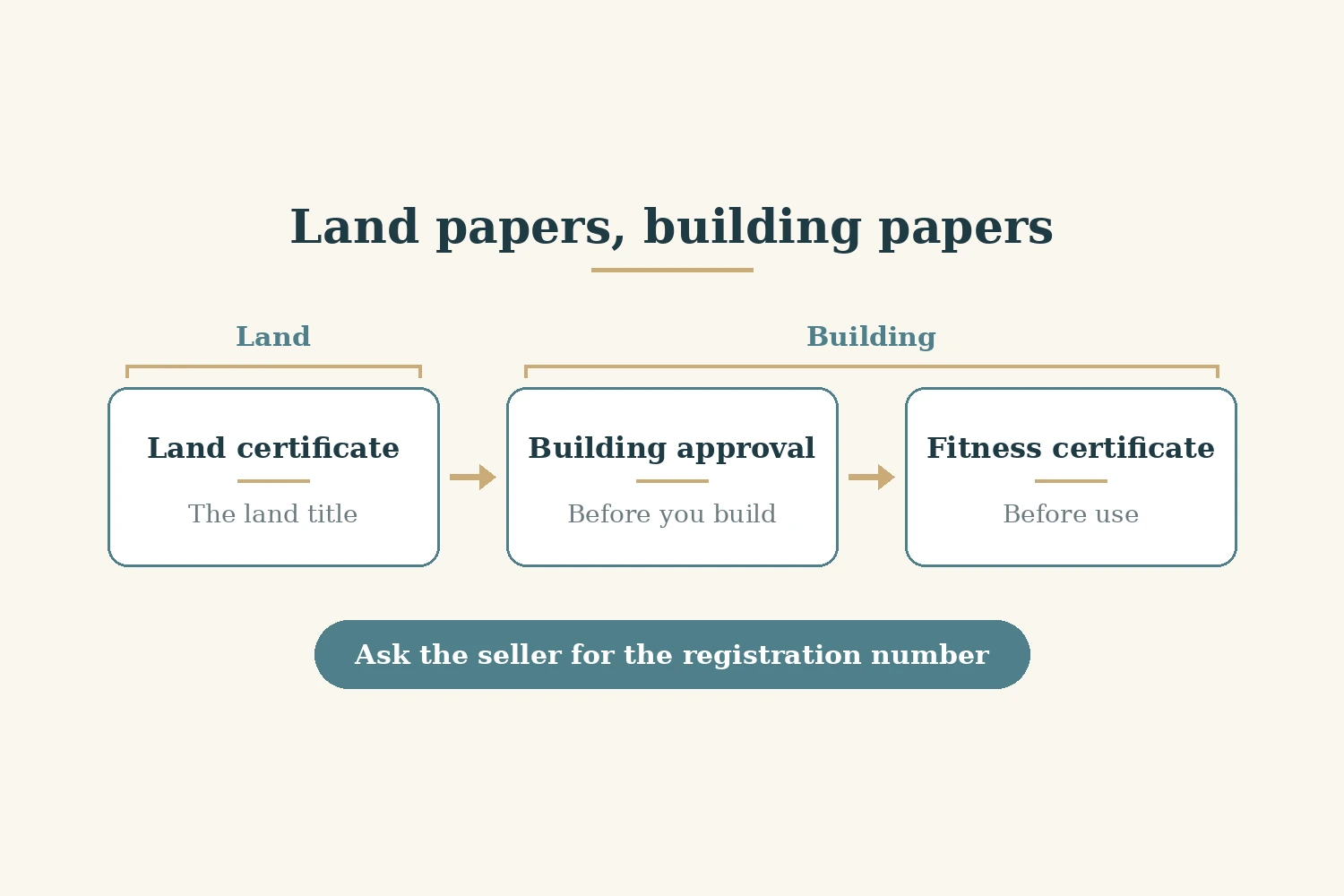
When you buy a villa in Bali, you are really buying two things: a piece of land and a building standing on it. The land has its own paperwork, the certificate from the national land agency (Badan Pertanahan Nasional, or BPN). The building has separate paperwork, and a clean land certificate tells you nothing about it. Indonesian law has two main building papers. The building approval (Persetujuan Bangunan Gedung, or PBG) comes before construction, and the certificate of functional fitness (Sertifikat Laik Fungsi, or SLF) comes before anyone uses the building. This guide explains what each one is, how they replaced the old building permit, what the regulation says happens when they are missing, and how a non-resident Indian (NRI) buyer can check them. It is not legal advice; for a specific villa, an Indonesian notary and lawyer should read the documents.
Land title and building approval: two different papers
The rules for buildings are set out in Peraturan Pemerintah (PP), meaning government regulation, No. 16 of 2021 on buildings. It took effect on 2 February 2021, the date it was promulgated (article 349), and repealed the earlier PP 36 of 2005 (article 348) (PP 16/2021, read 5 Nov 2026).
PP 16/2021 defines the PBG as the permit given to a building's owner to build, alter, extend, reduce or maintain a building according to the building technical standards (article 1 point 17). It defines the SLF as the certificate the regional government issues to declare a building fit for use before it can be used (article 1 point 18). It also defines a third paper, the building ownership letter (Surat Bukti Kepemilikan Bangunan Gedung, or SBKBG), as proof of the right to ownership of the building (article 1 point 19) (PP 16/2021, read 5 Nov 2026).
None of these is the land title. Our guide to Indonesian land title types covers the certificate side, including the right to build (Hak Guna Bangunan, or HGB) and the right to use (hak pakai). Whatever the ownership route, whether a lease, hak pakai or HGB held through a foreign-owned company (PT PMA, Perseroan Terbatas Penanaman Modal Asing), the building papers are a separate question. Our Bali guide and Indonesia guide give the wider picture.
What the PBG is, and what it replaced
Before 2021, buildings in Indonesia needed a building construction permit (Izin Mendirikan Bangunan, or IMB). PP 16/2021 now uses the PBG instead. Under article 253(1), the technical plan documents are submitted to the regency or city government to obtain a PBG before construction is carried out (PP 16/2021, read 5 Nov 2026). Article 253(3) says the PBG is for building a new building or its infrastructure, or for altering, extending, reducing or maintaining one.
The order matters: a PBG comes before the work, not after it. A villa built first and documented later has a route to regularise, covered below, but that is not the same as having had a PBG from the start.
The PBG also fixes what the building is for. Article 11(1) says the building's function and classification are written into the PBG, the SLF and the SBKBG. Under article 11(2), if the function or classification changes, the owner must apply for an amended PBG (PBG perubahan) (PP 16/2021, read 5 Nov 2026). So the function written on the PBG, whether a house or another kind of building, follows the villa through every later paper.
The Omnibus Law on job creation, Law 6 of 2023, is reported to amend the Building Law, Law 28 of 2002, so that building may start only after a PBG is issued, applied for through the central government's electronic system. We could not confirm this on an official government site as of 5 Nov 2026.
What the SLF is, and when it is renewed
Once a building is complete and its fitness for function has been declared, the regional technical office issues the SLF together with the building ownership letter (article 274(1)). Article 274(2) says the owner must obtain the SLF before the building can be used. Article 274(3) says the SLF comes as an SLF document, its attachments and an SLF label (PP 16/2021, read 5 Nov 2026).
The SLF does not last forever. Article 297(1) says it must be renewed within a set period, and article 297(2) sets that period at 20 years for single houses and row houses, and 5 years for other buildings. Under article 297(3), renewal is preceded by an inspection of fitness for function (PP 16/2021, read 5 Nov 2026).
Which period applies to a villa depends on the function recorded for it. Because article 11 writes the function into the PBG and SLF, a villa recorded as a single house would fall in the 20-year class, and one recorded with another function would fall in the 5-year class. Do not assume 20 years. Read the function on the papers, then count from the SLF's date. If a villa's SLF was issued 6 years ago and the villa is recorded under the 5-year class, 6 minus 5 means renewal was due a year ago.
PP 16/2021 does not itself say that a land certificate, strata title, HGB or hak pakai cannot be registered without a PBG. It only ties the SBKBG to the SLF. In practice, buyers often treat the PBG and SLF as part of the papers to see before signing, alongside the land certificate.
Old IMBs, and a villa built without a PBG
Many Bali villas were built before 2021 and hold an IMB, not a PBG. Article 346 deals with them (PP 16/2021, read 5 Nov 2026):
- Under article 346(1), buildings that obtained a permit from the regency or city before the regulation took effect keep that permit.
- Under article 346(2), a permit to erect a building obtained before the regulation took effect stays valid until it expires.
- Under article 346(3), a building that is already standing and does not yet have a PBG must obtain an SLF under this regulation in order to obtain a PBG.
So an IMB is not worthless, but you need to read it. Check that it covers the same parcel, the same building and the same function as the villa in front of you, and whether it has an end date. A villa with no IMB and no PBG is in a different position: under article 346(3), the route is through the SLF process, which means an inspection of the building as it stands. Its outcome cannot be known in advance. Treat a villa with neither paper as one with an open question, not a minor gap.
What happens if the papers do not match: the sanctions
PP 16/2021 sets out administrative sanctions in two places. There are no monetary penalties in it; the sanctions are steps a government can take against the building or the permit.
Article 327(1) applies to owners, managers, users and others who breach listed articles, including article 253(4) on the PBG and article 274(2) on obtaining the SLF before use. Under article 327(2), the sanctions may be (PP 16/2021, read 5 Nov 2026):
- a written warning;
- restrictions on building, use or demolition activity;
- temporary or permanent stoppage of building, use or demolition;
- freezing of the PBG, the SLF or a demolition approval;
- revocation of the PBG, the SLF or a demolition approval.
Article 12 covers an owner who does not keep to the function set in the PBG. Under article 12(2), the sanctions may be a written warning; restrictions on construction; temporary or permanent stoppage of construction; temporary or permanent stoppage of use; freezing or revocation of the PBG; freezing or revocation of the SLF; and an order to demolish the building (perintah pembongkaran) (PP 16/2021, read 5 Nov 2026).
That last item is why function matters. A villa approved as one thing and used as another sits under article 12, whose ladder ends in a demolition order. If you plan to use a villa differently from the function on its PBG, article 11(2) says an amended PBG is needed first. How tourism accommodation licensing through the national online licensing system (Online Single Submission, or OSS) connects to the PBG and SLF we could not confirm on an official government site as of 5 Nov 2026. Whether regency regulations (Peraturan Daerah, or Perda), such as Badung's, add monetary penalties or set PBG levies we also could not confirm on an official government site as of 5 Nov 2026, so this guide gives no figures for them.
How to check a PBG or SLF
PP 16/2021 sets up the building management information system (Sistem Informasi Manajemen Bangunan Gedung, or SIMBG) as the web system used to process the PBG, SLF, SBKBG and building records (article 1 point 48). Article 326(10) says the public uses SIMBG to get information about the building process (PP 16/2021, read 5 Nov 2026).
To follow an application on SIMBG, you need its registration number, and that has to come from the seller or developer. SIMBG's tracking page follows an application by registration number (SIMBG, read 5 Nov 2026).
When you have the papers, compare them with the villa:
- the parcel on the PBG or IMB matches the land certificate;
- the function and classification are what you expect, and match how the villa will be used;
- the number of floors and the floor area match what has been built, in square metres;
- the SLF, if there is one, is within its renewal period for that function.
On floor area, our guide to area measurement across markets explains how figures in square metres are measured. For villas near the coast, our guide to coastal setback and site plan checks in Bali covers the spatial plan extract and the confirmation of spatial use suitability (Kesesuaian Kegiatan Pemanfaatan Ruang, or KKPR) that sit alongside the PBG. Our Uluwatu guide, Canggu guide and Bukit guide describe the areas themselves.
Permit claims in listing text are the developer's statements. Ask for the PBG number and the SIMBG registration number, track the application yourself, and compare the papers with the villa.
Off-plan: ask for the PBG number before you pay
For a villa not yet built, article 253(1) means the PBG should exist before construction. So the first question for an off-plan seller is the PBG number for that exact parcel and that design. If the answer is that it is being processed, ask for the SIMBG registration number and track it, and think hard before paying more than you can afford to lose. Our guide to how to read project status explains why a status label on a listing is the seller's word rather than proof, and our guide to booking amount refund rules covers what can happen to a deposit if a project stalls.
If you are buying from India, our guides to what needs you there when buying remotely, cross-border due diligence and annual holding costs in Bali and elsewhere cover the steps around the permit check.
Who this is not for
This is not for buyers looking for a view on whether a Bali villa is a good purchase, or on prices or future values; it makes no such claims. It does not cover the land certificate in depth, ownership structures, tourism licensing, levies or tax. It is not legal advice.
Where that leaves you
A Bali villa needs two kinds of papers: the land certificate, and the building papers. Under PP 16/2021, the PBG comes before construction, the SLF before use, and the function written on them decides the SLF renewal period and what the building may be used for. Old IMBs stay valid until they expire, and a villa built without a PBG has to go through the SLF route. Breaches can lead to warnings, stoppage, freezing or revocation, and, where use does not match function, a demolition order. Ask the seller for the PBG and SLF numbers, and compare every figure with the villa itself before any money moves.
Sources
- PP 16/2021 on buildings, OSS copy
- PP 16/2021 on buildings, Indonesian Supreme Audit Board (BPK) copy
- SIMBG, Ministry of Public Works
Ready to find your next holiday home?
Browse our curated collection of vacation homes and managed farmland across India and beyond.