What You Pay Every Year Just to Hold: India, Dubai, Thailand and Bali
Buying a second home comes with a large, visible bill on the day of purchase. What follows is quieter: a charge that arrives every year whether or not anyone stays in the house. For a Non-Resident Indian (NRI) holding a home in India, Dubai, Thailand or Bali, each of those charges sits on a different base, set by a different authority, and is worked out in a different way. This guide sets out the base and the formula for each market, as far as we could confirm them from official sources, and says plainly where we could not. Every number below is either an official rate with its source or an illustrative example value; none is a listing price. It is general information, not tax advice.
Why an empty home still costs money every year
Purchase costs are paid once: stamp duty, registration and transfer fees, which our guides to stamp duty and registration by state in India and transaction costs in Dubai cover. Holding costs are different. They recur, they are charged on a base the authority sets or reads from a bill, and they usually do not depend on whether the home is used.
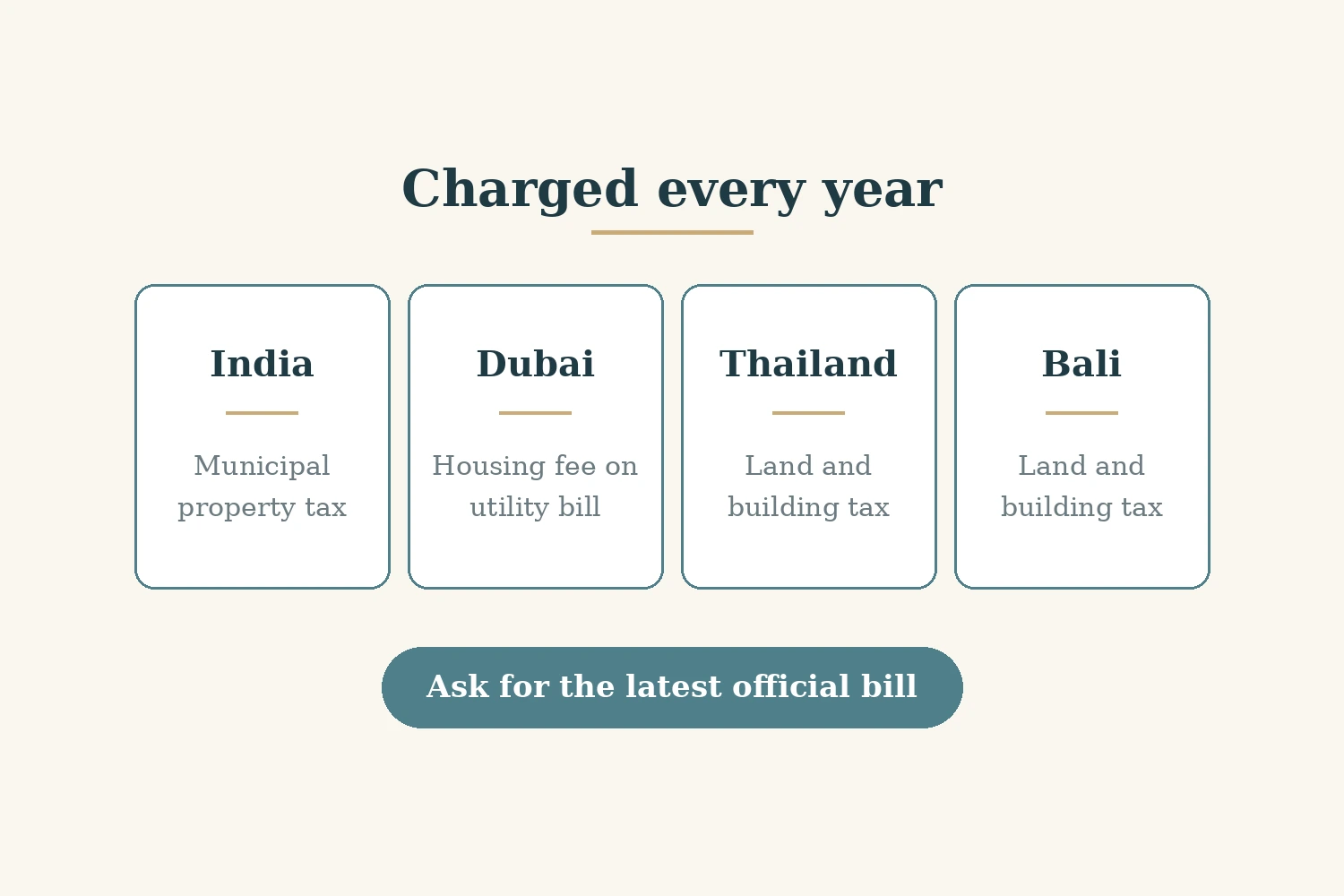
Across the four markets in this guide, that recurring charge rests on four different bases. In India it is a municipal or panchayat assessment of the property. In Dubai it is a housing fee collected through the utility bill. In Thailand it is a land and building tax on appraised value. In Indonesia it is a land and building tax on the government's assessed value, above a non-taxable threshold. Once you know the base and the rate, the arithmetic is simple. The hard part is getting the rate on paper from the right authority, and that is where this guide is careful to separate what we confirmed from what we did not.
India: the municipal assessment, using Bengaluru as the example
In India, the recurring charge on a home is a local tax, set by the municipal corporation in a city or the panchayat in a village, so there is no single national rate. We use Bengaluru as the example because its formula is published on an official portal.
The Bruhat Bengaluru Mahanagara Palike (BBMP), the city corporation, runs a property tax portal with a self-assessment form. The form says that the Unit Area Value (UAV) per month multiplied by ten months gives the Gross Annual Unit Area Value (BBMP property tax portal, read 31 October 2026). In other words, the starting point is a value per unit of area for the zone and type of property, scaled up to a ten-month annual figure, and the tax is then a rate applied to that annual value. The portal also has an official calculator.
What we could not confirm is the rate itself and any allowance for the age of the building. We could not confirm from an official source as of 31 October 2026 the maximum rate or the depreciation allowance that apply to that annual value, so we give neither. Ask BBMP, or use its calculator, for the current tax rate and any depreciation that applies to your property, and keep the receipt for the last year paid. For other states, we could not confirm from an official source as of 31 October 2026 the house tax rules for Goa or for Maharashtra's gram panchayats; ask the municipality or panchayat for its current demand notice. Our Bengaluru guide, Coorg guide, Goa guide and Karjat guide cover places where buyers meet these local taxes.
Dubai: the housing fee on the utility bill
In Dubai, the recurring charge on an occupied home is the housing fee, paid by the occupant on the monthly bill from the Dubai Electricity and Water Authority (DEWA). DEWA's guide to reading its bill describes the housing fee line as 5% of the annual rent amount divided into twelve monthly instalments (DEWA bill guide, read 31 October 2026). The United Arab Emirates (UAE) government portal says that tenants in Dubai pay housing fees to Dubai Municipality at 5% of the yearly rent, added to their monthly electricity and water bills (UAE government portal, read 31 October 2026).
Think of it as a fee paid by whoever occupies the home and holds the utility account. If you live in the home yourself, or leave it empty with the utilities connected, the basis is different, and that is where official sources run out. We could not confirm from an official source as of 31 October 2026 how the fee is worked out for an owner who lives in the home or for a vacant unit, so we give no figure for that case. Ask DEWA or Dubai Municipality for the basis applied to your account, and check the housing fee line on a recent bill.
The housing fee is separate from the building's service charges, which pay for the common areas and are set differently; our guide to service charges and running costs in Dubai covers those, and our Dubai guide covers the city.
Thailand: the Land and Building Tax
Thailand charges a yearly tax under the Land and Building Tax Act B.E. 2562 (Buddhist Era year 2562, which is 2019), which the Department of Lands lists among its laws (Department of Lands, read 31 October 2026). Foreigners can own condominium units, and the Thai government's public information portal says that a foreigner who owns a condominium unit pays the same rate as a Thai individual who owns the building, lives in it and is listed in the house registration (Thai government portal, read 31 October 2026). It gives these bands by value, which match section 94(3) of the Act:
- up to THB 40 million (Thai baht), 0.02%, at most THB 8,000 a year;
- THB 40 million to 65 million, 0.03%;
- THB 65 million to 90 million, 0.05%;
- THB 90 million or more, 0.1%.
The same page credits its content to a private law firm. The bands match those in the Act for an individual who owns a building but not the land, lives in it and is in the house registration (section 94(3), which set the rates for the first two collection years), and a later royal decree sets the rates for 2022 onward (Department of Lands copy of the Act, read 31 October 2026). Under the Act, an individual who owns both the land and the building, lives there and is in the house registration on 1 January is exempt on the first THB 50 million, while one who owns only the building is exempt on the first THB 10 million (section 41). We could not confirm from an official source as of 31 October 2026 which of the two a foreign condominium owner falls under, so we use neither as fact. Ask the local administrative office that bills the tax for its assessment notice, which shows the appraised value, any exemption and the tax due.
For a second home that is not your registered main residence, different rates may apply, and Thailand has reduced the tax by decree in some years. We could not confirm from an official source as of 31 October 2026 the current rates for a non-resident's second home, or any reduction for 2025 or 2026. Ask for the current royal decree on the tax and the notice for your unit. Our guides to Thai property taxes and fees, condominium common fees in Bangkok and Thai title deeds cover the rest, and our Phuket guide and Bangkok guide cover the places.
Bali: the land and building tax on assessed value
In Indonesia, the recurring tax is the Pajak Bumi dan Bangunan Perdesaan dan Perkotaan (PBB-P2), the rural and urban land and building tax, set by each regency within limits in national law. Law No. 1 of 2022 on central and regional government finance sets those limits (Law No. 1 of 2022, read 31 October 2026):
- The base is the Nilai Jual Objek Pajak (NJOP), the government's assessed value of the land and building (article 40(1)).
- A non-taxable NJOP of at least IDR 10 million (Indonesian rupiah) is given to each taxpayer, on only one property per regency each year (article 40(3) and (4)).
- The NJOP used to work out the tax is between 20% and 100% of NJOP after that non-taxable amount (article 40(5)).
- The rate is at most 0.5% and is set by the regency in its Peraturan Daerah (Perda), or regional regulation (article 41).
- The tax is the base multiplied by the rate (article 42), and the position on 1 January decides the year's tax (article 43(2)).
For Badung, the regency that covers much of south Bali, the regency's legal database lists a Peraturan Bupati (Perbup), or regent's regulation, No. 28 of 2024 on reductions to the principal PBB-P2 amount, set on 23 June 2024, promulgated on 23 July 2024 and recorded as in force (Badung legal database, read 31 October 2026); we did not read its contents. The Badung revenue office, the Badan Pendapatan Daerah (Bapenda), did not load for us, so we could not confirm from an official source as of 31 October 2026 Badung's PBB-P2 rate bands, its non-taxable amount or the share of NJOP it uses. Ask Bapenda Badung for your property's tax notice, which shows the NJOP, the non-taxable amount and the rate applied. Our Bali guide covers the island.
Worked arithmetic, using example values only
These three examples use illustrative values, not listing prices, and only rates we confirmed.
Dubai, a tenant's housing fee
Take an example annual rent of AED 100,000 (UAE dirhams). Five per cent of 100,000 is 5,000, so the housing fee is AED 5,000 a year. Spread over twelve monthly bills, that is about AED 416.67 a month. This is the fee paid by the occupant on the DEWA bill; it is not a figure for an owner or an empty home.
Bali, the legal ceiling, not the Badung bill
Take an example NJOP of IDR 2 billion. Subtract the national minimum non-taxable amount of IDR 10 million to leave IDR 1.99 billion. At the most the law allows, 100% of that is used, and the highest rate the law allows is 0.5%. Half of one per cent of IDR 1.99 billion is IDR 9.95 million. So under national law the tax on this example cannot exceed IDR 9.95 million a year. That is a ceiling, not the actual Badung bill, which depends on the regency's own rates and allowances.
Thailand, an owner-occupied condominium unit
Take an example appraised value of THB 30 million in the lowest band on the government portal. Two hundredths of one per cent of 30 million is 6,000, so the tax is THB 6,000 a year, within that band's stated maximum of THB 8,000. That is before any exemption; because of the unresolved exemption discrepancy above, the actual bill could be lower.
We give no worked example for India, because we could not confirm the rate. We have no conversion rates in our brief, so the figures stay in local currency.
Fees that are not taxes
The levies above are only part of the yearly cost. A condominium or managed villa charges service or common fees for shared areas, set by the building's owners' body or manager rather than by law, and utilities carry their own fixed charges. They are not taxes, but they arrive every year whether or not the home is used. Ask for the last year's statement of each before buying. For a comparison with a fifth market, our guide to property taxes for foreigners in Sri Lanka shows how differently another country builds the same charges.
Who this is not for
This is not tax advice, and it does not replace the authority's own notice for your property. It does not cover income tax, capital gains tax, inheritance or any tax in your country of residence. It gives no rate for India, for a Dubai owner or empty home, for a Thai second home, or for Badung, because we could not confirm those from official sources as of 31 October 2026. And it says nothing about what any property will earn or be worth.
Where that leaves you
Each market charges a yearly levy on a different base: an annual value in Bengaluru, the rent on the utility bill in Dubai, appraised value in Thailand and assessed value above a threshold in Bali. Before you buy, ask the seller for the last paid tax receipt or notice, the assessed or appraised value on it, and confirmation of any arrears, and get the current rate from the authority that bills it. When you come to sell, the same papers help; our guide to the NRI property sale process in India covers that end. This is general information, not tax advice.
Sources
- BBMP property tax portal: self-assessment form
- DEWA: understanding your bill
- UAE government portal: leasing a property in the UAE
- Thai government portal: land and building tax rates for foreigners residing in Thailand
- Department of Lands, Thailand: Land and Building Tax Act B.E. 2562
- Department of Lands, Thailand: Land and Building Tax Act B.E. 2562 (official PDF)
- BPK (Badan Pemeriksa Keuangan, Indonesia's Supreme Audit Board) legal database: Law No. 1 of 2022 on central and regional government finance
- Badung legal database: Perbup Badung No. 28 of 2024 on PBB-P2 reductions
Ready to find your next holiday home?
Browse our curated collection of vacation homes and managed farmland across India and beyond.