Is Phuket a Good Investment in 2026? An Honest Take
Is Phuket a good investment in 2026? The honest answer starts with a distinction most sales material blurs. The demand side of the island is real and measured: more people flew into Phuket in 2025 than in the year before, and the airport's own figures put the total above 17 million. The infrastructure side, the tram, the tunnel under Patong Hill and the larger airport that so many brochures lean on, is not built, and in most cases has no confirmed construction start. A purchase that makes sense on today's demand can be a reasonable one. A purchase whose case depends on what those projects will do to prices is a bet on government timetables that have already slipped. This piece separates the two, and it does not forecast prices or promise returns.
One practical note before we begin. We give amounts in Thai baht (THB) only. We have not added United States dollar (USD) equivalents because we could not confirm a current reference rate from the Bank of Thailand for this piece; please convert at a current rate yourself. If you are new to buying abroad in general, our piece on foreign property ownership explained is a good primer, and our Thailand guide and Phuket guide set the scene.
What a foreigner can actually own
Everything else in this piece depends on this question, and it is the one buyers most often take on trust. Thai law sets limits on what a foreign individual can hold: on land, on the share of a condominium building that can be in foreign hands, and on how long a lease can run. We have not re-read the primary legal texts for this piece, so we are not restating the specific limits here. Instead, we point you to the explainers where we set them out: our guide to owning property in Thailand as a foreigner, our piece on the Thai condominium foreign quota, and our explanation of the Thai 30-year lease.
The practical point survives without the numbers. A foreign buyer in Phuket is broadly choosing between two kinds of holding. One is a condominium unit owned outright inside a building's foreign allocation. The other is a lease, usually on a villa or on land, where what you hold is a contract right for a period, not ownership of the ground. The two are very different assets. A lease runs down over time, and any promise of renewal is only as good as the contract and the counterparty behind it. Our piece on Thai title deeds explains how to read what you are actually being offered.
There is a third route that some sellers suggest: holding land through a Thai company with local shareholders standing in for the real owner. We cover why that is risky in our piece on company structures and land ownership in Thailand. It is not a structure we would build an investment case on.
The demand side, measured
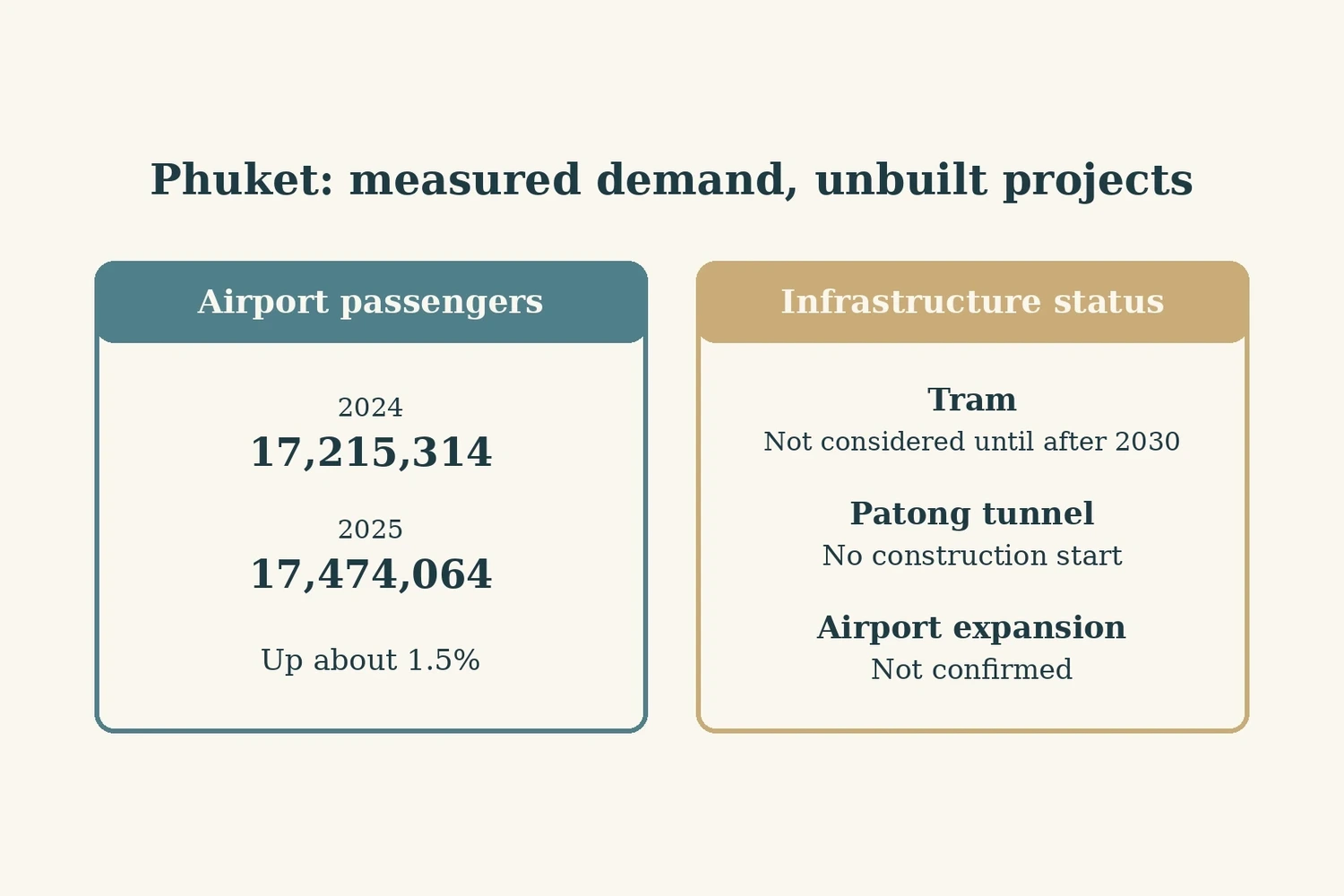
Here the evidence is genuinely good. According to the airport's managing director, Monchai Tanode, as reported by The Phuket News on 14 January 2026, Phuket International Airport handled 17,474,064 passengers in 2025. That was made up of 6,636,922 domestic passengers and 10,837,142 international passengers (6,636,922 + 10,837,142 = 17,474,064), across 106,581 flights.
The year before, the figure was 17,215,314. The increase is 17,474,064 less 17,215,314, or 258,750 passengers, which is about 1.5% (258,750 divided by 17,215,314). International passengers made up about 62% of the total (10,837,142 divided by 17,474,064).
Two things follow. First, the island's visitor base is large and mostly international, which is the core of any rental case. Second, growth in 2025 was modest. A rise of about 1.5% describes a mature, busy destination, not one on a steep upward curve. That is a reasonable foundation for a purchase priced on today's demand, and a weak foundation for one priced on rapid growth.
We have not fetched official tourist arrival figures from the Thai tourism authorities for this piece, and we have no verified price or rental yield data for Phuket from any independent source. So nothing here says what Phuket property has done to prices, or what it yields. If you want to understand how visitor numbers shift across the seasons, our piece on Phuket through the year is the place to start.
The infrastructure timeline, honestly dated
Much of the investment case made for Phuket rests on three projects: a light rail or tram line, a tunnel to Patong, and an expanded airport. On the evidence we could verify, none is under construction.
The tram first. The Phuket News reported on 9 January 2026 that Transport Minister Phiphat said the mass transit project remained government policy but would follow road improvements, with electric buses coming first. The first phase, from the airport to Chalong, was described as about 42 kilometres at around THB 35 billion, which works out at roughly THB 833 million per kilometre (35,000 million divided by 42). It was not to be considered until after 2030. That is a reported government statement, not a project document, but it is a clear signal: a buyer should not expect a tram within the life of most holding plans.
The Patong tunnel, linking Kathu and Patong, was described in the same report as 3.98 kilometres long with a budget of THB 16.759 billion, about THB 4.2 billion per kilometre (16,759 million divided by 3.98). We have seen later dates for Cabinet approval, construction and opening, but only in a broker's summary of press reports, which we have not been able to confirm, so we do not repeat them. What we can say is that it was not under construction at the time of that report.
The local view is blunter. The Phuket News has reported the island's Member of Parliament, Somchart, pressing the government over what he described as stalled tunnel and light rail projects, and citing 2,594 incidents and 25 deaths on Patong Hill between 2023 and 2025. Those are a politician's figures, quoted in the press, and we give them as such. They explain why the tunnel matters to residents. They do not tell you when it will be built.
Plans for a larger airport have also been reported, but we could only find them in the same broker summary, so we leave them out. The lesson across all three is the same: an infrastructure story without a construction contract is a possibility, not a price driver you can count on.
What a purchase costs
Buying in Thailand involves a transfer fee at the Land Department and one or more taxes, and who pays which share is a matter for negotiation between buyer and seller. We have not re-checked the rates against the primary pages of the Land Department and the Revenue Department for this piece, so we do not restate them or build a worked example here. Our piece on Thai property taxes and fees sets out the components and the arithmetic, and it is worth reading before you agree a price, because the split of costs is one of the few items a buyer can genuinely move.
If you are remitting from India, the money will go through the Liberalised Remittance Scheme (LRS), and the bank will collect Tax Collected at Source (TCS) above a threshold. Our LRS guide and our piece on TCS on foreign remittances for property cover that side.
Rental reality: short stays and guaranteed yields
Most Phuket investment pitches end with a rental number. Some of the listings on our own platform carry exactly that kind of claim, a guaranteed return from the developer for a fixed number of years, or a projected annual rental yield. These are developer marketing, not measured outcomes, and we do not repeat them as facts. They are the kind of claim this piece is meant to help you discount.
A guaranteed return is a promise by a seller, and the ones we see run for a limited period. When it ends, what is left is the actual rental performance of the unit, which no one has guaranteed. Ask who is making the promise, what happens if they cannot meet it, and what the unit earned in comparable buildings before any guarantee.
Short-stay letting raises a second question. Whether a building or rental pool is licensed to let rooms to holidaymakers for short stays is a legal matter that varies from building to building, and we have not checked the licensing rules against a primary source for this piece. Before you rely on nightly or weekly rental income, ask the operator in writing what licence covers the rental programme. Our piece on managing an overseas holiday rental covers the practical side, and our look at Bali rental yields shows how differently the same question plays out in another island market.
When the answer is yes, and when it is no
Pulling this together, the answer depends far more on what you are buying than on Phuket itself.
When the answer is yes
Phuket can be a sensible purchase when you are buying a condominium unit you can own outright, inside the building's foreign allocation, in a building whose rental arrangements are properly licensed, at a price that makes sense on today's measured demand. In that case you are, in effect, owning a well-located room in a busy destination, and the airport figures above support the idea that people will keep coming. Any upside from new infrastructure is a bonus, not the plan.
When the answer is no
The case is weak when it rests on a villa held on a lease that is being marketed as if its renewals were certain, on a developer's guaranteed yield, on land held through a nominee company, or on price growth from the tram, the tunnel or the airport expansion. Each of those depends on something outside your control: a contract partner, a seller's balance sheet, a legal structure that may not hold, or a government timetable that has already moved.
Who this is not for
This is not the right market for a buyer who needs certainty about income. The data we could verify says people come to Phuket in large numbers; it does not say what any given unit will earn. It is also not for anyone who needs to own land in their own name, or who wants to buy now on the expectation that infrastructure will lift prices within a few years. On the evidence above, that expectation is not supported. And if you would rather spend your time in Thailand's capital than on the coast, our Bangkok guide is the better starting point.
Where that leaves you
Phuket has the thing many holiday markets lack: measured, large, mostly international demand, at about 17.5 million airport passengers in 2025. What it does not yet have is the infrastructure that so much of its sales material assumes. The tram is not expected before the 2030s, the tunnel had no construction start in the reports we could verify, and the airport expansion we could not confirm at all.
So a Phuket purchase makes sense when it stands on today's demand alone, through a structure you can actually own, with rental income you have checked rather than been promised. If the case only works once the tram arrives, or once a guarantee has been paid, it is not an investment case yet. It is a hope, and should be priced as one.
Sources
- The Phuket News: Phuket airport passenger numbers rebound
- The Phuket News: Phiphat denies rumours Phuket mass transit project scrapped
- The Phuket News: MP Somchart presses over stalled Phuket infrastructure projects
Ready to find your next holiday home?
Browse our curated collection of vacation homes and managed farmland across India and beyond.