Lepakshi and Anantapur: Reading Andhra Land Records Before You Buy
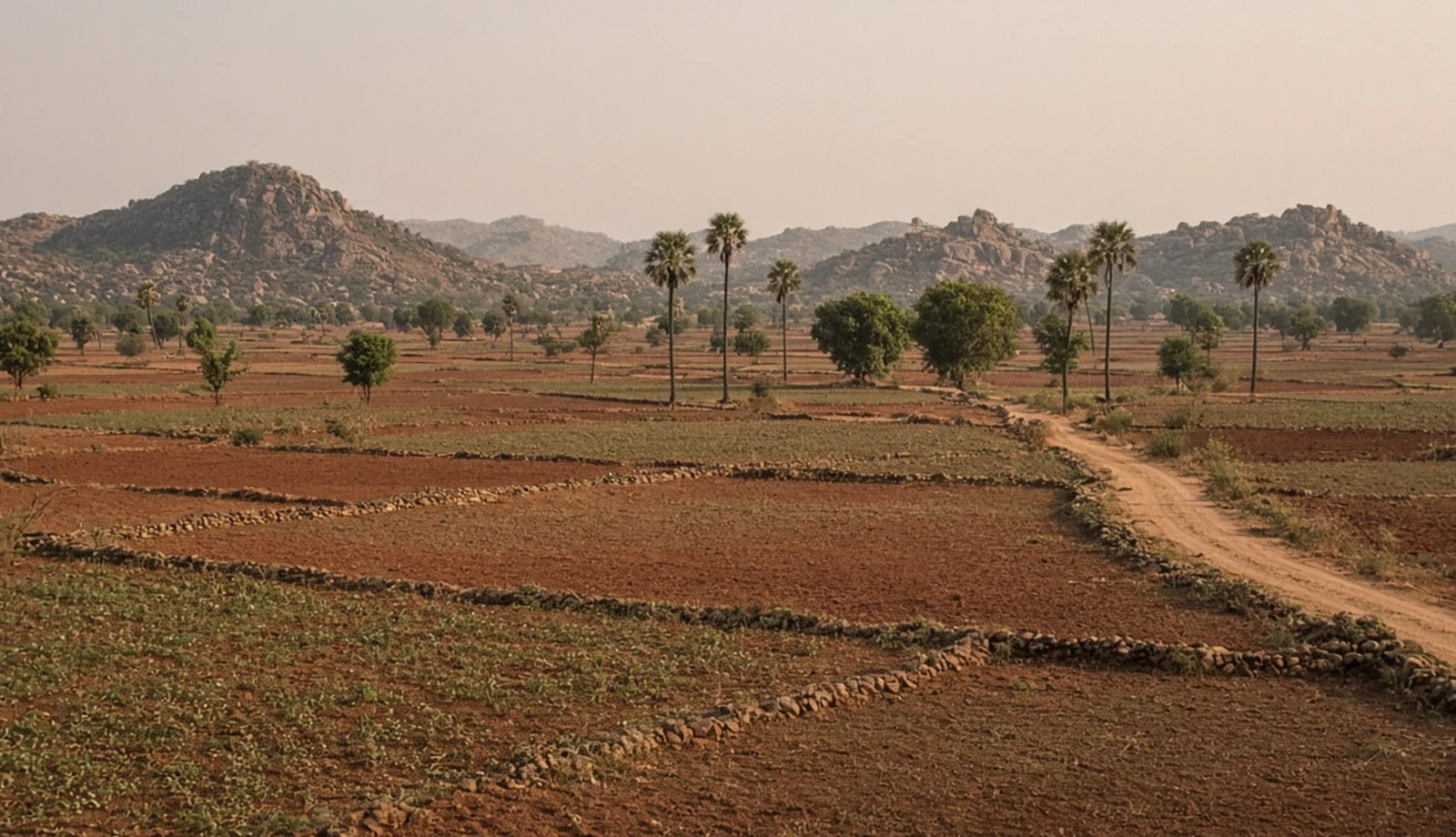
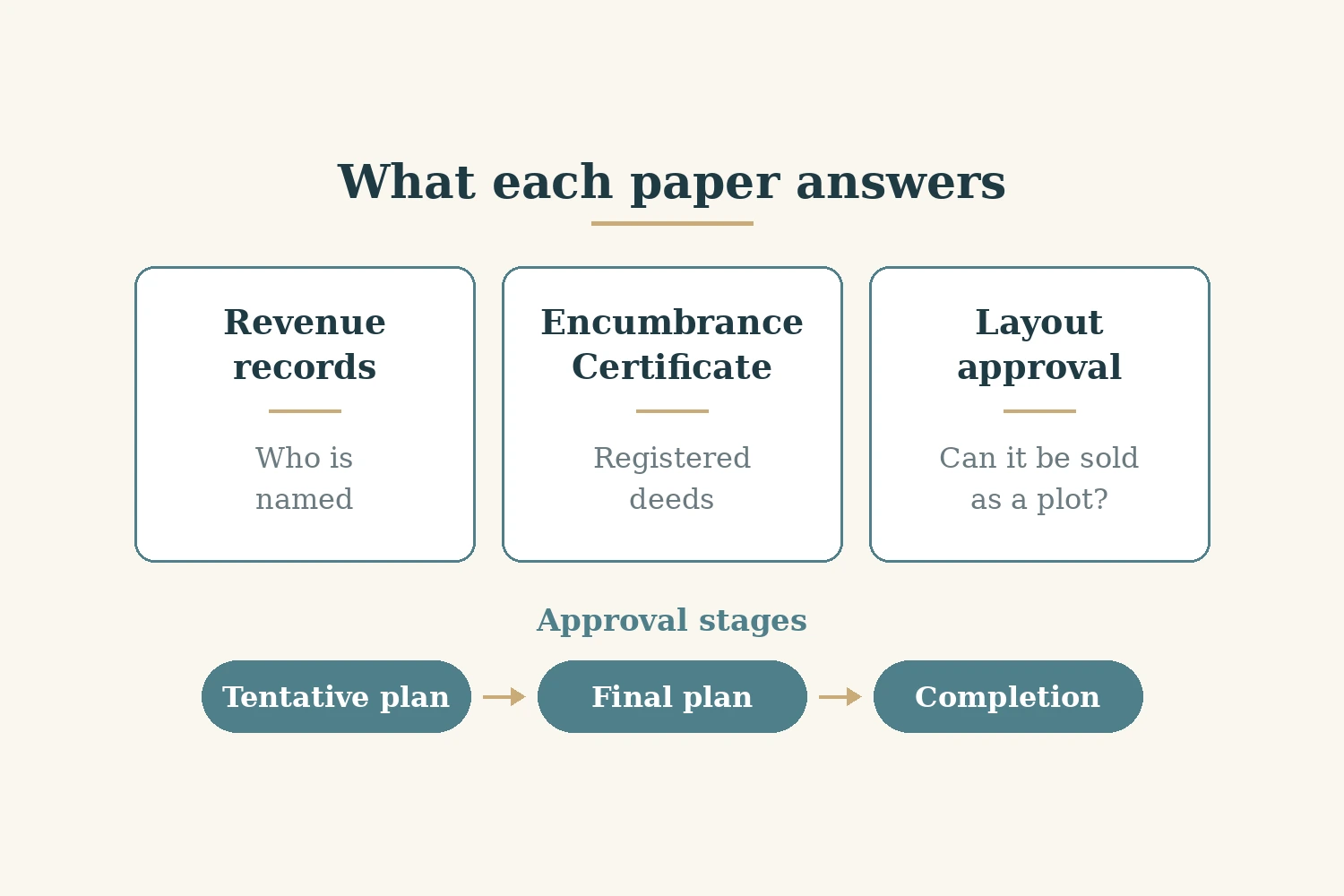
If you are looking at a plot near Lepakshi, on the Hindupur side of Andhra Pradesh (AP) and a drive north of Bengaluru, three papers will come up early: the 1-B register (the village Record of Rights extract), the adangal and the Encumbrance Certificate (EC). They answer three different questions, and none of them answers the one that matters most for a plot: may this land be sold as a plot at all? That answer comes from a layout approval, issued by whichever authority the village falls under, and for Lepakshi that question is not settled on the official pages we could read. This guide walks through each record, the layout approval route, the end of the old land conversion law, and the costs at registration, using official sources where we could reach them and saying plainly where we could not. It is general information, not legal advice.
Three records, three questions
The 1-B and the adangal are revenue records. Broadly, they tell you whom the revenue department records against a survey number and what is recorded about the land and its use. The EC is a registration record: it lists deeds registered against a property at the Sub-Registrar's Office (SRO). One record says who the state's land register names; the other says which registered transactions have touched the land.
Neither tells you that a plot can be sold as a plot. A clean 1-B and a clean EC on agricultural land still describe agricultural land. Whether that land can be divided and sold as residential plots is a planning question, covered further down.
The same logic applies across states, with different names. Our guide to patta, chitta and EC checks in Tamil Nadu works through the Tamil Nadu equivalents, and our land documentation checklist for non-resident Indians (NRIs) sets out the wider paper trail. Our Lepakshi guide and Andhra Pradesh guide describe the area itself.
Reading the 1-B, the adangal and the EC
AP's land records portal, MeeBhoomi, describes itself as covering the adangal, the 1-B, survey numbers and land parcel maps, and is run by the Office of the Chief Commissioner of Land Administration in Mangalagiri (MeeBhoomi, read 2 November 2026). Its home page lists services offered through village and ward secretariats, including mutation for transactions and mutation for correction. Mutation is the step that updates the revenue record after a sale, or corrects an error in it.
The adangal is also known as the pahani. The Sri Sathya Sai district website says the mandal revenue inspector inspects crop fields and writes field inspection details in the pahani (Sri Sathya Sai district, read 2 November 2026).
Beyond that, we could not confirm from an official source as of 2 November 2026 exactly which fields the 1-B and the adangal each contain, or whether a copy printed from MeeBhoomi is accepted as a certified copy. So treat an online printout as a starting point, ask the seller for certified copies, and check that the name, survey number and extent match across the 1-B, the adangal and the sale deeds.
The EC comes from AP's Registration and Stamps Department, through its Integrated Grievance Redressal System (IGRS) portal. The EC page offers two products: "EC For Information Only" and "Signed EC" (IGRS, read 2 November 2026). The first is useful for a quick look; for a purchase, ask for the signed version.
The period an online EC covers, and where older records sit, we could not confirm from an official source as of 2 November 2026, so ask the SRO what period your EC covers and get a search for any earlier period you need. Note that the Directorate of Town and Country Planning (DTCP) layout handbook, discussed below, asks a layout applicant for a 13-year non-encumbrance certificate and link documents for the last 13 years, which is a sensible minimum to ask a seller for too (DTCP handbook, read 2 November 2026).
An EC only shows registered deeds. A blank result means no registered deed was found for the search you ran, not that the land is free of every claim. Check the search used the right survey number, village and SRO.
Which authority? Puttaparthi or Anantapur
Lepakshi mandal is in Sri Sathya Sai district; the district's list of mandals includes Lepakshi, Hindupur and Penukonda (Sri Sathya Sai district, read 2 November 2026).
The planning authority matters because it approves layouts. A notification in the AP Gazette Extraordinary of 17 August 2026 (No. 523), issued by the Municipal Administration and Urban Development (MA&UD) department as Government Order (G.O.Ms.) No. 190, reorganised the Puttaparthi Urban Development Authority (PUDA) and added certain urban local bodies (ULBs), mandals and villages to its area (public archive copy of the gazette, read 2 November 2026). We could not confirm from an official copy of the notification, as of 2 November 2026, whether its schedule includes Lepakshi mandal, in full or in part. The DTCP list of urban development authorities (UDAs) now shows both the Puttaparthy UDA and the Ananthapur UDA (DTCP, read 2 November 2026).
There is a conflict to be aware of. AP's industries single-window page still lists some Lepakshi villages under the Anantapuramu UDA. Neither page settles it: ask PUDA, in writing, whether your village is in its area. A related government order renaming the older Anantapur authority was reported in the press; we could not confirm it from an official source as of 2 November 2026. Our Puttaparthi guide covers the neighbouring area.
Layout approval: three stages
AP's DTCP published a Handbook on Layout Approval Process in October 2026 (DTCP handbook, read 2 November 2026). It says the AP Land Development (Layout and Sub-division) Rules 2017, issued as G.O.Ms. No. 275 of 18 July 2017, supersede earlier layout rules of individual authorities. It also says that, under G.O.Ms. No. 5 of 11 January 2025, the UDA is competent to approve all layouts for gram panchayats (village councils) falling under a UDA. Applications go online through the AP Development Permission Management System (APDPMS), via a licensed technical person.
The handbook describes three stages:
- A Tentative Layout Plan (TLP), with 21 days for scrutiny, field inspection and approval.
- A Final Layout Plan (FLP), released after 15% of the plotted area is mortgaged to the local body, with 21 days.
- A Layout Development Completion Certificate (LDCC) once works are done, with 15 days.
It also sets 10% of layout area as public open space, a minimum road width of 9 metres in residential layouts, a minimum residential plot of 100 square metres with 8 metres of frontage on roads up to 12 metres, rising to 150 square metres with 10 metres of frontage on roads above 12 metres, and a requirement to start development within one year and finish within three. As a worked example of the mortgage: on a layout with 10,000 square metres of plots, 15% of 10,000 is 1,500 square metres held back until the works are complete.
The handbook's application checklist is also a useful buyer's checklist. It asks for ownership papers such as the sale deed, pattadar pass book, title deed or pahanies, the link documents for the last 13 years, the latest 13-year non-encumbrance certificate, and a no-objection certificate from the District Collector where the land is assigned or alienated land. If a seller cannot produce these, a layout application would struggle too. So ask for the TLP, FLP and LDCC numbers, and check them with the UDA. Our guides to villa checks near Hyderabad and reading a project's status cover similar questions in a neighbouring state.
NALA is gone: what replaced it
Using farmland in AP for other purposes once meant a conversion under the AP Agricultural Land (Conversion for Non-Agricultural Purposes) Act 2006, known as the NALA (Non-Agricultural Land Assessment) Act. That Act was repealed by Act No. 20 of 2025, deemed in force from 3 September 2025 (Act No. 20 of 2025, gazette text as published by PRS Legislative Research, read 2 November 2026). The repeal saves actions already taken, and pending conversion applications are to be decided under the old Act. It also says unauthorised layouts stand validly converted on payment of conversion tax on the land's basic value for the relevant period, without penalty.
In its place, G.O.Ms. No. 211 of 8 October 2025 issued rules for External Development Charges (EDC), levied at 4% of the prevailing SRO value of the agricultural land on building or layout applications, with double charges for anyone who misrepresents land use or value to evade them (G.O.Ms. No. 211, read 2 November 2026). As an illustration with a round number, if the SRO value of a parcel were Rs (Indian rupees) 10 lakh, 4% of 10 lakh is Rs 40,000.
A separate point: the AP Land Titling Act 2022 was repealed in 2024 by Act No. 11 of 2024, so the revenue record and registered deeds remain the paper trail (Act No. 11 of 2024, gazette text as published by PRS Legislative Research, read 2 November 2026). Our guides to land conversion in Jaipur and managed farmland law by state show how other states handle this.
Where AP RERA comes in
Under section 3(2)(a) of the Real Estate (Regulation and Development) Act 2016 (RERA Act), a project needs no registration where the land is not more than 500 square metres or the apartments are not more than eight, counting all phases (RERA Act, Goa RERA copy, read 2 November 2026). Whether AP has set a lower threshold, and whether AP RERA treats managed farmland sold as plots or undivided shares as a real estate project, we could not confirm from an official source as of 2 November 2026.
The AP RERA Rules 2017 (G.O.Ms. No. 115 of 27 March 2017) define a layout plan as a plan dividing land into plots, roads, open spaces and amenities, and require a promoter of plotted development to disclose the plot areas, the land earmarked for public purposes, the amenities and the completion period (AP RERA Rules, read 2 November 2026). The DTCP handbook lists RERA registration as something to be obtained after the FLP is released.
So ask any seller for the AP RERA registration number and the layout approval number, and check both on the official sites. Our guide to buyer protection for under-construction homes explains what registration covers.
What it costs to register
AP's IGRS publishes a transfer duty of 1.5% on the value of a sale of immovable property, collected for the local body, effective from 1 April 2013 (IGRS transfer duty note, read 2 November 2026). The registration fee on a sale deed we could not confirm from a current official source as of 2 November 2026; an IGRS fee table from 2013 shows 0.5%, and some non-official sites give a different figure.
The stamp duty rate on a sale deed we could not confirm from an official source as of 2 November 2026, so we give no figure. Use the AP Registration and Stamps Department's own duty and fee calculator for your deed before you budget. Our guides to stamp duty and registration by state and financing a plot cover the wider costs.
Who this is not for
This is not legal advice and does not replace a local lawyer reading the records for your survey number. It does not cover roads or connectivity: claims about airports, highways or corridors near Lepakshi we could not confirm from an official source as of 2 November 2026, so treat any distance or road claim in a listing as the developer's statement. Our Bengaluru guide covers the city end of the drive, and our guide to land checks in Dapoli on the Konkan coast shows how coastal rules add another layer in a different state.
Where that leaves you
As listed on avacasa.life on 2 November 2026, we had 9 listings in AP, 7 of them in Lepakshi, all managed farmland and 7 marked under construction by the sellers, priced from about Rs 12.5 lakh to about Rs 36 lakh and up. Managed farmland is agricultural land, which is a lawful product with different checks from a plotted layout. For each one, ask for the AP RERA number and the layout approval number, if any, and check them yourself.
So: read the 1-B and adangal for who the record names, the signed EC for registered deeds, and the layout approval from the right authority for whether a plot is a plot. And remember that the NALA conversion route was repealed with effect from 3 September 2025.
Sources
- MeeBhoomi, AP land records portal
- Sri Sathya Sai district: mandal list
- IGRS AP: Encumbrance Certificate service
- AP Gazette Extraordinary, 17 August 2026, No. 523 (Puttaparthi UDA), public archive copy
- DTCP AP: urban development authorities
- DTCP AP: Handbook on Layout Approval Process, 2026
- AP Act No. 20 of 2025, NALA repeal (gazette text, PRS Legislative Research copy)
- G.O.Ms. No. 211, External Development Charges Rules 2025
- AP Act No. 11 of 2024, Land Titling repeal (gazette text, PRS Legislative Research copy)
- Real Estate (Regulation and Development) Act 2016, Goa RERA copy
- AP RERA Rules 2017
- IGRS AP: transfer duty
- IGRS AP: registration fee table, 2013
- IGRS AP: duty and fee calculator
Ready to find your next holiday home?
Browse our curated collection of vacation homes and managed farmland across India and beyond.