Joint Ownership and Co-Buying a Second Home: Structures and Pitfalls

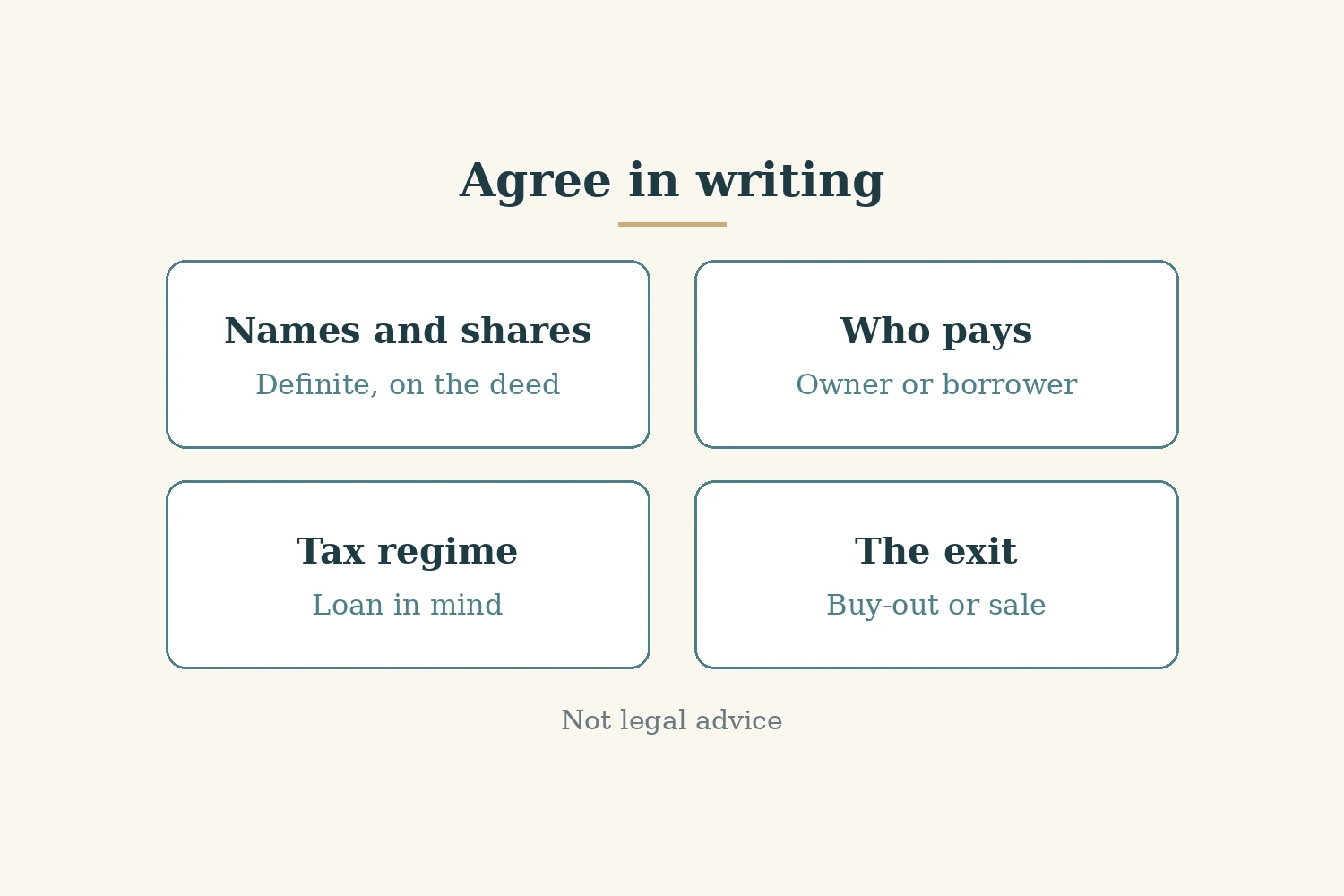
Putting two names on the deed of a second home feels like a family courtesy. It is a legal structure. Who is on the deed, and whether each share is written as a definite figure, decides how income tax assesses each of you, how stamp duty is charged, whether a women-only concession survives, and what is left to sort out when one of you dies or wants out. In Maharashtra, adding one male name to the purchase can switch off a women-only stamp duty cut altogether, and years later a buy-out between the same co-owners can be stamped as a fresh conveyance rather than as a partition.
This guide is for a resident Indian buyer putting a second home in two or more names: spouses, siblings or friends. It is not for anyone hoping a relative's name on the title will hold the property for them; that is nominee ownership, and our piece on the risks of nominee ownership explains why it fails. A non-resident Indian (NRI) co-buyer walks the same title and stamp path with extra questions of their own, and our explainer on Overseas Citizen of India (OCI) and Person of Indian Origin (PIO) definitions starts there.
Write definite shares into the deed
The clearest official reason to write shares down comes from income tax. The Income Tax Department's page on self-occupied house property says that where co-owners hold definite and ascertainable shares, each co-owner's share of the income is worked out separately (read 10 Nov 2026). Its page on income from house property, as amended by the Finance Act, 2025, puts the same rule under section 26: each co-owner is assessed on their own share, and annual value is divided in proportion to it (read 10 Nov 2026). These department pages cite the Income-tax Act, 1961, which governs income earned up to 31 March 2026. The Income-tax Act, 2025 replaced it from 1 April 2026 and renumbered these rules; the section 80C deduction, for example, now sits in section 123 read with Schedule XV (read 10 Nov 2026).
Where shares are not definite, the department taxes the income as that of an Association of Persons, a separate assessable unit. Two people who buy at sixty and forty per cent and write those figures in are each assessed on their own part, sixty plus forty making the whole.
We could not confirm the text of the Transfer of Property Act, 1882 (TPA) on how shares are treated between joint transferees on India Code as of 10 Nov 2026. So do not guess what the law presumes when a deed is silent. Write the figures in and the question does not arise. Then check that the land record follows the deed once the transfer is mutated; our guides to the Maharashtra Land Revenue Code and to the Karnataka RTC (Record of Rights, Tenancy and Crops) and Pahani show where the names should appear.
Stamp duty is state law, and a women-only cut is not a joint-purchase cut
Stamp duty is charged by the state, so the state decides what two names cost. Our state-by-state stamp duty and registration guide and our piece on Telangana stamp duty and registration are the places for rates.
Maharashtra shows how a co-buying choice changes the bill. Section 9 of the Maharashtra Stamp Act, 1958 lets the State Government reduce or remit duty for a class of persons by an order in the Official Gazette (Inspector General of Registration (IGR) Maharashtra, Act modified up to 13 July 2026, read 10 Nov 2026). Under that power, an order dated 31 March 2021 cuts duty by one per cent of what Article 25(b) of Schedule I would otherwise charge, on a conveyance or agreement to sell of a residential unit bought by a woman or women, from April 2021 (IGR Maharashtra gazette, read 10 Nov 2026).
The explanation in that order is the part co-buyers miss. The cut applies only where women are the only purchasers, and the units named are a flat, bungalow, row house, independent house or tenement. Add a husband, brother or male friend and the order, as written, does not apply to the instrument at all. It is not a cut shared across the buyers, and the order does not name a bare plot.
The order also says a woman who takes the remission must not sell to a later male purchaser within 15 years, or the one per cent and a penalty fall due; transfer by inheritance on her death is excluded. We could not confirm an official repeal of the 15-year condition on the IGR Maharashtra website as of 10 Nov 2026, so keep it in view. We could not confirm the current Article 25(b) rates on the IGR Maharashtra website as of 10 Nov 2026; ask the sub-registrar for the live rate.
We could not confirm a current women's stamp duty concession in Karnataka on the Karnataka government's legislation portal as of 10 Nov 2026. Our Karnataka guide and Maharashtra guide cover the wider picture in each state.
A co-ownership agreement sits beside the deed
Many co-buyers sign a private agreement recording who pays what, how holidays are shared, how running costs split and how one can buy the other out. Our breakdown of annual holding costs lists what the cost-sharing clause has to cover.
The agreement does not put a name on the title; the deed does. We could not confirm on India Code as of 10 Nov 2026 whether section 17 of the Registration Act, 1908 requires such an agreement to be registered. Ask your lawyer whether yours needs registering.
Getting out: a partition is not a buy-out
Co-ownerships usually end in a division of the property or a buy-out of one share. Maharashtra stamps these differently.
Section 2(m) of the Maharashtra Stamp Act defines an instrument of partition as one by which co-owners divide, or agree to divide, property into separate holdings, and it takes in a court or revenue partition order, an arbitration award directing partition, and a document recording a partition already made (IGR Maharashtra compilation, read 10 Nov 2026). The explanation to section 2(g) treats an instrument by which one co-owner transfers their interest to another, where it is not a partition, as a conveyance (read 10 Nov 2026). Section 30 names the default payer: the grantee on a conveyance, and on a partition, the parties in proportion to their shares (read 10 Nov 2026). Your agreement can share the cost differently, but it does not change who the Act names.
A one-bedroom flat cannot usefully be divided, so for most second homes the realistic exit is a buy-out or a sale to an outsider. Budget for conveyance duty on that buy-out when you sign, not when one of you wants out. We could not confirm the text of the Partition Act, 1893 on India Code as of 10 Nov 2026, so nothing here describes what a court may order between unwilling co-owners.
Nominee, Hindu Undivided Family (HUF) and company are different vehicles
A nominee holding is the failure case: one person pays, another is named, and the payer is left trying to prove an interest the title does not show. Our piece on nominee ownership risk covers why it breaks down.
A Hindu Undivided Family (HUF) is a recognised person for some tax purposes; the Income Tax Department's deductions page lists an HUF, with an Individual, as eligible for section 80C (read 10 Nov 2026). How an HUF holds property is family law. We could not confirm the text of the Hindu Succession Act, 1956 (HSA), including its provisions on coparceners, on India Code as of 10 Nov 2026.
A company holding a family holiday home raises its own questions. We could not confirm the company-law or stamp treatment of a company-owned second home on an official source as of 10 Nov 2026, so treat that route as one for specialist advice.
When one co-owner dies
A will helps, but it does not repair a deed that never said who owned what. We could not confirm how the HSA passes a co-owner's share on India Code as of 10 Nov 2026, so this guide does not set that out. Our guides to inheritance and succession of Indian property and to wills covering property in two countries go further.
Home loans, co-borrowers and income tax
A co-borrower on a loan is not automatically a co-owner on the deed, and the tax pages read ownership and payment separately.
Section 24(b) allows interest on borrowed capital. For a self-occupied home bought or built with a loan taken on or after 1 April 1999 and finished within five years, the cap is Rs 2 lakh (two hundred thousand rupees); for repairs or renewal it is Rs 30,000 (Income Tax Department, income from house property, read 10 Nov 2026). From Assessment Year 2020-21 the deduction can cover two self-occupied houses, but the combined cap stays at Rs 2,00,000 or Rs 30,000, so two houses do not double it. For a co-owned let-out property, each co-owner claims interest according to their contribution to repaying it.
Section 80C allows an Individual or an HUF up to Rs 1,50,000 a year for listed payments, including home-loan principal and the stamp duty and registration fee on a residential house; sections 80C, 80CCC and 80CCD(1) together stop at Rs 1,50,000. It follows actual payment, it is not allowed if the house has been let out, and a sale within five years of the end of the year of possession can turn earlier deductions into income (deductions page, read 10 Nov 2026).
We could not confirm on the Income Tax Department website as of 10 Nov 2026 that each co-owner receives a separate section 24(b) or section 80C cap on the same loan. Let a tax adviser apply the caps to your payments.
The regime matters as much as the share. Under the default regime in section 115BAC, the deductions page lists only a short set of Chapter VI-A deductions, and section 80C is not among them (read 10 Nov 2026). A related department page on house property states that the default regime does not allow the section 24(b) interest deduction on a self-occupied house (read 10 Nov 2026). Each co-owner is assessed on their own share, so one loan can be treated differently in each pair of hands.
A short note on Dubai: two names on one title
Our pieces on foreign ownership across the United Arab Emirates (UAE) and Dubai freehold and leasehold zones, and our Dubai guide, cover where buyers may own.
Under Law No. 7 of 2006 on real property registration, a transaction creating or transferring a property right is not valid unless recorded in the Property Register, and the Dubai Land Department (DLD) issues title deeds from that register (Articles 9 and 22, Dubai Legal Portal, read 10 Nov 2026). An inheritance certificate is registered too, and an heir's disposal is not recognised against others unless registered (Article 11). Both buyers' names belong on the register.
DLD's split ownership and partners division services both refer to co-owners' respective shares, and the partners division page lists a fee of 1 per cent of the value of the shares separated (read 10 Nov 2026). We could not confirm on the DLD website as of 10 Nov 2026 how shares are printed on a title deed issued to two buyers, so ask to see the draft record. Families wanting a formal undivided-share contract can use Law No. 9 of 2020 on family property, which requires each partner's share in a notarised contract (read 10 Nov 2026).
Keep strata law apart: Law No. 6 of 2019 on jointly owned real property governs buildings and communities with common parts, not two friends buying one villa (read 10 Nov 2026).
Where that leaves you
Before you sign, check that the agreement and the deed carry every name and a definite share. Write down who pays what, and whether each borrower is also an owner. In Maharashtra, claim the women-only cut only if every purchaser is a woman and the asset is a residential unit, and keep the 15-year condition in view. Choose tax regimes with the loan in mind. Agree the exit, and budget for a buy-out stamped as a conveyance. For Dubai, check both names on the DLD register.
Co-buying works between people who trust each other. It works best when the paperwork does not depend on that trust. Our India guide and Goa guide are good places to start on where to buy.
Sources
- IGR Maharashtra: The Maharashtra Stamp Act, section-wise compilation modified up to 13 July 2026
- IGR Maharashtra: Revenue and Forests Department order dated 31 March 2021 on the women purchaser stamp duty reduction
- Income Tax Department: self-occupied house property
- Income Tax Department: income from house property
- Income Tax Department: house property
- Income Tax Department: deductions
- Income Tax Department: frequently asked questions (FAQs) on interplay and transition to the Income-tax Act, 2025
- Income Tax Department: Income-tax Act, 2025, Schedule XV
- India Code: Transfer of Property Act, 1882 (could not be opened 10 Nov 2026)
- India Code: Hindu Succession Act, 1956 (could not be opened 10 Nov 2026)
- India Code: Partition Act, 1893 (could not be opened 10 Nov 2026)
- Dubai Land Department: split ownership service
- Dubai Land Department: partners division registration service
- Dubai Legal Portal: Law No. 7 of 2006 Concerning Real Property Registration%20of%202006%20Concerning%20Real%20Property%20Registration%20in%20the%20Emirate%20of%20Dubai.html)
- Dubai Legal Portal: Law No. 6 of 2019 Concerning Ownership of Jointly Owned Real Property%20of%202019%20Concerning%20Ownership%20of%20Jointly%20Owned%20Real%20Property%20in%20the%20Emirate%20of%20Dubai.html)
- Dubai Legal Portal: Law No. 9 of 2020 Regulating Family Property%20of%202020%20Regulating%20Family%20Property%20in%20the%20Emirate%20of%20Dubai.pdf)
Ready to find your next holiday home?
Browse our curated collection of vacation homes and managed farmland across India and beyond.