Property in Two Countries: Wills, Probate and Who Inherits What

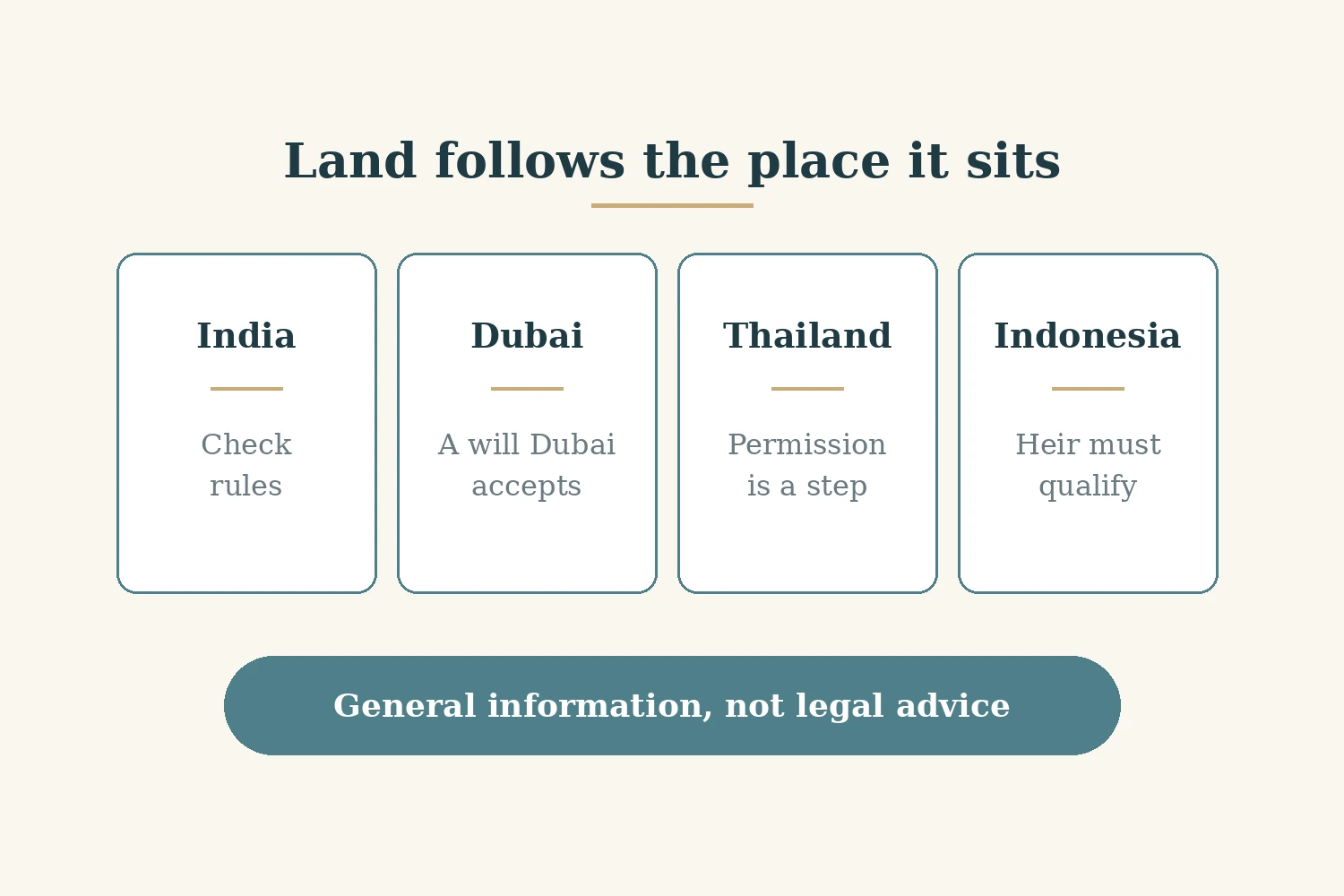
If you are a Non-Resident Indian (NRI) with a flat in Pune and a villa in Dubai, or a family home in Goa and a condominium in Phuket, it is natural to assume that one will, made wherever you live, will settle both. It may not. Each country decides for itself how land inside its borders passes on death, which court or registry acts on a will, and whether a foreign heir may hold that land at all. So a cross-border owner needs a plan for each country: a will that each place will act on, and a check of whether the people you name can actually hold what you leave them. This guide sets out what we could confirm from official sources on 30 October 2026, and says plainly where we could not. It is general information, not legal advice; for your own estate, a lawyer in each country should draft and check the documents.
The short answer: land follows the place it sits
The practical rule of thumb is simple. For land and buildings, expect the country where the property sits to decide how it passes, which formalities a will must meet, and which court or registry gives effect to it. A will that is perfectly valid where you live may still need a court in another country to act on it before a registry there will change the owner's name. And even when the will works, the heir may face local limits on who may hold land.
That is why the rest of this guide goes country by country. It does not try to tell you which personal law applies to you in India, which depends on your religion and circumstances; our guide to inheritance and succession in India for NRIs covers that. Here the question is the cross-border one: which law, which court, which registry, and which limits on a foreign heir.
India: what we could confirm, and what we could not
India's main statute on wills and probate is the Indian Succession Act, 1925. We could not confirm its text from an official source on 30 October 2026, because India Code, the government's legislation site, would not load from our system. So we do not quote its provisions on which law governs Indian land, on how probate is defined, or on when probate is needed, and we give no rule here that depends on them. In particular, do not assume that any one provision applies to every Indian who dies; the Act's provisions apply differently depending on the person's community and circumstances.
We also could not confirm from an official source what the Repealing and Amending Act, 2025 (Act 37 of 2025) changes in the Indian Succession Act, including any change to its probate provisions, because the India Code copy would not load on 30 October 2026; check the current position with a lawyer in India.
What this means in practice is narrower but still useful. If you hold land in India, expect an Indian court, registry and land office to be involved when it passes on your death, whatever country you die in. A will made abroad is not a shortcut around that, and an executor abroad will usually need someone in India to act. Our guides to power of attorney for NRI buyers and the NRI property sale process in India cover acting from a distance, and our Goa guide covers one of the places we list.
Dubai: two routes for non-Muslims
Dubai offers non-Muslims more than one way to make a will that will be acted on there. One is the Dubai International Financial Centre (DIFC) Courts Wills Service. The other is a will registered with a court under the federal civil personal status law. They have different rules, so compare them separately.
The DIFC Courts Wills Service
The DIFC Courts describe the Wills Service as a joint initiative of the Government of Dubai and the DIFC Courts that lets non-Muslims investing and living in the United Arab Emirates (UAE) pass on their assets and appoint guardians for their children (DIFC Courts service page, read 30 October 2026). It was established by Resolution No. 4 of 2014 of the President of the DIFC, and its authority was reaffirmed by Dubai Law No. 15 of 2017.
Its frequently asked questions set out who can register a will: you must not be Muslim and never have been Muslim, you must be at least 18 years of age, and you must own assets in the UAE or have minor children living with you in the UAE (DIFC Courts wills FAQ, read 30 October 2026). The service registers five types of will: a full will, a property will, a business owners will, a financial assets will and a guardianship will.
The scope matters. Rule 9(2) of the DIFC Wills and Probate Registry Rules says the rules apply only to the part of an estate situated in the Emirate of Dubai and the Emirate of Ras Al Khaimah, and that a grant extends only to that part (DIFC Courts rules, read 30 October 2026). Rule 9(3) says the rules do not apply to an intestate estate or the intestate part of one. So a DIFC will is a will for property in Dubai and Ras Al Khaimah. It is not a will for your property in India, and we do not claim that India recognises a DIFC grant.
A court-registered will under the federal law
The UAE also has a federal Decree-Law No. 41 of 2022 on civil personal status, with an implementing Cabinet Resolution No. 122 of 2023, under which non-Muslims may be able to register a will with a court. We could not confirm their text from an official source on 30 October 2026, because the UAE legislation portal blocked our access. So we give no age limit, no witness rule and no default shares for this route. Note only that its age and formalities may differ from the DIFC route's, and ask a UAE lawyer which route suits your estate. Our guides to buying property in Dubai as a foreign buyer and the Oqood register cover how a Dubai title is recorded in the first place, and our Dubai guide covers the city.
Thailand: a procedure exists, and permission is a step
Thailand limits foreign ownership of land, so the question for a foreign heir is not only who inherits but whether they may hold the land. The Department of Lands publishes a service procedure titled, in our translation, acquisition of land by a foreigner by inheritance as a statutory heir under section 93 of the Land Code, posted on 2 September 2025 (Department of Lands service page, read 30 October 2026). Its attached document would not open for us, so we have not read the steps.
What that tells you is limited but important: there is a formal procedure, and it is a matter for the Department of Lands, not something that happens automatically when a will is read. Do not assume that permission will be given. We could not confirm from an official source the wording of the Land Code on this point, any time limit for disposing of land a foreign heir cannot keep, or how Thailand's Civil and Commercial Code treats heirs and wills. A Thai lawyer should advise on all three. Our guide to owning property in Thailand as a foreigner covers the ownership rules, and our Phuket guide and Bangkok guide cover the places.
Indonesia: the heir must be able to hold the right
Indonesia's rules turn on what kind of right is being passed on, and whether the heir may hold it. Peraturan Pemerintah (PP), meaning government regulation, No. 18 of 2021 was enacted and promulgated on 2 February 2021 (Coordinating Ministry for Infrastructure legal database, read 30 October 2026). Under its article 49(2)(e), a right of use with a fixed term, hak pakai, can be granted to a foreigner. Under article 50, a holder who no longer meets the conditions must release or transfer the hak pakai to someone who does within one year, and if they do not, the right ends by law. Under article 69(2) and (3), a foreigner's house or residence can be inherited, and if the heir is a foreigner, the heir must hold immigration documents (PP 18/2021, copy in the legal database of the Badan Pemeriksa Keuangan (BPK), Indonesia's Audit Board, read 30 October 2026).
For ownership rights, an article published by the Directorate General of Taxes explains that under article 21(3) of the Basic Agrarian Law (Undang-Undang Pokok Agraria, or UUPA), a foreigner who acquires hak milik, full ownership, by inheritance without a will must release it within one year, or it ends by law and the land passes to the state (Directorate General of Taxes article, read 30 October 2026). That is the tax authority's article quoting the law, not the law's own text, and the article states that it is the author's personal view. Treat it as a pointer to check with an Indonesian notary, not as the final word. Our guides to owning property in Indonesia as a foreigner and nominee ownership risk cover why the type of right matters, and our Bali guide covers the island.
One will or two: avoiding wills that cancel each other
Many cross-border owners end up with more than one will, for example a DIFC will for Dubai and a will for India. That can work, but only if the documents are drafted together. The usual risk is that a later will contains a general clause revoking all earlier wills, and so cancels the will for the other country without anyone intending it. Another risk is that two wills name different executors or different heirs for the same asset.
We give no template, because the wording has to fit each country's formalities. The practical step is to ask the lawyer drafting each will to see the other, to limit each will clearly to the property in its own country, and to make sure neither revokes the other by accident. Revisit both when you buy or sell property in either country.
The paper checklist
Whatever the countries, the same handful of papers decides whether your plan works:
- The title: whose name is on each property, what kind of right it is, and which registry holds the record.
- The will for each country: made in a form that country will act on, and limited to that country's property.
- The executor: someone who can act in that country, or appoint someone who can.
- The heir's eligibility: whether each person you name may hold that kind of property in that country, and what happens if they cannot.
- Powers of attorney: who can act for you, or for your executor, while you or they are abroad.
Our guides to cross-border property due diligence, foreign property ownership and foreign ownership in the other markets we list cover the ownership side of each of these checks.
Who this is not for
This is not legal advice, and it is not a substitute for a lawyer in each country where you hold property. It does not cover Indian personal law by religion, taxes on inheritance, or fees for registering wills or obtaining grants. It does not give the Indian Succession Act's provisions, the UAE federal route's rules or default shares, or Thailand's Land Code and Civil and Commercial Code wording, because we could not confirm those from official sources on 30 October 2026. And it does not cover countries other than India, the UAE, Thailand and Indonesia.
Where that leaves you
Property in two countries usually means two sets of rules on death, and often two wills. For each country, find out which court or registry will act on a will, make a will in a form it accepts and limit it to that country's property, check that your heirs may hold what you leave them, and make sure your wills do not cancel each other. In Dubai, the DIFC route covers only Dubai and Ras Al Khaimah. In Thailand, a foreign heir's land is a matter for the Department of Lands. In Indonesia, a foreign heir must be able to hold the right, and time limits apply. This is general information, not legal advice: have a lawyer in each country draft and check the documents.
Sources
- DIFC Courts: Wills Service
- DIFC Courts: wills frequently asked questions
- DIFC Courts: DIFC Wills and Probate Registry Rules
- Department of Lands, Thailand: acquisition of land by a foreigner by inheritance as a statutory heir under section 93 of the Land Code
- BPK legal database: PP No. 18 of 2021
- Coordinating Ministry for Infrastructure legal database: PP No. 18 of 2021 record
- Directorate General of Taxes: article on the tax aspects of transferring land and buildings owned by foreign citizens
Ready to find your next holiday home?
Browse our curated collection of vacation homes and managed farmland across India and beyond.