Reading an RTC (Pahani) Before You Buy in Karnataka

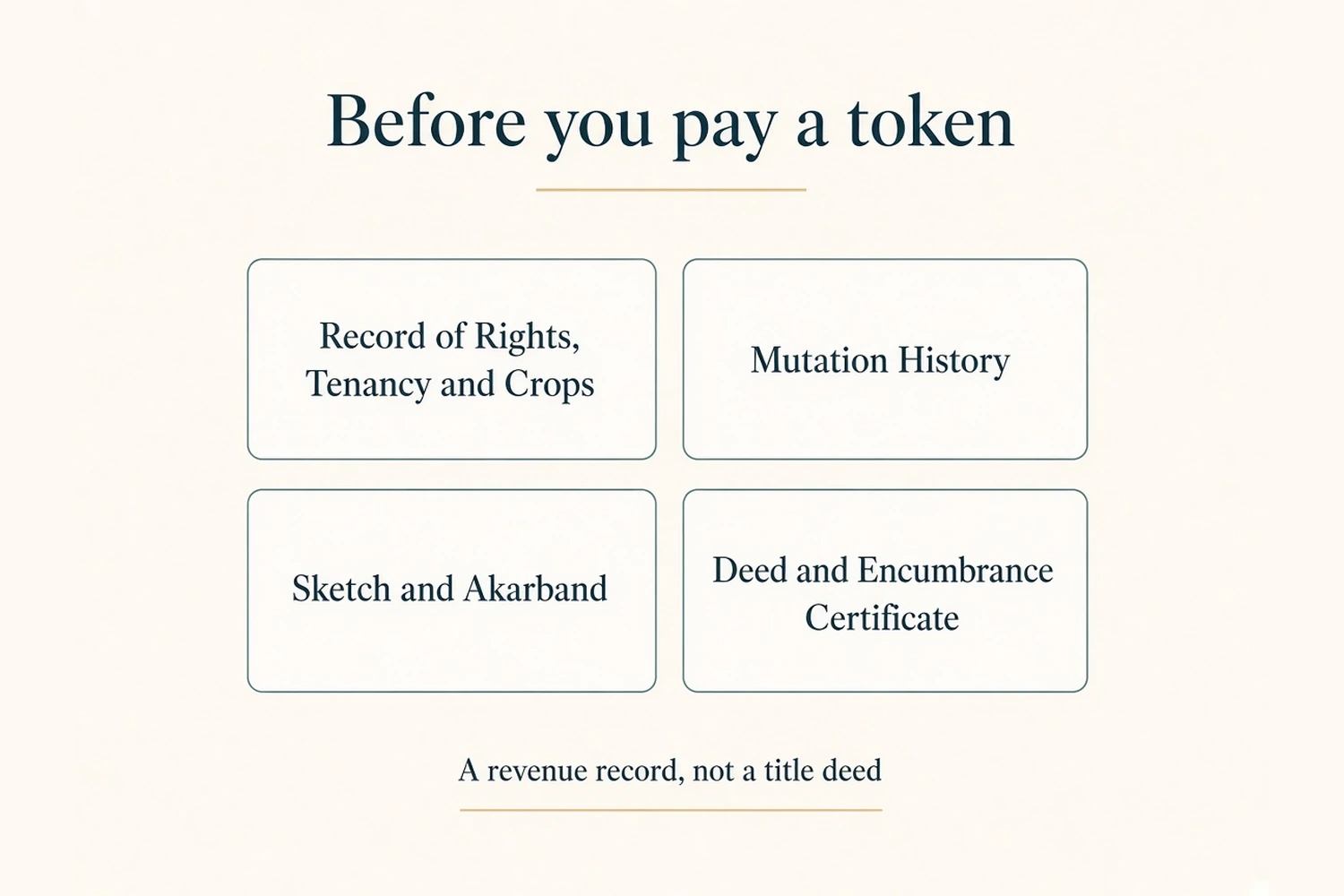
The first document most Karnataka land sellers send is a photograph of an RTC, the Record of Rights, Tenancy and Crops, which nearly everyone still calls a Pahani. It arrives on WhatsApp before the site visit, often cropped, and is offered as though it settles who owns the land. It does not. An RTC or Pahani in Karnataka is the revenue record for a survey number or hissa: whom the Revenue Department has on its books, how much land, of what kind, and what was grown on it. Ownership is traced through registered deeds on a different system. The useful way to read the RTC before paying a token is as one of five papers that must tell the same story, and as the signal to stop when they do not.
A Record of Rights, Tenancy and Crops (RTC) extract is a revenue record, not a title deed
Karnataka keeps its rural land records on Bhoomi, run by the Revenue Department's Bhoomi Monitoring Cell (Karnataka Revenue Department, read 10 Nov 2026). Hassan district's land-records page explains that Bhoomi was inaugurated in 2000, that the manual RTCs then in use were digitised, and that ownership and other changes in RTCs are carried out through mutation (Hassan district, read 10 Nov 2026).
Deeds live elsewhere. Sales are registered on a separate system, reached through the Kaveri Online Services portal (Kaveri, read 10 Nov 2026), and it is that side, with an encumbrance certificate, that carries the chain of title. The RTC tells you whom the revenue record names today. It does not show the sales that put that name there, or whether the person in front of you can sign.
As for the legal weight of an entry, we could not confirm the current text of the Karnataka Land Revenue Act, 1964 on the state's official legislation site or on India Code as of 10 Nov 2026. Older reproduced copies circulate, but they predate later amendments and are not treated here as current law. So nothing below rests on a section number. The working rule is simple: a revenue entry is evidence to be matched, not a conclusion to be accepted. The Karnataka guide maps the state's markets; this is the paper beneath them.
Pulling the current, digitally signed record on Bhoomi
Start at Bhoomi, not the seller's image. Its RTC page, headed as Form 16, asks for district, taluk, hobli and village, then the survey number, hissa number and period or year (Bhoomi, read 10 Nov 2026). Its tabs cover the current year, old years, the MR (Mutation Register), mutation status, khata extract, survey documents, akarband, survey sketch, eChavadi and record-room documents.
One link matters most: a separate click to obtain the original digitally signed RTC and Mutation Register. Download that signed file, and the older years too. A screenshot can be edited or stale; a signed extract you pulled on a known day is something your lawyer can work from.
Two cautions. The portal says its information is updated in all respect and can be accessed online without visiting the department (Bhoomi, read 10 Nov 2026). That describes the database, not title to any parcel. And the khata extract is a different Bhoomi product from the RTC, so do not treat the words as synonyms; a municipal property-tax khata is a further document again, outside this guide.
A buyer abroad reads exactly the same record online. Residence status changes other parts of the transaction, not the reading of a Pahani; the guide to who counts as a Non-Resident Indian (NRI) or Overseas Citizen of India (OCI) covers that side.
What the record should show you
The clearest public description of an RTC's contents is a government-hosted draft, Evaluation of Quality of Land Records: Karnataka, marked Draft for Discussion (read 10 Nov 2026). It is a secondary evaluation, not law and not an official column schedule.
It describes columns for survey number and hissa; total area in acres, guntas, annae and paisae, with private and government kharab recorded separately; assessment; soil category; patta or sarkar status; trees and irrigation; owners, shares and khata number; the year and reason of each mutation; bank loans, mortgages and court cases; and yearly cultivators, seasons and crops. It notes that 40 guntas make one acre, so 2 acres 10 guntas is two acres plus ten fortieths, or a quarter, of an acre: two and a quarter acres.
We could not confirm the column headings of a current digitally signed RTC against that list as of 10 Nov 2026, so treat it as things to find, not a template. Read owners and shares first, then extent and its kharab split, then loans and court cases, and the crop history last. The Tamil Nadu patta, chitta and encumbrance certificate guide applies the same discipline next door.
Mutation history, and why a fresh screenshot is not enough
A mutation is how a change reaches the RTC. The draft evaluation says some mutations, such as a sale through a registered deed, involve a notice period, while others, such as mortgages and court orders, are described as not needing one. Today's owner line is the end of a process; you want to see the process.
Bhoomi offers the Mutation Register, mutation status and mutation history (Bhoomi, read 10 Nov 2026). Read the history for the survey number and hissa as far back as it goes, and ask the seller to match each change, whether inheritance, partition or sale, to a document. A name with no explainable mutation, or a recent change still open, is a question to settle before money moves.
The same page points to the state's revenue court cases portal, and to eChavadi, where citizens can register as interested parties and receive Short Message Service (SMS) updates (Bhoomi, read 10 Nov 2026).
We could not confirm on an official copy of the Act as of 10 Nov 2026 the current procedure for reporting an acquisition, objecting to a mutation or appealing a mutation order. The draft also describes a J-slip sent from Kaveri to Bhoomi after a registered sale to speed mutation; that is a practice description, and we could not confirm that every registered sale now mutates automatically.
Survey number, hissa, extent and phodi
The draft evaluation defines a hissa number as a sub-division number within a survey number, and phodi as the bifurcation of a survey number into sub-survey numbers. A developer's layout plot number is not a hissa unless the record shows one.
Bhoomi's survey services include viewing and requesting survey documents and downloading revenue maps by village (Karnataka Revenue Department, read 10 Nov 2026). The portal also lists Mojini, which the draft describes as the survey department's tool for spatial records and measurement. A village map is context, not a boundary; that needs the hissa's sketch, the akarband and a surveyor on the ground.
If the deed schedule sells more than the RTC records for that hissa, or the sketch and RTC disagree, stop. We could not confirm on an official copy of the Act as of 10 Nov 2026 the current sketch requirements when part of a survey number is sold, so ask your lawyer which sketch registration will need. The Goa Form I and XIV guide shows another state separating survey identity from ownership.
Kharab, and land that may not be the seller's to sell
Many RTCs record a kharab extent, set apart from the cultivable area. The draft evaluation describes the extent column as capturing private kharab, marked (a), and government kharab, marked (b). Watch for a gross figure, kharab included, quoted as the land on offer.
What follows legally from either label depends on the current Karnataka Land Revenue Act, 1964, as amended, and the Karnataka Land Revenue Rules, 1966. We could not confirm either on an official text as of 10 Nov 2026, including any definition of A kharab and B kharab, whether either can be conveyed, and how either is assessed.
So keep the rule narrow. Do not price, measure or accept a kharab extent as part of the purchase until your lawyer has shown you, on the current Act and Rules, what it is. Where the record labels part of the extent as government kharab, assume nothing about it travelling with a private sale. Price the extent that is clearly the seller's.
Conversion is a separate order
An agricultural RTC describes agricultural land. A house, homestay or plotted layout needs a change of use through a conversion order, which is a separate document. Bhoomi links to a search for final land-conversion orders, searchable by request identifier, survey number or reconversion identifier after choosing district, taluk, hobli and village (Karnataka land conversion, read 10 Nov 2026).
If a seller says the land is converted, find the final order on that search against the same survey number. A crop entry, a khata, a management contract or a brochure line is not a conversion order.
We could not confirm on an official copy of the Karnataka Land Revenue Act, 1964 as of 10 Nov 2026 the current conversion procedure, including whether later amendments to section 95 have changed the route, fees or timelines. Managed-farmland contracts can describe uses the land record does not support; the managed-farmland contract and land-law guide covers that gap.
Matching the record to the deed and the encumbrance certificate
The deed chain and the encumbrance certificate (EC) come from the registration side, through Kaveri (read 10 Nov 2026), which the draft evaluation expands as Karnataka Valuation and e-Registration System Integrated. We could not confirm Kaveri's EC search screens, fees or period of coverage as of 10 Nov 2026. Ask your lawyer what EC period the chain needs. An EC reflects registered transactions; an unregistered agreement, some court matters and revenue dues may not appear.
Then lay the papers side by side. Village, survey number and hissa should be identical on the RTC, mutation entries, sketch, deed schedule and EC. The owner's name and share should be explained by a mutation that matches a registered document. The deed extent should not exceed the recorded extent once kharab is set out as the record shows it. Classification and any conversion order should fit the intended use. If any of these fails, stop and resolve it. Registration costs are set out in the stamp duty and registration guide by state; if borrowing is planned, the plot financing guide explains how lenders approach land.
The logic travels: Maharashtra's 7/12 extract, Tamil Nadu's patta and chitta, and Goa's Forms I and XIV all sit beside a registration system, and the India guide groups the states we cover.
Before the token: a checklist, and where that leaves you
Before money moves, the file should hold:
- A digitally signed current RTC and Mutation Register you pulled, plus older years.
- Mutation history for the survey number and hissa, with a document behind every change.
- The sketch and akarband for that hissa, and a surveyor's view on the ground.
- The deed chain and an EC for the period your lawyer specifies.
- A clear answer on any kharab entry, taken from the current Act and Rules.
- A final conversion order from the official search if the use is not agricultural.
- A look at the loans and court-case entries and the revenue court cases portal.
As listed on avacasa.life on 10 Nov 2026, the catalogue carried 96 Karnataka listings out of 1,308: 68 managed farmland, 17 villas, 7 plots, 3 fractional investment records and 1 resort. Sixty-eight plus seventeen plus seven plus three plus one makes ninety-six. Kanakapura and Sakleshpura led the city tags, with 11 each. We have not pulled an RTC, mutation history, conversion order or EC for any of them, and a city tag is not a survey number. The Sakleshpur micro-market map and Kanakapura Road micro-market map, with the Sakleshpur, Kanakapura, Hassan and Bengaluru guides, tell you where to look, not what a parcel's record says.
This is not for an existing owner wanting an operating manual, someone still choosing a location, or a buyer who wants one document to settle the matter and will not pay a lawyer and surveyor before the token.
Where that leaves you is an order of work. Pull the signed record yourself, read the mutations behind the owner's name, and make extent, sketch, deed and EC agree. When they agree, the file is worth taking further. When they do not, you have found the question to settle first.
Sources
- Karnataka Revenue Department: Bhoomi unified portal
- Bhoomi: View RTC and Mutation Register, Form 16
- Hassan district: Land Records
- Karnataka land conversion: final orders search
- Bhoomi: Revenue Maps
- Kaveri Online Services: Karnataka registration portal
- Evaluation of Quality of Land Records: Karnataka: Draft for Discussion, secondary evaluation, not law
Ready to find your next holiday home?
Browse our curated collection of vacation homes and managed farmland across India and beyond.