Bringing Sale Proceeds Back to India

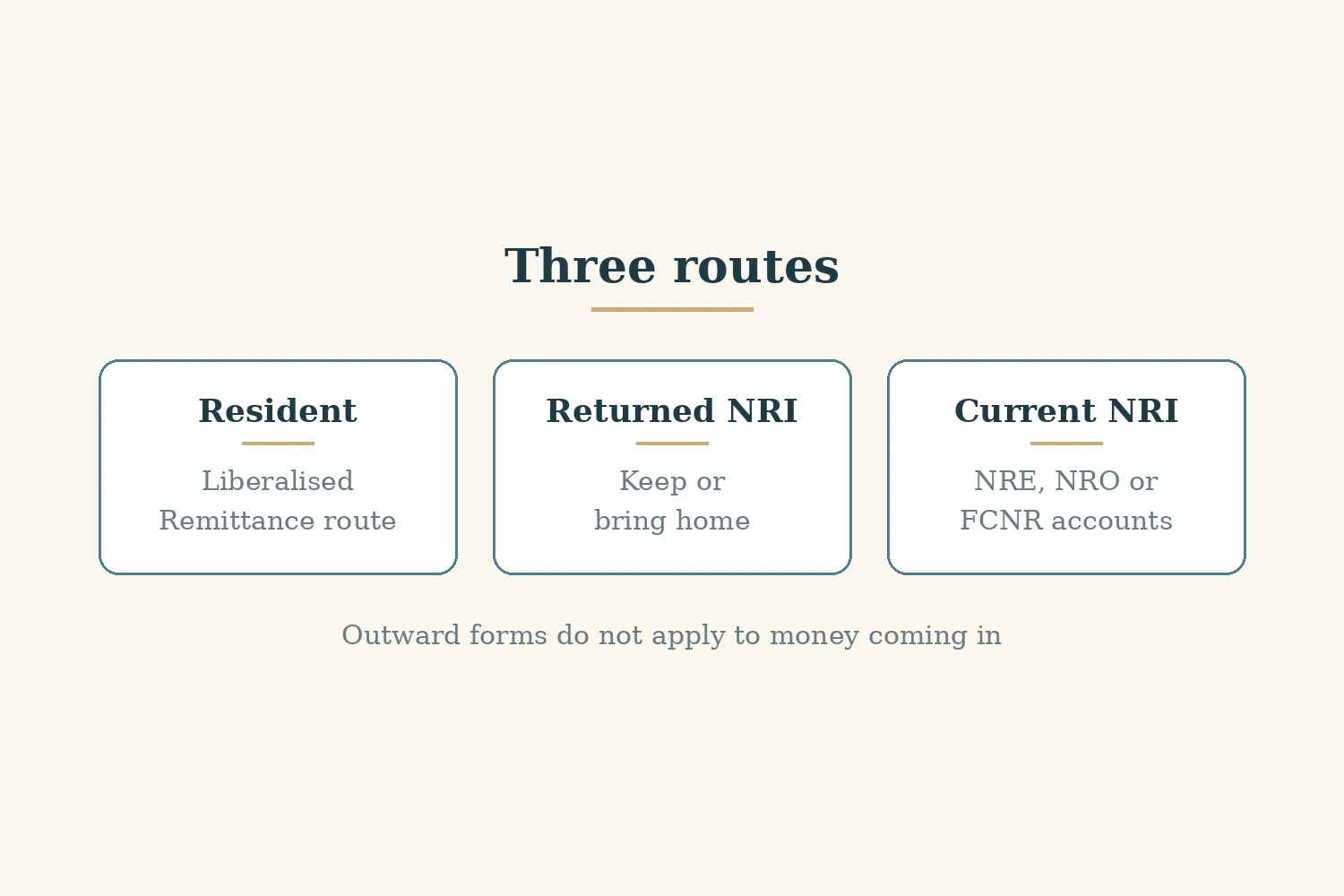
You have sold a property abroad and the money sits in a foreign bank account. Getting it into India is less about tax forms than people expect and more about one question: which Indian account may it land in, given who you are today? A non-resident Indian (NRI), a resident who bought abroad under the Liberalised Remittance Scheme (LRS), and an NRI who has since come home each walk a different route under the Foreign Exchange Management Act (FEMA) and the Reserve Bank of India (RBI) rules made under it. Two outward-only rules, Form 15CA and tax collected at source (TCS), are often wrongly applied to money coming in. This guide covers the India inbound leg only; for the Thai exit, see our guide to selling a Thai condo and moving the money out. It is not legal or tax advice.
It is also a different exercise from bringing home rental receipts from a Bali villa you still own. Rent is recurring income from an asset that stays abroad. Sale proceeds are a one-off receipt that ends the ownership, so the questions are which account takes the credit, what the bank needs to see, and whether India taxes the sale.
Two paths into an Indian account: NRI or resident
Start with your residential status for FEMA purposes, not the bank form. An NRI's foreign sale proceeds are an inward remittance to a non-resident account. For a resident, the rules depend on how the asset was acquired: with money sent out under the LRS, or while living abroad. Our guide to NRI, Overseas Citizen of India and person of Indian origin definitions explains the categories, and our explainer on foreign property ownership sets out how ownership abroad works in principle. See also our India guide.
Tax residence under the Income-tax Act is a separate test and can give a different answer.
The resident path under the Liberalised Remittance Scheme (LRS)
A resident individual may remit up to United States dollars (USD) 250,000 per financial year, April to March, under the LRS for permitted current or capital account transactions, including buying immovable property abroad under the overseas investment framework (RBI Master Direction on the LRS, updated as on 6 Sep 2024, read 9 Nov 2026). A Permanent Account Number (PAN) is mandatory and the remittance goes out on Form A2. The RBI's frequently asked questions (FAQ) on property purchase abroad by resident individuals list the LRS among several permitted routes (RBI FAQ, updated 6 Apr 2023, read 9 Nov 2026). Our guides to the LRS limit for buying property abroad and using the LRS to buy property abroad cover the purchase side.
The sale side turns on one paragraph. Under the same Master Direction, an investor who remitted under the LRS may retain and reinvest income earned on the investment. Foreign exchange that has been received, realised, left unspent or unused must, unless reinvested, be repatriated and surrendered to an authorised person within 180 days from receipt, realisation, purchase or acquisition, or from the date of return to India, under Regulation 7 of the relevant FEMA regulations (RBI Master Direction on the LRS, updated as on 6 Sep 2024, read 9 Nov 2026). The RBI's LRS FAQ restates the retain-or-reinvest choice and the 180-day surrender rule (RBI LRS FAQ, updated 6 Apr 2023, read 9 Nov 2026).
So a resident selling an LRS-funded property has two choices: reinvest abroad in a permitted way, or bring the money home through a bank within 180 days. Leaving it idle abroad indefinitely is not one of them.
One point surprises people. Bringing the money home does not give back any of that year's LRS limit. The LRS FAQ says that once USD 250,000 has been remitted in a financial year, the resident cannot make further LRS remittances that year even if investment proceeds have come back (RBI LRS FAQ, updated 6 Apr 2023, read 9 Nov 2026).
Returned NRIs and Foreign Exchange Management Act (FEMA) section 6(4)
If you bought the property while living abroad and later moved back to India, a different rule applies. FEMA section 6(4) lets a person resident in India hold, own, transfer or invest in foreign currency, foreign securities or immovable property outside India if it was acquired while the person was resident outside India, or inherited from a person resident outside India. The RBI clarified that income and sale proceeds of such assets need not be brought back to India (RBI A.P. (DIR Series) Circular No. 37, 19 Oct 2011, read 9 Nov 2026).
The RBI's Master Direction on miscellaneous matters consolidates the same list and says a returned resident may freely use these assets abroad, and income or sale proceeds received after return, for payments or fresh investments abroad without RBI approval, provided the cost is met only from those eligible assets and the transaction does not breach FEMA (RBI Master Direction, Miscellaneous, updated as on 13 May 2026, read 9 Nov 2026). Keeping the money abroad is a lawful choice.
If you do bring it home, a Resident Foreign Currency (RFC) account is designed for this. A resident may open one with foreign exchange received from converting assets acquired while non-resident, or inherited or gifted by a person resident outside India, and repatriated to India, and the balances are free of restrictions on use outside India (RBI Master Direction, Deposits and Accounts, updated as on 2 Sep 2026, read 9 Nov 2026).
The NRI path: Non-Resident External (NRE), Non-Resident Ordinary (NRO) and Foreign Currency Non-Resident (Bank) (FCNR(B)) accounts
For a current NRI, the sale proceeds of a foreign property sent through banking channels are an inward remittance, and the RBI deposits rules allow inward remittances into all three non-resident accounts (RBI Master Direction, Deposits and Accounts, updated as on 2 Sep 2026, read 9 Nov 2026):
- NRE account: inward remittances are a permitted credit, alongside interest, transfers from other NRE or FCNR(B) accounts and maturity proceeds of investments made from the account.
- NRO account: inward remittances from outside India are permitted credits, as are legitimate dues in India.
- FCNR(B) account: follows the same credit and debit pattern as the NRE account, held as a foreign-currency fixed deposit.
Because the money is foreign exchange arriving from abroad, the NRE or FCNR(B) account is usually the natural home; the NRO account is built for income that arises in India. The documentation is the authorised dealer (AD) bank's call.
Sending the sale proceeds of property in India out of the country is the opposite journey, with its own conditions in the RBI property FAQ (RBI FAQ, updated 6 Apr 2023, read 9 Nov 2026).
Form 15CA, Form 15CB and TCS: two outward rules that do not apply inbound
Forms 15CA and 15CB, renamed Form 145 and Form 146 under the Income-tax Rules, 2026 from 1 Apr 2026, are filed by the person paying a non-resident or a foreign company, before the money is remitted; they do not apply to sale proceeds coming into your Indian account (Income-tax Rules 2026, rule 220; Income Tax Department Form 145 FAQs, read 9 Nov 2026). If a branch asks for Form 15CA or Form 145 on an inbound credit, point to the purpose of rule 220 (formerly Rule 37BB).
TCS works the same way round. Under section 206C(1G) of the Income-tax Act, 1961, now section 394(1) of the Income-tax Act, 2025 for remittances from 1 Apr 2026, TCS is collected on remittances under the LRS and on overseas tour packages; our guide to TCS on foreign remittances for property covers the rates. It is collected when money leaves India. Central Board of Direct Taxes (CBDT) Circular No. 10/2023 of 30 Jun 2023 deals with putting TCS on LRS remittances and overseas tour packages into practice; we could not confirm its full text on the Income Tax Department site as of 9 Nov 2026, so it is not quoted here.
The TCS you paid when you sent the purchase money out is a tax credit, claimed in Schedule TCS of your income tax return for the relevant year (Income Tax Department, Schedule TCS page, read 9 Nov 2026). We could not confirm on any Income Tax Department page, as of 9 Nov 2026, that receiving foreign-property sale proceeds into an Indian account is itself a TCS event under section 206C(1G).
Tax on the sale, if it is chargeable in India
Whether India taxes the sale depends on your residential status under the Income-tax Act. A resident and ordinarily resident individual is taxed on global income; a resident but not ordinarily resident (RNOR) individual, a status many returning NRIs hold for a few years, and a non-resident are generally taxed only on income received or arising in India (Income Tax Department, residential status page, read 9 Nov 2026). Confirm your status for the year of sale with a tax professional.
Where the gain is chargeable in India and section 112 applies, the Finance (No. 2) Bill 2024 set out the rate on long-term capital gains (LTCG) at 12.5% for transfers on or after 23 Jul 2024, and 20% for transfers before that date, subject to the section's separate clauses for residents, non-residents and companies (Finance (No. 2) Bill 2024, read 9 Nov 2026).
Pay and document the source-country tax first. Relief for foreign tax is a treaty question for your adviser; our guide to double taxation treaties and Indian property income explains the mechanics for Indian-property income, a starting point rather than an answer for a foreign sale. Rent earned in India is a separate filing, covered in our guide to declaring Indian rental income.
The paper the bank will ask for
The RBI requires an AD bank to satisfy itself under FEMA section 10(5) that a transaction is genuine and to keep documents on record (RBI Master Direction on the LRS, updated as on 6 Sep 2024, read 9 Nov 2026). We could not confirm an RBI-published checklist for crediting foreign property sale proceeds as of 9 Nov 2026, so the lists below reflect what banks commonly ask for, not a numbered RBI form.
Resident who bought under the LRS
Sale agreement and transfer evidence, identity and know-your-customer (KYC) papers, the original outward remittance evidence (Form A2 and bank advice), and the realisation date for the 180-day window.
Returned NRI using section 6(4)
Sale and transfer evidence, proof the asset was acquired while resident outside India or inherited, KYC papers, and an RFC account request if you want to stay in foreign currency.
Current NRI
Sale and transfer evidence, KYC papers, and the account to credit, usually NRE or FCNR(B).
For Thailand, the purchase-side trail is covered in our guide to the Thai foreign exchange transaction form when money moves in, and the exit in the Thai condo guide above. If the property was held through a local nominee, read our piece on nominee ownership risk before you expect any bank to accept the paper. Our Dubai, Thailand and Bali guides and our guide to buying property in the United Kingdom, Singapore and the Gulf cover source markets.
Three things not to assume. No rule in the RBI pages cited here caps what you may bring back at what you originally sent out; the constraints are tax, where chargeable, and the bank's documentation. Bringing money back does not restore LRS headroom. Neither Form 15CA nor TCS applies to the inbound credit.
Who this is not for
This is not for NRIs selling property in India and sending rupees abroad, or for anyone bringing home rental income from a property still owned abroad. It does not cover the source-country exit, company-held property, inheritance or treaty relief calculations.
Where that leaves you
Decide which of the three you are before calling the bank. A resident who bought under the LRS should reinvest or bring the money home within 180 days, knowing it will not restore that year's limit. A returned NRI may keep the proceeds abroad under section 6(4) or bring them into an RFC account. A current NRI can credit an NRE, FCNR(B) or NRO account. In every case, Form 15CA and TCS belong to money going out, not coming in. Settle tax by residential status and keep the sale papers together.
Sources
- RBI Master Direction: Liberalised Remittance Scheme
- RBI FAQ: Liberalised Remittance Scheme
- RBI FAQ: Purchase of immovable property outside India by resident individuals
- RBI A.P. (DIR Series) Circular No. 37, 19 October 2011
- RBI Master Direction: Miscellaneous
- RBI Master Direction: Deposits and Accounts
- Income Tax Department: Form No. 145 (Earlier Form No. 15CA) FAQs
- CBDT Notification G.S.R. 740(E), 16 October 2023 (Rule 37BB)
- Income Tax Department: process document for Forms 15CA and 15CB
- CBDT Circular No. 10/2023
- Income Tax Department: Schedule TCS
- Income Tax Department: residential status
- Finance (No. 2) Bill 2024
Ready to find your next holiday home?
Browse our curated collection of vacation homes and managed farmland across India and beyond.