Buying Property in Oman as a Foreigner: Integrated Tourism Complexes Explained
If you have looked at Dubai first, you will arrive in Oman with a map in your head: find the zone where foreigners may buy, then pick a property inside it. Oman does not work like that. For a foreign buyer the question is not mainly where the land is but which project it belongs to. A foreigner's title rests on the specific development holding a licence as an Integrated Tourism Complex (ITC), and that licence brings conditions that buyers used to Dubai do not expect: deadlines to build, limits on selling, and residency that depends on what exactly you own. So buying property in Oman as a foreigner starts with the project's licence, not with the price. This guide is written for a high net worth individual (HNI) or non-resident Indian (NRI) weighing Oman next to Dubai, and it states as fact only what we could source. Where something could not be confirmed, we say so rather than guess.
Amounts are in Omani rials (OMR). We have not given United States dollar (USD) equivalents, because we could not confirm the exchange rate against a source that loaded; any conversion you see elsewhere should be checked against a current rate before you rely on it. If you are new to the general idea of owning abroad, our piece on foreign property ownership explained is a useful primer, and our Oman guide covers the country itself.
The legal basis: Royal Decree 12/2006 and the ITC regulation
Foreign ownership in Oman's tourism developments rests on Royal Decree No. 12/2006, which brought in the Real Estate Ownership Act for Integrated Tourism Complexes licensed by the competent authorities. Its Executive Regulation was prepared by the housing ministry together with the Ministry of Tourism. According to the chair of a law firm interviewed by the Times of Oman, the Act has been amended up to Royal Decree 76/2010, and the Executive Regulation, Ministerial Decision 191/2007, has been amended up to Ministerial Decision 109/2022.
That amendment history comes from a newspaper interview, not from the legal text itself; the decree as first issued can be read on qanoon.om, an Omani legal database. Treat the decree numbers as a guide to what your lawyer should pull, not as a substitute for reading the current consolidated text.
The practical consequence is simple. Because the right to own comes from the project's ITC licence, the first document worth seeing is evidence that the project holds that licence. A sales brochure that describes a project as freehold is not the same thing.
What an ITC title actually lets you do
The rules below are as described in the Times of Oman interview. The ownership of units and plots, the build deadline and its extension, the mortgage exception and residency for owners of completed units also appear in the decree text on qanoon.om; the Musandam usufruct and the investor visa for plot owners rest on the interview alone. Confirm them with a lawyer before you sign.
Omani and non-Omani individuals and companies may own built units or plots of land inside an ITC. There is a regional exception: in Musandam, non-Omanis are limited to built units, held under a usufruct, a right to use and benefit from the property, of up to 99 years. Elsewhere, ownership is not described with that limit.
The rule that most surprises buyers concerns plots. If you buy a plot rather than a finished unit, you must build on it within four years, with a possible extension of up to two more, so up to six years in total (4 + 2). Until the building is complete you cannot sell the plot. The one exception described is a mortgage to finance the construction itself. In other words, a plot in an ITC is not a piece of land you can hold and trade; it is a commitment to build.
That changes the risk. A buyer who sees a plot as a low-cost way into a growing project is in fact signing up to a construction budget and a deadline. If either slips, the plot cannot simply be sold on. For a contrast with another market where foreigners face their own set of structural limits, see our guide to owning property in Thailand as a foreigner.
Residency through ownership: what the property gives you
Residency is the other reason many buyers look at Oman, and it too depends on what you own. According to the same Times of Oman source, owners of a completed unit in an ITC receive renewable residency for themselves and their first-degree relatives. Owners of a plot receive a multi-entry investor visa, renewed every two years.
So two buyers in the same development can end up with different residency positions. The owner of a finished villa has a renewable residence; the owner of a plot still waiting to be built has a visa that must be renewed every two years until the building is complete.
Oman has also promoted a separate long-term investor residency, sometimes called Golden residency, with its own value thresholds and recent changes. We could not confirm the current thresholds or the rules for it on a government page, so we do not quote any figure here. If long-term residency is the main reason you are buying, get the current terms from the relevant Omani authority in writing first.
What it costs: the 3% fee and the fixed fees, worked on OMR 100,000
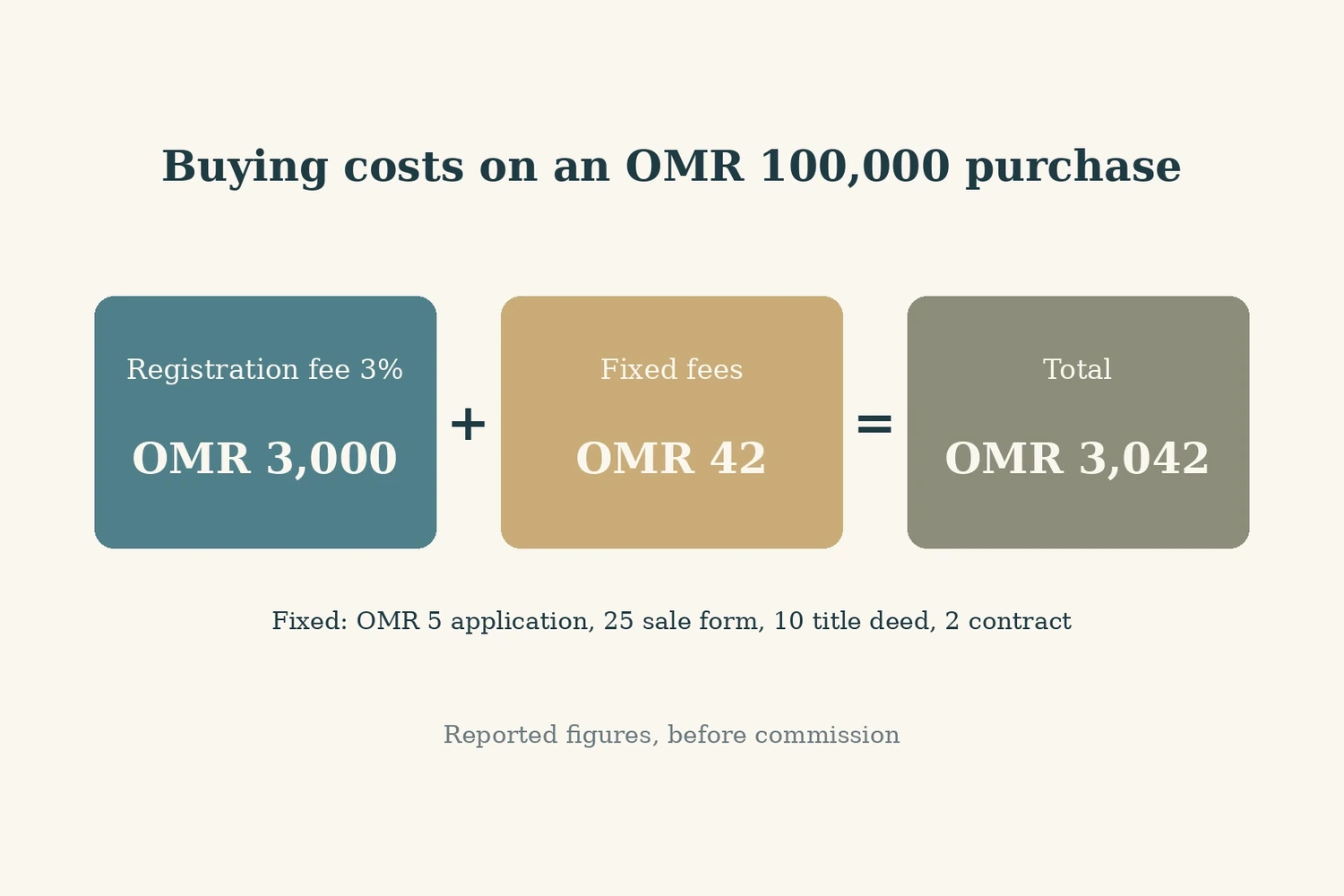
The main transaction cost is a registration fee of 3% of the sale value. Two secondary sources, the property guide published by Damas and a service guide from Al Tareq Group, both citing the service guide of the Ministry of Housing and Urban Planning (MHUP), attribute it to Ministerial Decision 570/2025, the ministry's fees regulation. They also list fixed fees of OMR 5 for the application, OMR 25 for the sale form for non-Omanis, OMR 10 for the title deed and OMR 2 for the contract. We have not read the decision on the ministry's own site, so these are reported figures, not confirmed ones.
On a purchase at OMR 100,000, the arithmetic is:
- Registration fee: 100,000 x 3% = OMR 3,000.
- Fixed fees: 5 + 25 + 10 + 2 = OMR 42.
- Total: 3,000 + 42 = OMR 3,042, or about 3.04% of the price.
Two things are missing from that sum. First, we do not know whether the 3% is paid by the buyer, the seller, or split by contract; our sources do not say, so check the sale agreement. Second, agency commission is not included, because we found no source for commission norms in Oman. Ask the agent to state their fee and who pays it in writing. If you are comparing with Dubai, our breakdown of Dubai property transaction costs shows the same exercise there.
Financing, resale and the things we could not confirm
The only financing rule we can state from our sources is the one already mentioned: a plot in an ITC can be mortgaged to finance construction, even though it cannot be sold before completion. Whether Omani banks lend to non-residents buying finished units, and on what terms, we could not confirm. Our general piece on financing a property purchase abroad sets out the questions to ask any lender.
The same applies to tax inside Oman. Claims about a municipal tax on rental income, the absence of property or capital gains tax, and a planned personal income tax circulate widely, but we found them only in secondary material, so we do not state them. Ask a local tax adviser what applies to your case before you build any return assumptions.
Resale has one firm rule, the bar on selling an unbuilt plot, and otherwise depends on the project. A buyer of a completed unit should ask the developer what the resale process is, and whether the project's licence places any condition on who may buy from them.
Oman next to Dubai: where the comparison holds
The comparison is useful but only up to a point. In Dubai, foreign ownership is largely a question of which area a property is in; our explainers on buying property in Dubai as a foreign buyer and on Dubai freehold and leasehold zones cover how that works, and our Dubai guide and UAE guide give the wider picture. In Oman, the question is which project, and whether it holds an ITC licence.
That difference changes the order of due diligence. In Dubai you can start with the location and work inwards. In Oman you start with the licence, then the type of title (built unit, plot, or usufruct in Musandam), then the conditions attached, and only then the price. The cost side, on the reported figures, is a single percentage plus a few fixed fees, similar in shape to Dubai though not in amount.
Several Avacasa listings sit in AIDA in Muscat, and our Muscat guide describes the area. We have not verified whether AIDA holds ITC status, so nothing here should be read as a statement about it; that is exactly the question to put to any developer, ours included.
The Indian side: Liberalised Remittance Scheme and TCS
For a buyer remitting money from India, the purchase goes through the Liberalised Remittance Scheme (LRS), and the bank collects Tax Collected at Source (TCS) on the remittance. Under the Finance Act 2025, effective from 1 April 2025, the threshold below which no TCS applies was raised from 7 lakh to 10 lakh Indian rupees (INR) per financial year. Above it, the rate for purposes other than education or medical treatment is 20%, as set out in a TCS FAQ published by SBM Bank India. The same FAQ says the INR 10 lakh threshold is a combined limit across all LRS purposes and all authorised dealer banks, not a limit per bank. From 1 April 2026, according to a notice from HDFC Bank on TCS rates for LRS remittances, the rule is unchanged in substance: nil up to INR 10 lakh a financial year, and 20% above it for purposes other than education or medical treatment, with the threshold still combined across all banks.
On a remittance of INR 1 crore in one financial year, with no other LRS remittances that year:
- First INR 10 lakh: nil TCS.
- Remaining INR 90 lakh (1 crore less 10 lakh) x 20% = INR 18 lakh TCS.
- Effective rate on the whole remittance: 18 lakh divided by 1 crore = 18%.
Our pieces on TCS on foreign remittances for property, the LRS limit for buying property abroad and the fuller LRS guide go into the detail. The overall LRS cap, the reporting of overseas property, and disclosure duties are covered in those posts and in our explainer on the Black Money Act and foreign property; we have not restated them here because we did not re-check them for this piece. NRIs living in the Gulf, the United Kingdom or Singapore should also read our piece on buying abroad from the UK, Singapore and the Gulf Cooperation Council (GCC).
Who this is not for
Oman's ITC route does not suit a buyer who wants a plot to hold and trade. The build deadline and the bar on selling before completion make that impossible by design. It is also a poor fit for anyone whose decision rests on a residency figure or a tax position they have not seen in writing from a government source, because several of the numbers in circulation could not be confirmed. And if you need to borrow locally as a non-resident, you should treat financing as unknown until a bank has given you terms.
Where that leaves you
Buying in Oman is less a question of geography than of paperwork. The order of questions is fixed: does the project hold an ITC licence; what exactly will you own, a built unit, a plot or, in Musandam, a usufruct; what conditions follow from that, including the build deadline for plots; and what residency does that ownership give you. The costs, on the reported figures, are modest and easy to calculate, about OMR 3,042 on an OMR 100,000 purchase before commission. What is harder is everything we have marked as unconfirmed, and those are the points to settle with a local lawyer before money moves.
Sources
- Times of Oman: legal framework governing foreign ownership in ITCs
- Damas: Oman property buying costs
- Al Tareq Group: MHUP services guide 2026
- Finance Act 2025
- SBM Bank India: TCS on LRS FAQs
- HDFC Bank: revision in TCS on LRS transactions from 1 April 2026
- Qanoon: Royal Decree 12/2006
Ready to find your next holiday home?
Browse our curated collection of vacation homes and managed farmland across India and beyond.