Undeclared Foreign Assets: The Black Money Act Exposure

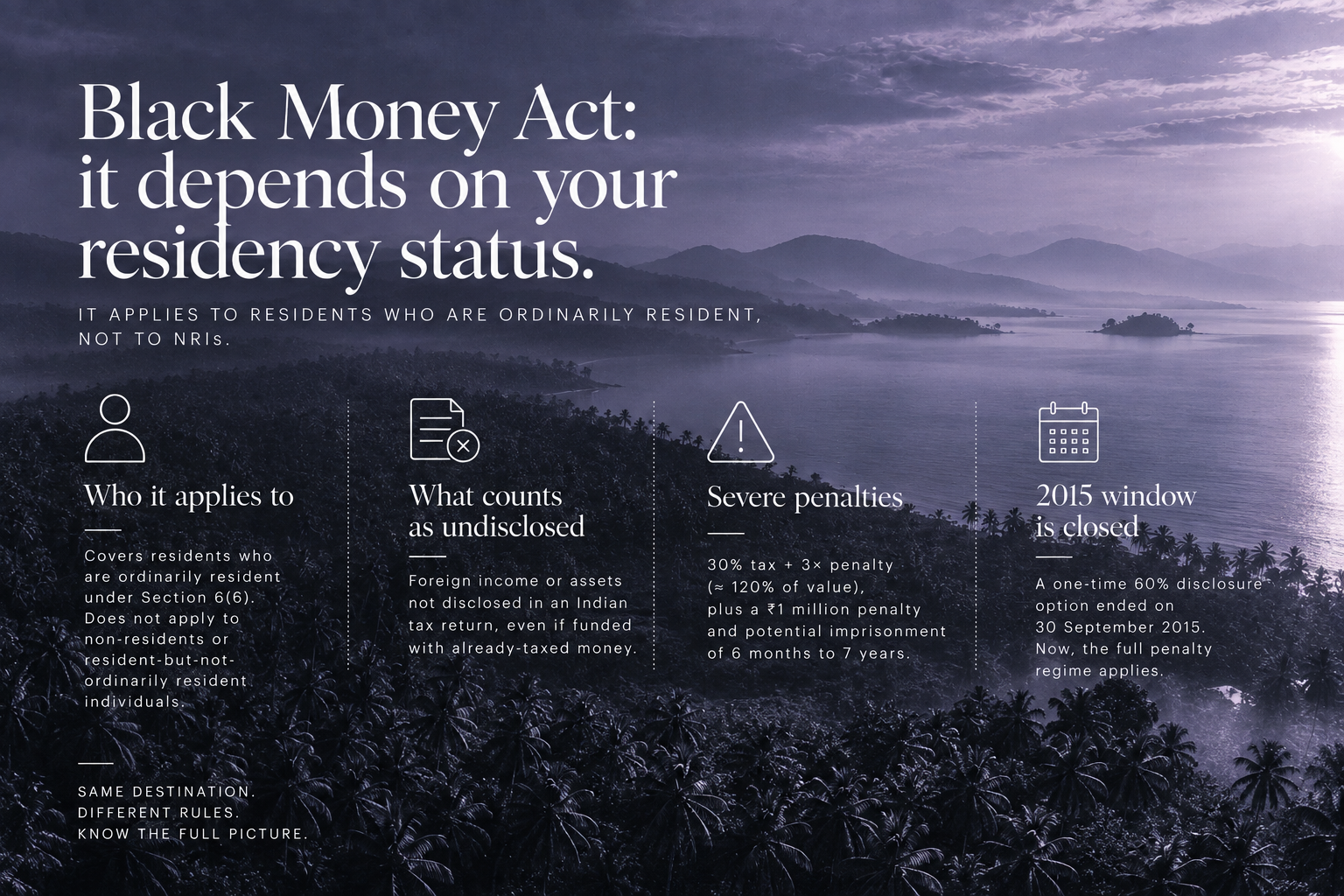
The Black Money Act carries a real, specific exception that most of the anxiety around it ignores: it applies to residents who are ordinarily resident, and not to someone holding NRE or NRO status while genuinely non-resident. Getting this distinction right matters more than almost anything else in this area, because the penalties on the wrong side of it are severe enough that a buyer needs to know with certainty which side they actually fall on, not assume it based on citizenship or where the property happens to sit.
What the Act actually covers and who it applies to
The Black Money (Undisclosed Foreign Income and Assets) and Imposition of Tax Act, 2015 covers undisclosed foreign income and foreign assets held by a person who qualifies as resident and ordinarily resident under Section 6(6) of the Income Tax Act. A person holding non-resident or resident-but-not-ordinarily-resident status is not covered by this Act, which means the single most important question for anyone with an overseas property is not whether the asset exists, but which of these residency categories actually applies to them for the relevant assessment year, since that status can change from year to year as circumstances evolve.
What counts as undisclosed, and why the definition is broader than it first appears
Undisclosed foreign income and assets include income from a foreign source that was not disclosed in a filed return, income from a foreign source for which no return was filed at all, and the value of any foreign asset that itself was never disclosed, regardless of whether the funds used to acquire it were ever taxed anywhere. A property purchased entirely with legitimately earned and already-taxed money can still trigger exposure under this Act if the asset itself, its existence, was never disclosed in the required schedule of foreign assets on an Indian tax return during a year the individual held ordinarily resident status.
The penalties are genuinely severe, not a minor compliance footnote
Failing to disclose a foreign asset, or providing inaccurate information about one, carries a penalty of 1 million rupees under the Act, alongside potential imprisonment ranging from six months to seven years. Where undisclosed foreign income or assets are actually detected during an assessment, tax applies at a flat 30 percent rate, with an additional penalty equal to three times that tax, producing an effective exposure of roughly 120 percent of the asset's value, on top of the same prosecution risk. This is a materially harsher regime than the ordinary income tax penalty structure applied to domestic non-disclosure, and it reflects the specific policy intent behind the Act rather than an oversight in drafting.
The compliance window that closed, and why late disclosure now is genuinely worse than it would have been
The Act offered a one-time voluntary compliance opportunity in 2015, allowing disclosure at a combined 60 percent rate, 30 percent tax plus a 30 percent penalty, rather than the full penalty regime. That window closed on 30 September 2015, and any disclosure made after that date, whether voluntary or discovered through assessment, faces the full penalty and prosecution framework described above rather than the more moderate terms that were briefly available. A buyer who assumes a similar amnesty opportunity might reappear, and delays addressing an undisclosed asset on that assumption, is taking on real and escalating risk the longer disclosure is postponed.
What this means for an NRI returning to India
An NRI who has held foreign property for years while genuinely non-resident, and who then returns to India and becomes ordinarily resident, needs to disclose existing foreign assets going forward from the point their residency status changes, and should review their full foreign asset holdings carefully at that transition rather than assuming continuity of non-resident status protects assets acquired before the move. Inheritance and Succession of Indian Property for NRIs and Declaring Indian Rental Income: ITR and Compliance cover related compliance questions that similarly turn on residency status rather than citizenship or nationality alone.
What Avacasa recommends
Determine actual residency status under Section 6(6) for each relevant assessment year before assuming the Black Money Act does or does not apply, since this status, not citizenship or where the property sits, is what actually decides exposure. Disclose foreign assets in the required schedule on any Indian return filed during a year of ordinarily resident status, regardless of how the asset was funded, and treat any existing gap in past disclosure as an urgent matter for professional advice rather than something to defer.
Before you commit
Can Foreigners Own Property Abroad? Freehold, Leasehold and Use Rights covers the ownership structures this disclosure obligation sits on top of, and Liberalised Remittance Scheme: How Much You Can Send Abroad and TCS on Foreign Remittances: Rates, Thresholds and Credits cover the compliance layers that apply at the point of remittance itself, before this disclosure obligation even arises. Due Diligence When Buying Property in Another Country, 10 Questions to Ask Before Signing Anything and How to Verify a Developer's Track Record round out the wider checklist.
Sources
- The Black Money Act's applicability to ordinarily resident individuals specifically, and its exclusion of non-resident and RNOR status_and_Imposition_of_Tax_Act,_2015)
- Penalty structure including the 1 million rupee non-disclosure penalty, the 120 percent effective exposure on detected assets, and the closed 2015 compliance window
Ready to find your next holiday home?
Browse our curated collection of vacation homes and managed farmland across India and beyond.