Muscat Through the Year: Heat, the Cool Season and Coastal Life

Muscat does not have four seasons so much as two. For roughly five months of the year the days are warm rather than hot and the nights are mild; for the other five, daytime highs sit in the high 30s degrees Celsius (C) and the nights barely cool. For a non-resident Indian (NRI) thinking about a second home on Oman's coast, that split decides almost everything: when you will actually use the house, when to visit and inspect it, and what the house needs to cope with while you are away. This guide walks through the year using official climate normals, the city's main winter festival and the two cyclone windows, then turns to what the climate means for a home bought off plan.
The short version: two seasons, not four
The figures here come from the World Meteorological Organization (WMO) World Weather Information Service, which publishes climate normals supplied by national weather services. For Muscat it gives figures for the Seeb station, with a base period of 1986 to 2009 (WMO, read 3 November 2026). Oman's own Directorate General of Meteorology, now at met.caa.gov.om under the Civil Aviation Authority, offers an interactive climate tool, but its monthly values could not be read as plain text, so we use the WMO normals throughout.
On those normals, the coolest month is January, with an average daily high of 25.1 degrees C and an average low of 16.7 degrees C. The hottest is June, with an average high of 40.0 degrees C and an average low of 30.3 degrees C. Average highs are 35 degrees C or more in every month from May to September. Rain is scarce: adding the twelve monthly averages gives about 89.7 millimetres a year, and the wettest month, December, averages 16.5 millimetres over 1.4 rain days.
So the useful way to think about Muscat is a cool season from about November to March, a hot season from May to September, and two short shoulder months, April and October, in between. Our Muscat guide and Oman guide describe the city and country more broadly.
November to March: the season the home is for
This is the stretch most second-home owners will plan around. On the WMO normals, November averages a high of 30.3 degrees C and a low of 20.8 degrees C. December cools to 26.8 and 18.3, January to 25.1 and 16.7, February sits at 26.4 and 17.8, and March warms again to 29.5 and 20.3.
This is also when most of the year's little rain falls. December to March together average 16.5 plus 13.2 plus 14.0 plus 16.4, which is 60.1 millimetres. Divided by the yearly 89.7, that is about two thirds of the annual total in four months. Even then, the busiest month for rain, January, averages only 3.2 rain days. Rain is uncommon, but when it comes it is concentrated in these months, so it is worth knowing how a house and its access road drain.
For an owner, these months are the obvious time to stay, to host family, and to schedule site visits and snagging inspections on a home that is being built. Humidity, sea temperature and the timing of the daily sea breeze we could not confirm from an official source as of 3 November 2026, so we give no figures for them.
January and Muscat Nights
January brings Muscat's main public winter festival, Muscat Nights. The 2026 edition ran from 1 to 31 January 2026 and was organised by Muscat Municipality; the Municipal Council of Muscat Governorate reviewed the municipality's programme and noted events spread across several main sites in the governorate (Muscat Municipal Council, read 3 November 2026).
The dates for a 2027 edition we could not confirm from an official source as of 3 November 2026. If you want to be in Muscat for the festival, check the municipality's announcements before you book.
April and October: the shoulder months
April and October are almost mirror images on the WMO normals. April averages a high of 34.7 degrees C and a low of 24.2 degrees C; October averages 34.6 and 24.2. Both are warmer than any month of the cool season, but below the peak of summer.
They differ in one way that matters. October falls inside one of the two cyclone windows described below, and April does not. A visit in October can be pleasant, but it is worth following the official weather service before and during the trip. Both months also work as arrival and departure points: opening the house in October, or closing it up in April.
May to September: heat, and nights that stay warm
From May to September, Muscat is hot by day and warm by night. On the WMO normals, average highs run 39.6 degrees C in May, 40.0 in June, 38.0 in July, and 35.6 in both August and September. The nights are the bigger change for most visitors: average lows are 28.7 in May, 30.3 in June, 30.1 in July, 28.2 in August and 26.8 in September. In June, the gap between the average high and the average low is 40.0 minus 30.3, which is 9.7 degrees, so the evening brings little relief.
Rain is almost absent in most of these months; May and September average 0.0 millimetres and 0.0 to 0.1 rain days. June is the exception on paper, averaging 10.9 millimetres over just 0.1 rain days. June also falls inside one of the two cyclone windows described below.
For a second home, these are the months the house is most likely to stand empty, and also the months it is under the most stress.
Cyclone windows, and what Gonu and Shaheen showed
Oman's Directorate General of Meteorology says there are two tropical cyclone seasons in the North Indian Ocean, which includes the Arabian Sea: the first in May and June, the second in October and November (Directorate General of Meteorology, read 3 November 2026).
Two recent storms fall inside those windows. The India Meteorological Department (IMD), in its report on Gonu, describes it as the first super cyclone on record over the Arabian Sea, active from 1 to 7 June 2007, which crossed the Oman coast near Muscat in the early hours of 6 June 2007, in Coordinated Universal Time (UTC), as a very severe cyclonic storm, per the IMD report (read 3 November 2026).
Cyclone Shaheen came in the autumn window. Oman's Directorate General of Meteorology says it made landfall on 3 October 2021, at about 20:00 local time, as a Category 1 cyclone on the coast of Al-Musannah, with sustained winds of 75 knots, or 139 kilometres an hour, recorded at Said Bin Sultan Naval Base. The greatest impact was from Al-Musannah to Sohar, and the National Committee for Emergency Management recorded 12 deaths from flooding (Directorate General of Meteorology, read 3 November 2026). How much damage either storm did in Muscat specifically we could not confirm from an official source as of 3 November 2026.
Gonu fell in June and Shaheen in October, both inside the two official windows. An owner of a Muscat home should know both windows and plan the empty months around them.
What the heat asks of a house, and what to check off plan
A home that will spend much of the hot season empty needs a few things that a brochure rarely shows. Cooling should be sized for the peak months, when average highs reach 40 degrees C and nights stay near 30. Shade, the orientation of glazing and the position of terraces affect how hard that cooling has to work. Drainage around the house and on the access road matters for the rare heavy rain. And there needs to be a plan for the empty months: who checks the house, who runs the cooling, and who acts if a cyclone warning is issued.
For an unfinished home, these are questions for the plans and the contract, not the sales gallery. Ask to see the cooling specification, the elevations showing shade and orientation, the site drainage, and the maintenance arrangements during handover. Our guides to buyer protection for under-construction homes and cross-border due diligence set out the wider checks.
On ownership, Oman has its own rules for foreign buyers; our guide to buying property in Oman as a foreigner covers them. The text of Royal Decree 12/2006 on ownership in integrated tourism complexes we could not confirm from an official source as of 3 November 2026, and whether any particular development holds that status, or what its licence and project status are, we also could not confirm. For comparison across the region, see our guides to foreign ownership by emirate in the United Arab Emirates, Dubai's freehold and leasehold zones, buying in the UK, Singapore and the Gulf and foreign ownership in the other markets we list, plus our Dubai guide.
As listed on avacasa.life on 3 November 2026, we had 12 listings in Oman, all in one development in Muscat and all marked under construction by the seller. Seven were priced, from about OMR (Omani rial) 61,300 to about OMR 807,700, rounded to the nearest hundred; the rest were on request. We have no exchange rate to hand, so we have not converted them.
Who this is not for
This is not for anyone who wants a home to use mainly in summer; on the official normals, Muscat from May to September is hot by day and warm by night. It is not legal or tax advice, and it does not cover residency rules, which our guide to visas linked to property discusses. It makes no claim about what a home might earn when you are not using it.
Where that leaves you
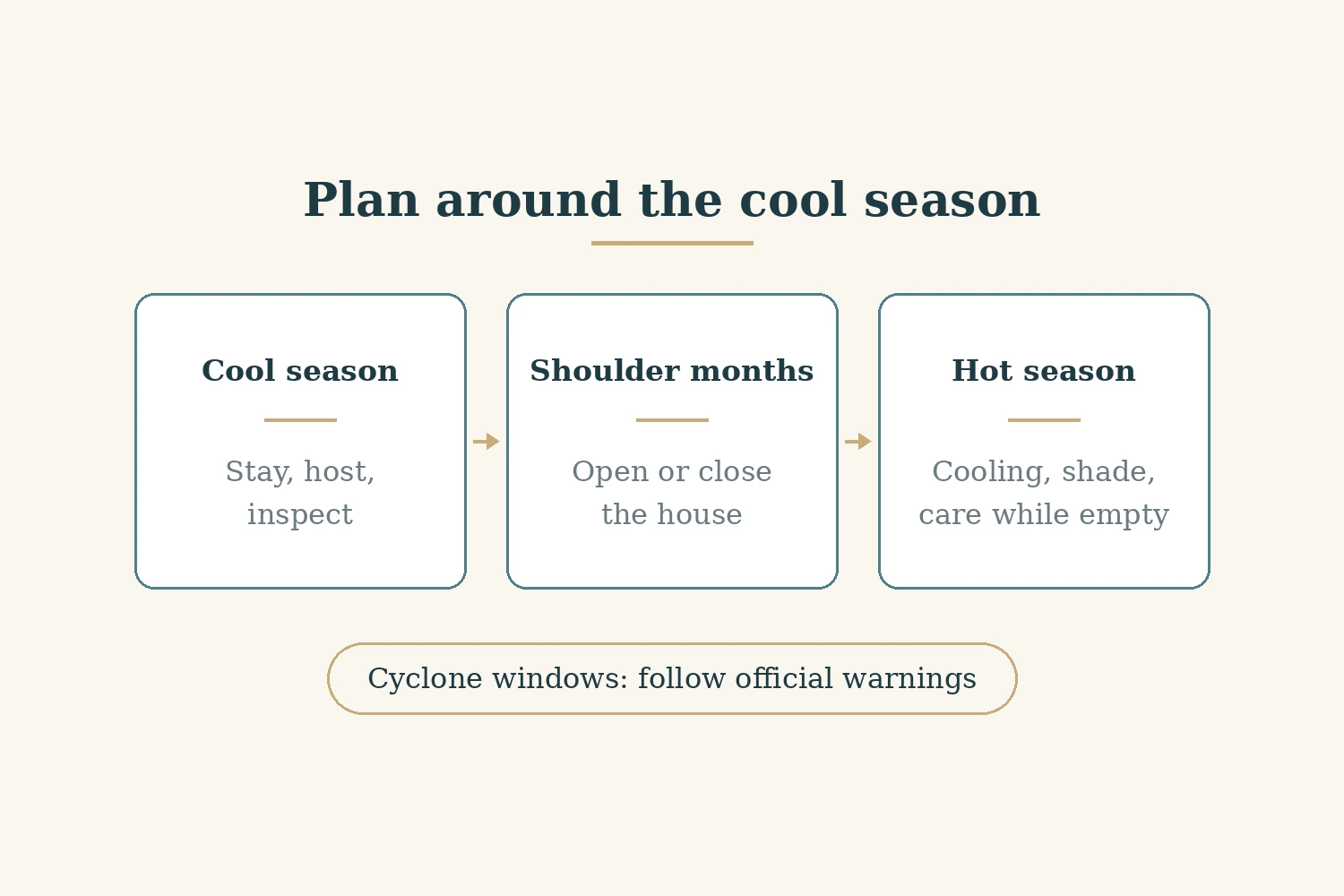
Treat a Muscat home as a cool-season home, and plan the year around that:
- November to March: stay, host, and inspect. Average highs 25 to 30 degrees C, and most of the year's rain. January brings Muscat Nights, with 2027 dates to be confirmed.
- April and October: open or close the house. Average highs near 35 degrees C, and October sits in a cyclone window.
- May to September: expect the house to be empty and working hard. Average highs 35.6 to 40.0 degrees C, nights near 27 to 30, and May and June in a cyclone window.
Then check the plans for cooling, shade, drainage and empty-month care before you sign. Our guide to Chikmagalur through the year takes the same approach for a hill town in India.
Sources
- WMO World Weather Information Service: Muscat (Seeb) climate normals, 1986 to 2009
- Directorate General of Meteorology, Oman: tropical cyclones
- Directorate General of Meteorology, Oman: Cyclone Shaheen, 1 to 4 October 2021
- India Meteorological Department: report on super cyclonic storm Gonu
- Muscat Municipal Council: Muscat Nights 2026 programme (Arabic)
Ready to find your next holiday home?
Browse our curated collection of vacation homes and managed farmland across India and beyond.