How to Read a Rental Yield Claim: Five Questions to Ask First

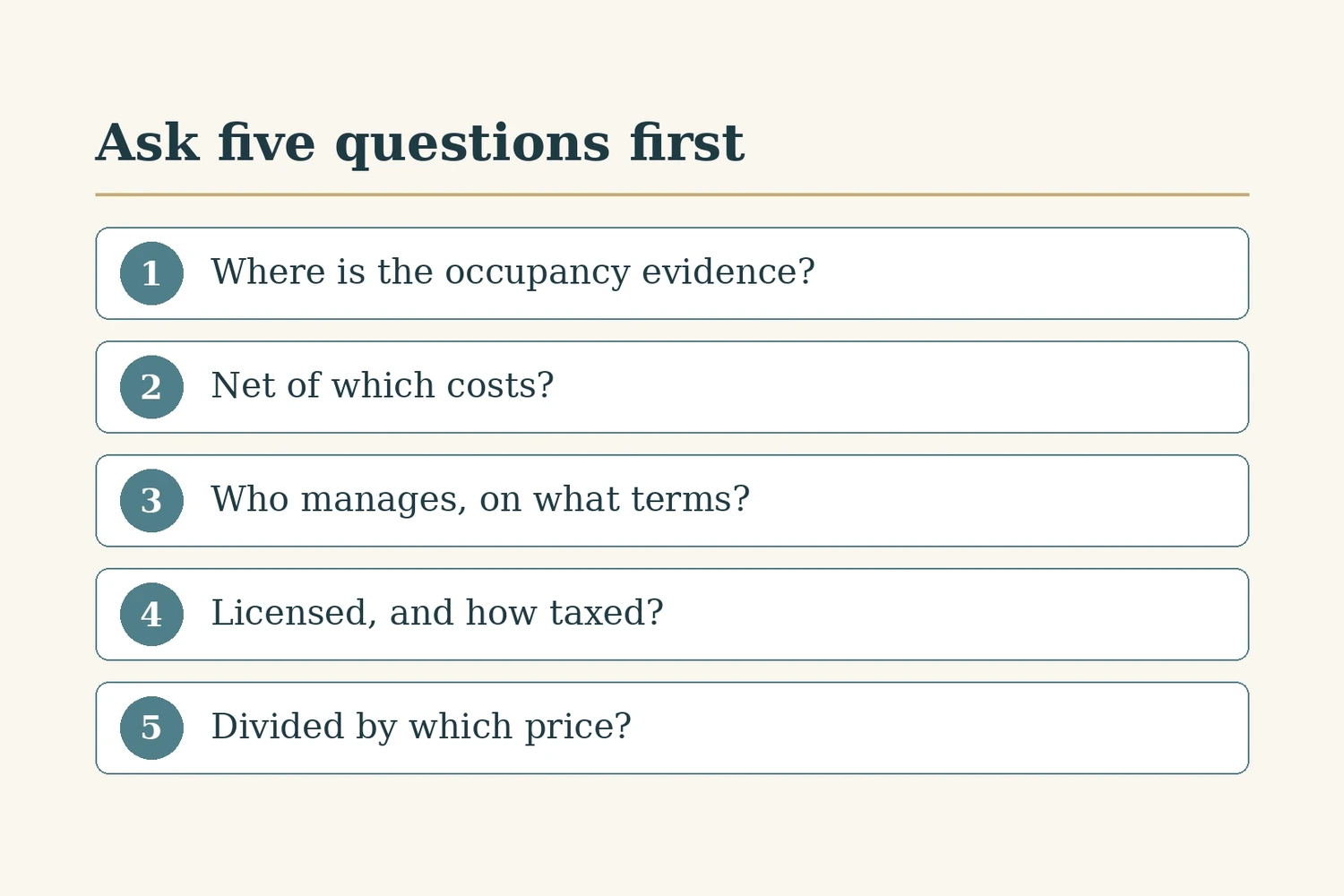
A rental yield figure is usually the most confident number on a brochure and the least explained. It sits next to the price, it reads like a fact, and it rarely comes with the working behind it. That does not make every figure wrong. It means the number on its own tells you very little, and the useful work is in the questions you ask before you rely on it. This guide sets out what a headline yield leaves out, then five questions to put to any yield claim you see: in a developer's brochure, in an agent's message, in an article or on a listing page, including the listings on property sites like this one. If the seller can answer all five with documents, you can build your own net figure. If they cannot, the headline figure has nothing behind it you can check.
What a headline yield figure leaves out
In its simplest form, a gross yield is one year's assumed rent divided by one price. Both halves of that sum are choices. The rent is an assumption about how often the property will be let and at what rate. The price is whichever figure the seller chose to divide by. Nothing in the result tells you which assumption was used for either.
What the gross figure leaves out is everything between the rent and your bank account: service or common charges, utilities, upkeep, replacing furniture, insurance, booking-platform fees, cleaning between guests, the weeks the property stands empty, management fees, tax and any loan interest. Some of these are fixed and arrive whether or not the property is let. Others rise and fall with bookings. A figure described as "net" can still leave several of them out.
A yield is also a forecast dressed as a measurement. A figure based on a busy season, a launch-year promotion or another building's results can be honest about its own inputs and still be a poor guide to your unit. The five questions below are a way to turn the headline back into its inputs, so you can judge each one separately.
Question one: where is the occupancy evidence?
Ask what level of letting the rent assumes, and ask to see the evidence for it. The strongest evidence is a record from units like yours: payout statements from booking platforms or signed leases from comparable units in the same building or estate, covering at least one full year, including the low season. A year matters because a holiday market can look very different in its best and worst months.
A forecast, a "market average" or a figure from a different building is not evidence for your unit. It may be a reasonable starting point, but it should be labelled as an assumption, not presented as a result. If the occupancy cannot be shown, treat the whole yield figure as an assumption too. Our guide to holiday rental management overseas explains how occupancy, rate and season interact for a second home that is let out.
Question two: net of which costs?
Ask for the list of costs that have already been taken off, and tick it against the full list: service or common charges, utilities, a maintenance reserve, replacing furnishings, insurance, platform fees, cleaning and turnover between stays, vacancy, and loan interest if you are borrowing. "Net" with no list attached should be read as gross.
The fixed costs are the ones most often missing, because they arrive whether or not the unit is let. Building charges are a good example: in a managed building they are set by the building's own budget and can change. Our guides to Dubai service charges and running costs and the real cost of owning a villa in Bali show how these costs are made up in two markets, and our Bali guide and Dubai guide describe the places themselves.
Question three: who manages it, and on what terms?
Ask who will run the rental, what they take, and for how long you are tied to them. A manager may take a share of revenue, a fixed fee or both, and the contract may lock you in for a term. Ask what you can do if bookings fall short, and what happens if the operator leaves or the building's management changes.
Be especially careful with programmes that promise a fixed rental return for a set period. The promise is a contract term, not a fact about the property. Read it as a contract term: who makes the promise, for how long, what it is calculated on, what conditions apply, and what happens when the term ends or the operator exits. A promise from a developer or operator is only as strong as the party behind it and the contract that sets it out. Once the term ends, the property earns whatever the market pays. Our guide to checking a developer's track record covers how to judge the party making the promise.
Question four: is it licensed, and how is the income taxed?
Ask whether short-stay letting is allowed for this specific unit. Building rules, a local licence or a registration may all apply, and they vary by market and sometimes by building. A rental that cannot legally be let short-term earns nothing from short stays, whatever the brochure says.
Then ask how the rental income is taxed, both where the property is and where you live. Tax comes off whatever the property earns, and for a buyer abroad two tax systems may both apply. For Indian residents and Non-Resident Indians (NRIs), our guides to declaring Indian rental income and the Double Taxation Avoidance Agreement (DTAA) and property income explain the home side. For one overseas market, our guide to Thai property taxes and fees covers the local side, with our Phuket guide describing the island.
Question five: what price is the rent divided by?
Ask what the denominator is. It might be the list price, a launch price, a discounted price, or the full cost of buying, including transfer taxes, registration, fees and furnishing. The same rent divided by a smaller price gives a bigger percentage, so a figure built on the lowest available price will look better than one built on what you will actually pay.
The fairest denominator for you is your own all-in cost: what leaves your account to complete the purchase and make the property ready to let. Ask the seller to state which price they used, and rebuild the sum on yours. Our explainer on foreign property ownership covers the ownership structures that can add costs in some markets.
What India's advertising code says about claims
In India, the Advertising Standards Council of India (ASCI) publishes a general code that applies to advertisements of all kinds. It does not single out yield claims, and nothing here suggests it bans them. But three of its general principles, in chapter I of the code (read on 25 October 2026), map neatly onto the questions above. In our paraphrase:
- Claims about matters of objectively ascertainable fact should be capable of substantiation, and advertisers should produce that substantiation when ASCI asks for it (clause 1.1).
- Where a claim is said to rest on independent research or assessment, the advertisement should give the source and date (clause 1.2).
- Advertisements should not mislead by implication, omission, ambiguity or exaggeration (clause 1.4).
ASCI's half-yearly complaints report for April to September 2024 named real estate as the most violative sector among the cases it investigated (read on 25 October 2026). ASCI also reported that it reviewed Maharashtra property advertisements for mandatory disclosures, such as the project registration number and quick response (QR) code, under an arrangement with the Maharashtra real estate regulator. That is a finding about complaints and disclosures, not about yield figures, and we do not suggest that any particular project has breached anything. It is a reminder that a claim in an advertisement is still a claim, and the questions above are a fair way to test it.
Who this is not for
This guide is not for a buyer who is purchasing purely to live in the property and has no plan to let it. It is not a calculator and gives no figures to compare against, by design. It does not set out the legal remedies open to a buyer misled by an advertisement in any market, or the rules in any market other than the general advertising code in India. And it is not tax advice: the tax treatment of rental income depends on your residence and the market, and needs checking with an adviser in each.
Where that leaves you
A yield figure is a summary of assumptions. The five questions turn it back into those assumptions: the occupancy evidence, the costs taken off, the manager and contract, the licence and tax, and the price it was divided by. If a seller can document all five, you can build your own figure, on your own costs and your own price. If they cannot, you have learned something about the claim. The same questions apply to any figure you see, wherever it appears. Our questions to ask a Bali developer and cross-border due diligence guide put them alongside the title and legal checks, and our Goa guide covers a home market where many second homes are let.
Sources
- Advertising Standards Council of India: Code and Guidelines book
- Advertising Standards Council of India: press release, half-yearly complaints report 2024-25
- Advertising Standards Council of India: half-yearly complaints report 2024-25
Ready to find your next holiday home?
Browse our curated collection of vacation homes and managed farmland across India and beyond.