DAMAC and Sobha Master Communities: Who Controls What
Buy a villa or apartment in a large Dubai master community, such as DAMAC Hills, DAMAC Lagoons or Sobha Hartland, and you are signing up to two sets of rules at once: those of your building and those of the whole community around it. The master developer writes many of those rules. What it does not get to do, under Dubai law, is price them on its own or change them on its own. For a Non-Resident Indian (NRI) buyer who will mostly deal with the community from abroad, the useful question is not whether a developer has a good name. It is who signs off the rules, who approves the charges, and who can hold up a resale. This guide answers those three questions from the law and from the Dubai Land Department's (DLD) own pages, read on 29 October 2026. It says nothing about DAMAC or Sobha beyond what those official sources say, and it makes no claim about prices, rents or future values.
Two layers of control: the community and the building
The rules come from Dubai Law No. 6 of 2019 concerning ownership of jointly owned real property (Dubai Legislation Portal, official English text, read 29 October 2026; the Arabic text prevails). Article 3 says it applies to all master projects and jointly owned property in the emirate, including those in special development zones and free zones. It replaced the earlier law: article 51 repeals Law No. 27 of 2007, while keeping the old implementing resolutions in force only where they do not conflict with the new law, until they are replaced. So if a document you are shown cites Law No. 27 of 2007, treat that as out of date.
Article 2 sets out the cast. A master project is a project to develop vacant land, with its infrastructure and common facilities, subdivided for sale and classified as a master project by the Real Estate Regulatory Agency (RERA). A master developer is a licensed developer classified as such. A sub-developer is a developer granted the right, by the master developer, to develop part of a master project. In practice, that means the company whose name is on the community may not be the company that built your tower, and both layers bring their own rules and charges. Our guide to Dubai's freehold and leasehold zones and our guide to buying property in Dubai as a foreign buyer cover who can buy where.
The master community declaration: the rulebook and who signs it off
The top layer's rulebook is the master community declaration. Article 2 of Law No. 6 of 2019 defines it as the conditions and provisions governing the development and operation of a master project and the jointly owned property and common facilities in it, including the planning and construction standards of the master community.
Article 21 sets three conditions that matter to a buyer. The master developer must issue the declaration before it makes any legal disposition of the project's land, buildings or units, which means before it sells. The declaration must be approved by RERA. And any amendment that affects purchasers' rights in any way cannot be made without RERA's approval first.
The practical step is simple: before you pay, ask for a copy of the RERA-approved declaration for the community, and read the parts on use of the common facilities, building standards and charges. We could not confirm from an official source whether DAMAC Hills, DAMAC Hills 2, DAMAC Lagoons, Sobha Hartland or Sobha Sanctuary each has a RERA-approved declaration, or what any of them says. That is a document to ask for, not one we can describe.
Below the declaration, article 20 has the developer issue building management regulations for major and hotel projects, approved by RERA before any sale and consistent with the master community declaration.
Who runs the common facilities
The roads, parks, gates and other shared parts of a master community are the common facilities. Article 19 says the master developer of a master project undertakes their management and maintenance, but must outsource that work to a management company under a written agreement approved in advance by RERA.
At building level, article 18 sorts jointly owned property into categories for management. For major projects in the first category, the developer is responsible for management, and an owners committee is selected by RERA from owners living in the project. So in a typical master community the developer, or a company it appoints with RERA's approval, runs both layers. We do not name the management companies for any of these communities, because we could not confirm them from an official source.
Two charges, not one
Owners in a master community can face two separate annual charges.
The first is the building's service charge, which article 25 shares among owners by the area of their units and which pays for the building's common parts. Our guide to Dubai service charges and running costs explains it in detail.
The second is the master community's usage charge. Article 26 entitles a master developer to collect usage charges from owners or sub-developers for managing, operating, maintaining and repairing the common parts of the master project. These apply to completed buildings, buildings under construction and vacant land, so a buyer of an off-plan unit should ask when the usage charge starts. Each owner's share is calculated by a method set in a resolution of the DLD's Director General, which must comply with the approved declaration. We could not locate that resolution, so we do not describe the method.
Article 31 requires the master developer to open a separate usage charges account for each major project with a bank recognised by RERA, and the management entity must deposit collected usage charges into it within seven working days. Where the developer uses common facilities commercially with DLD approval, a share of the net profits must go into that account. We give no usage charge figure for any of the five communities: we could not confirm one from an official source.
RERA approves the number, not the developer
This is where the developer's control stops. Article 27(a) says a management entity must not charge owners any amount for the management, operation, maintenance or repair of common parts or common facilities, or for any other reason, without RERA's approval first. Under article 27(b), RERA may not approve a service charge or usage charge budget unless a certified audit firm recognised by RERA has approved it. Article 27(c) lets RERA approve a temporary budget.
The DLD publishes a Service Charge Index on its website where approved charges can be looked up by project, use and year (DLD service page, read 29 October 2026). Use it for the exact project you are considering, and treat any charge quoted by a seller as unconfirmed until it matches the index.
Owners also have a voice. Under article 22, an owners committee for a first or third category project has at most nine members appointed by RERA, and is constituted once at least 10% of the units are registered to owners. Article 23 has it meet every three months, and article 24 includes reviewing the annual maintenance budget among its duties.
The law cuts both ways. Article 28 says an owner or sub-developer may not refuse to pay service or usage charges approved by RERA, or waive their interest in the common parts to avoid them. Article 29 says a developer or management entity must not prevent an owner from taking possession of or using their unit, or the common parts or facilities, to force payment outside the law's procedures.
Resale: the developer's NOC and the lien
When you come to sell, the developer's control is felt most. The DLD's property sale registration page lists among the documents required a no objection e-certificate (e-NOC) from the developer in the freehold areas, obtained through the Dubai REST app (DLD service page, read 29 October 2026). So the DLD requires the developer's no objection certificate (NOC) before a sale is registered in a freehold area. For a unit not yet transferred to the land registry, the DLD's frequently asked questions say resale is possible after obtaining a NOC from the developer (DLD FAQ, read 29 October 2026). Our guide to the Oqood register explains that interim stage.
The charges sit behind the NOC. Article 32(a) gives the management entity a lien on every unit for unpaid service charges, and a unit may not be disposed of until they are paid. If an owner does not pay, article 32(b) has the management entity give written notice in a RERA-approved form allowing 30 days, after which its claim is enforceable by an execution judge, who may order a public auction. So unpaid charges can stop a sale, and the charges themselves are the ones RERA approved.
We do not give NOC fees, validity periods or processing times for DAMAC or Sobha: we could not confirm any of them from an official source, and figures published by other developers do not carry over. Ask the developer for its NOC terms and fee in writing, and keep the reply. Our guides to Dubai property transaction costs and the buying process step by step cover the rest of a transfer.
DAMAC and Sobha communities on our site
As listed on avacasa.life on 29 October 2026, counting listings by their community field across all 1,304 live listings, we have 84 listings in the five communities this guide uses as examples.
DAMAC communities
DAMAC Hills 2 has 25 listings: 11 marked completed, 13 under construction and 1 pre-launch. DAMAC Lagoons has 16: 10 completed and 6 under construction. DAMAC Hills has 11: 5 completed and 6 under construction. Our DAMAC Hills guide describes the area.
Sobha communities
Sobha Hartland, counting Sobha Hartland and Sobha Hartland II, has 25 listings: 9 completed and 16 under construction. Sobha Sanctuary has 7, all under construction.
That is 52 DAMAC listings and 32 Sobha listings, and 52 plus 32 makes 84. Of the 84, 48 are marked under construction (13 plus 6 plus 6 for DAMAC, 16 plus 7 for Sobha), which is 48 out of 84, or about 57%. These are seller labels. Many of the records also carry a regulator approval flag without a registration number, so do not treat our listing data as proof of anything: check the project yourself on the DLD's or RERA's own services. For off-plan units, our guides to Dubai escrow and off-plan protection and buyer protection on under-construction property cover where your payments go. Our Dubai guide, Dubai Hills guide and United Arab Emirates (UAE) guide cover the wider city, and our comparison of Business Bay, Jumeirah Village Circle (JVC) and Dubai Islands shows the same checks in other communities.
Who this is not for
This is not a guide to whether DAMAC, Sobha or any community is a good purchase, or to prices, rents or future values; we make no such claims, and we describe both companies only as master developers in the legal sense. It does not give charge figures, NOC fees or timings, name management companies, or cover roads, transport or other infrastructure. It does not cover residence routes, for which our guide to the golden visa property route is the place to start. And it is not legal advice: for a specific purchase, a lawyer in Dubai should read the documents.
Where that leaves you
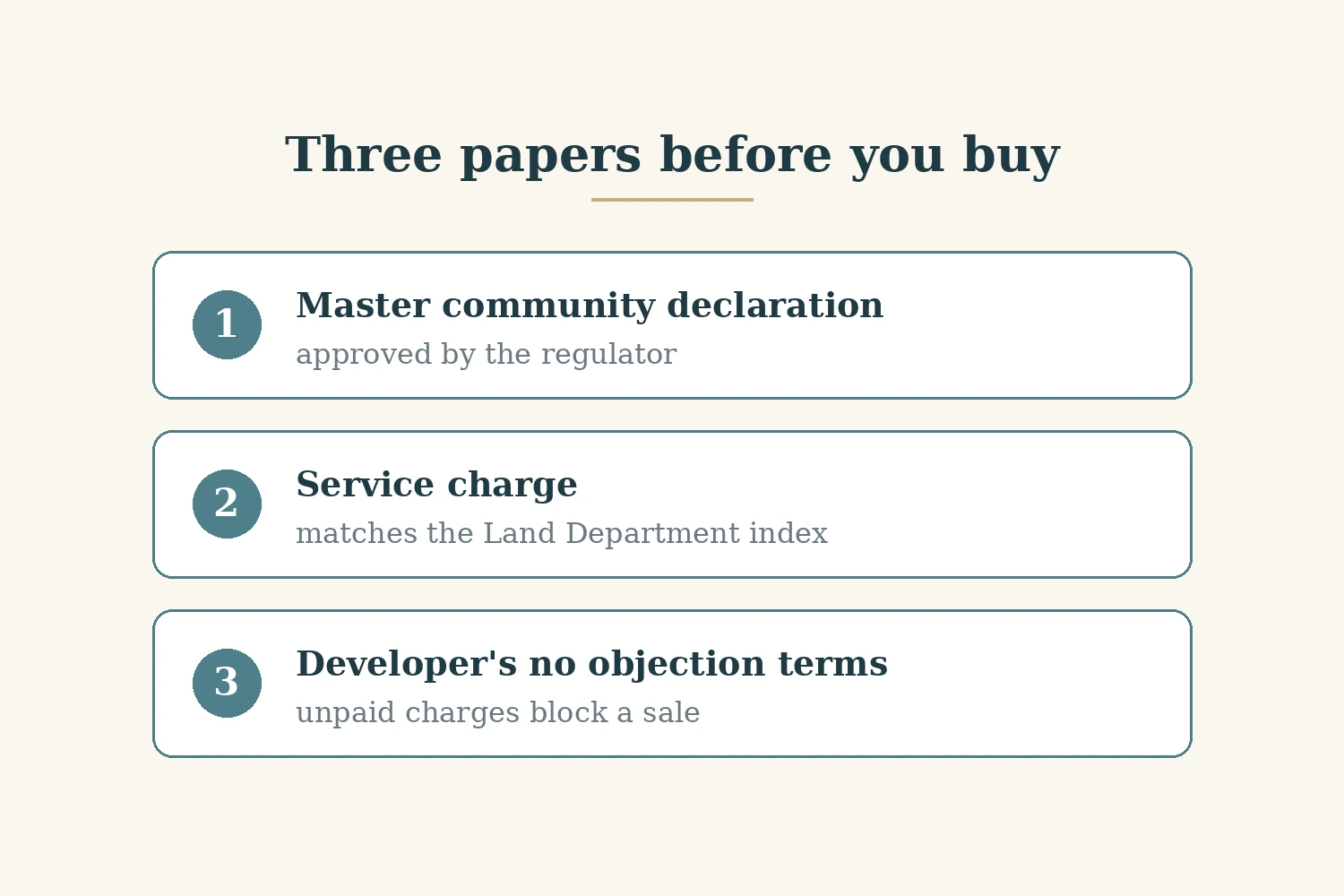
In a Dubai master community, the developer writes the rules, but RERA approves the rulebook, the charges and any change to buyers' rights, and the DLD requires the developer's NOC before a resale registers. So before you buy, ask for three things. First, the RERA-approved master community declaration. Second, the approved service charge and any usage charge for the exact project, use and year, matched against the DLD index. Third, the developer's NOC terms and fee in writing. If any of the three is missing or does not match, ask again in writing before any money moves.
Sources
- Dubai Legislation Portal: Law No. 6 of 2019 concerning ownership of jointly owned real property in the Emirate of Dubai
- Dubai Land Department: property sale registration
- Dubai Land Department: frequently asked questions
- Dubai Land Department: Service Charge Index
Ready to find your next holiday home?
Browse our curated collection of vacation homes and managed farmland across India and beyond.