Homestay and Farm-Stay Licensing: Goa, Coorg and Lonavala
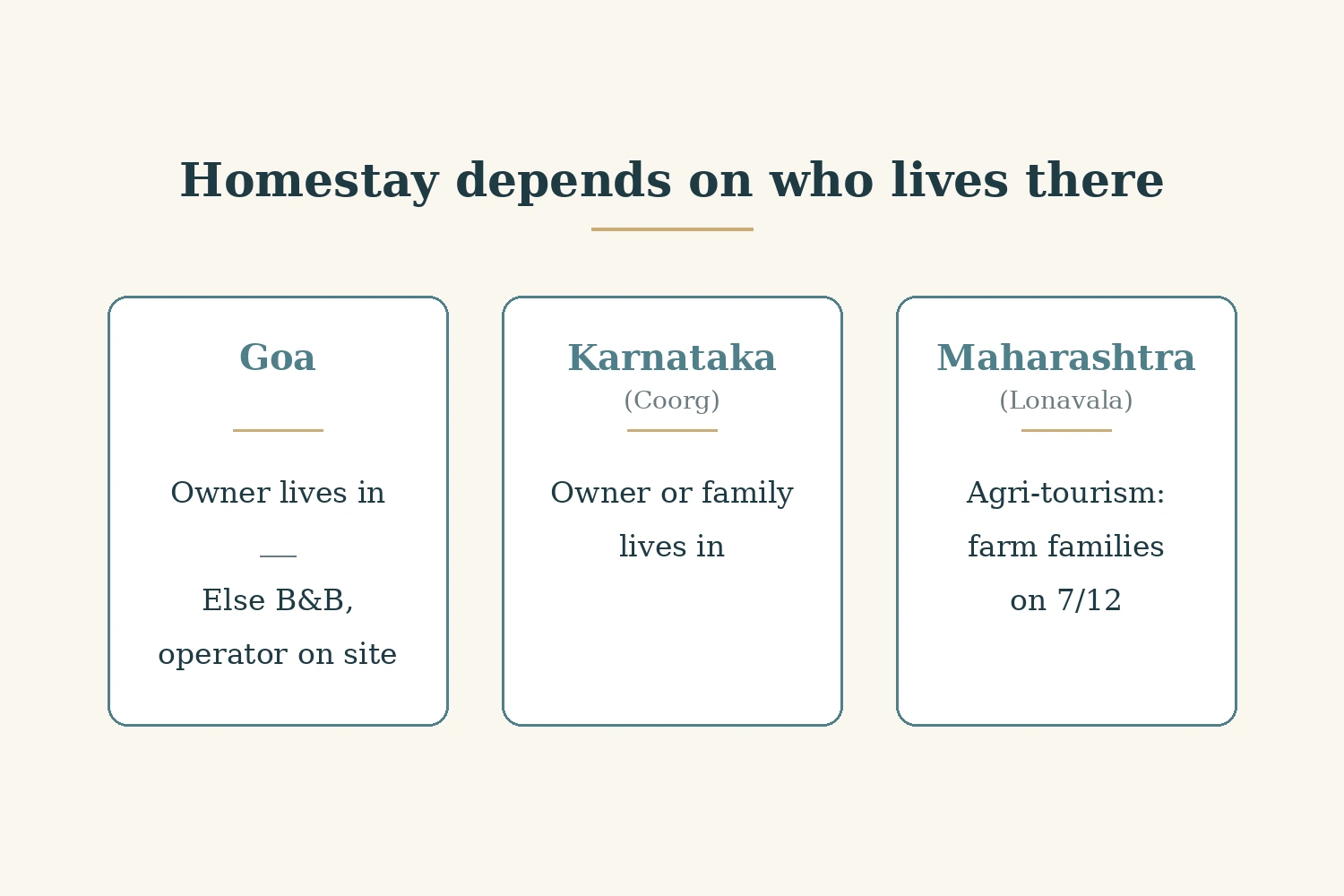
"Buy a weekend home and run it as a homestay when you are not there" is one of the most common plans we hear from second-home buyers. In Goa, Karnataka and Maharashtra it usually starts in the wrong legal category. In all three states, "homestay" is not a marketing word but a registration category, and it turns on one question: who actually lives in the house. If the owner or the owner's family lives there, a homestay may be possible. If the owner lives in Mumbai, Pune or Bengaluru, the routes are narrower: a bed and breakfast run by an operator who lives on site, in Goa and Karnataka, or, in Maharashtra, agri-tourism, which is open only to farm families. This guide sets out what each state's official scheme says, as read on 27 October 2026, and what to check before you buy with hosting in mind. It is not legal advice, and it makes no claim about what any property might earn.
Homestay is a legal category, not a marketing word
Each of the three states defines a homestay by residence:
- Goa's policy gives the homestay classification only where the owner or promoter and their family physically live in the establishment.
- Karnataka's 2025 guidelines define a homestay as a private residence where the owner or their immediate family, meaning spouse or children, physically lives.
- Maharashtra's tourism policy describes bed and breakfast and homestay units as ones where the guest stays with the owner or a family member in their usual place of residence.
So the first question is not how many rooms the house has or how close it is to the beach. It is whether you, or your immediate family, will live there. If not, the homestay category does not fit, and you need to look at the routes below.
Goa: homestay or bed and breakfast
The Goa Department of Tourism's "Homestay and Bed & Breakfast Policy" (goatourism.gov.in, read 27 October 2026) draws the line clearly. In our paraphrase:
- A homestay is an establishment where the owner or promoter lives with their family, letting a minimum of two and a maximum of six rooms.
- A bed and breakfast (B&B) is an establishment where the owner does not live on site, but a designated agent or operator does, with the same room limits.
- A promoter is a person authorised by the owner under a valid power of attorney (POA).
- The establishment must be registered with the local authority as a wholly residential unit.
- It cannot be registered in a cooperative housing society or gated complex without a no-objection certificate (NOC) from the body managing it, and it needs the local trade licence and health and safety permissions.
- Registration with the Department of Tourism is required before operating, and B&Bs must hold a licence from the Food and Drugs Administration (FDA).
For an absentee owner, the B&B route with a resident operator is the one the policy describes. Whether a promoter holding a power of attorney can meet the homestay residence test is something to confirm with the department; we do not suggest using a power of attorney to get round the residence requirement. Applications are made through the Goa Online portal. The policy page does not show its notification date, so confirm the current terms with the department. Our guides to Goa's Form I and XIV and Parra, Nerul and Siolim cover the title and zoning checks, and our Goa guide describes the state.
Coorg: Karnataka's 2025 homestay guidelines
In Karnataka, the "Guidelines for Registration of Homestay Establishments 2025" (Government Order (G.O.) No. TOR 133 TDO 2025, Department of Tourism, read 27 October 2026) make registration compulsory before operating a homestay, under the Karnataka Tourism Trade (Facilitation and Regulation) Act, 2015 (KTTF Act) and its rules. In our paraphrase:
- A homestay is a privately owned residence, including one on a farm or plantation, where the owner or their spouse or children physically live, letting between one and six rooms. The guidelines treat it as a non-commercial activity.
- A B&B is where the owner does not live on site but a designated agent or operator does. The guidelines treat it as commercial and say separate guidelines will be issued; we could not find them, so confirm with the department.
- An owner of several houses can register only the one they live in. Rented, leased or sub-let homes cannot be registered as homestays, and joint owners need affidavits from their co-owners.
- Applications go online to the Deputy Commissioner (DC) of the district. Field checks cover ownership, the gram panchayat property record and a police check, and approval comes from a committee chaired by the DC.
- Registration is valid for five years and can be renewed. The fee is as notified by the government; confirm it with the department.
- Rooms may be in the owner's house or in a separate cottage on the same plot, under the same survey number. Dormitories, bunk beds and time-share letting are not allowed, and breakfast is mandatory.
The one-house rule matters most for second-home buyers. If your main home is elsewhere, a Coorg house you visit at weekends is not the one you live in. Our Coorg micro-market map describes the area, and our Coorg guide and Madikeri guide describe the places.
Karnataka's April 2026 circular
Karnataka followed the guidelines with Circular No. TOR 134 TDO 2025, dated 27 April 2026, on "upgraded protocols for operations, safety and security for Homestays and B&B Establishments" (read 27 October 2026). In our paraphrase, it refers to criminal incidents in Koppal and Kodagu, requires the registration certificate and licences to be displayed at the entrance, and says the Tourism Department will list registered units, recommending that online travel agents and other agents work only with registered establishments.
For a buyer, the practical point is that an unregistered homestay is harder to run openly than it may once have been. Penalties for operating without registration are not something we could confirm; ask the department.
Lonavala and Karjat: Maharashtra's homestay definition
Maharashtra's Tourism Policy 2024 (Government Resolution TDS-2022/09/CR No 542/Tourism-4, 18 July 2024, read 27 October 2026) defines "Bed & Breakfast/ Homestays/ Vacation Rental Homes" as units where the guest stays with the owner or a family member in their usual place of residence, with at least one lettable room. Such units must follow the Ministry of Tourism's Bed and Breakfast Scheme or the state's guidelines and be registered with the Directorate of Tourism.
The state's Aaple Sarkar services portal also lists "Bed and Breakfast Scheme Registration and Renewal" as an online service (read 27 October 2026). Which body processes registrations in practice is something to confirm with Maharashtra Tourism when you apply. Local body permissions, such as from the municipal council or gram panchayat, are not covered here; confirm them locally. Our Karjat micro-market map and our Lonavala guide and Karjat guide describe the area.
Maharashtra agri-tourism: for farm families only
Maharashtra's other route is agri-tourism, and it is not open to most second-home buyers. Under the Agri Tourism Policy (Government Resolution TDS 2019/8/C.N.514/ENVI, 28 September 2020, read 27 October 2026), in our paraphrase:
- Eligible applicants are individual farmers, farmers' cooperatives and certain agricultural institutions and farmer companies, and agriculture must be the main occupation.
- The centre must be in a village at least one kilometre from municipal limits, on at least one acre of agricultural land.
- The land record (the 7/12 extract) must be in the farmer's name or a family member's name.
The 2024 tourism policy adds that agri-tourism accommodation must be separate from the farm owner's usual home, and that a farmer no longer needs non-agricultural permission for agri-tourism but must inform the revenue department. The two documents give different validity periods for the licence, so confirm the current term and any fee with the Directorate of Tourism.
If you are buying farmland as a city-based non-farmer, this route will usually not be yours. Our guides to reading a 7/12 extract, the Maharashtra Land Revenue Code and managed farmland and land law by state explain why.
Before you buy with hosting in mind
Before you buy a house or farm on the strength of a hosting plan, check:
- Who will live there. If neither you nor your immediate family will, the homestay category does not fit in any of the three states.
- Whether a B&B with a resident operator is allowed where you are buying, and what licences it needs.
- In Karnataka, whether this would be the only house you register, and whether any cottages sit on the same survey number.
- In a housing society or gated complex in Goa, whether the managing committee will give an NOC.
- In Maharashtra, whether you qualify for agri-tourism at all, which depends on being a farmer with the land record in the family's name.
- In Goa, the panchayat or municipal trade licence; Karnataka's guidelines say a registered homestay does not need one. Confirm any other local permissions with the local body.
Non-Resident Indians (NRIs) face the same residence test as anyone else. Our questions before signing a land deal cover the wider checks, and any rental receipts are taxable: see our guide to declaring Indian rental income. If a seller quotes what a homestay "earns", our guide on how to read a seller's rental claim sets out the questions to ask.
Who this is not for
This is not for someone who will live in the house full time with their family and wants a step-by-step registration walkthrough: the departments' own pages are the place for that. It does not cover hotels, resorts or other commercial accommodation, states other than Goa, Karnataka and Maharashtra, or fees and penalties, which we could not confirm. And it makes no claim about what any homestay, B&B or agri-tourism unit might earn.
Where that leaves you
In Goa, Karnataka and Maharashtra, a homestay is defined by who lives in the house. An owner who does not live there has narrower routes: a B&B with an operator living on site in Goa or Karnataka, or agri-tourism in Maharashtra, which only farm families can use. Registration comes before the first paying guest, not after. If your plan depends on hosting, settle which category you would fall into, and whether you qualify for it, before you buy.
Sources
- Goa Department of Tourism: Homestay and Bed & Breakfast Policy
- Goa Online: Department of Tourism service TOU03
- Karnataka Tourism: Guidelines for Registration of Homestay Establishments 2025, G.O. No. TOR 133 TDO 2025
- Karnataka Tourism: Circular No. TOR 134 TDO 2025, 27 April 2026
- Karnataka Tourism: homestay guidelines and circular
- Maharashtra Tourism: Tourism Policy of Maharashtra 2024
- Maharashtra Tourism: Agri Tourism Policy, 28 September 2020
- Aaple Sarkar: Bed and Breakfast Scheme Registration and Renewal
Ready to find your next holiday home?
Browse our curated collection of vacation homes and managed farmland across India and beyond.