Section 154 Permission in Uttarakhand: Who Needs It
Most buyers looking at land in Uttarakhand have heard, correctly, that the state tightened its rules for outside buyers in recent years. What that shorthand skips is that a real, specific threshold decides whether permission is actually required at all, and a buyer who never crosses it does not need the permission process most of the anxiety around this rule is actually about.
The threshold that determines whether permission applies
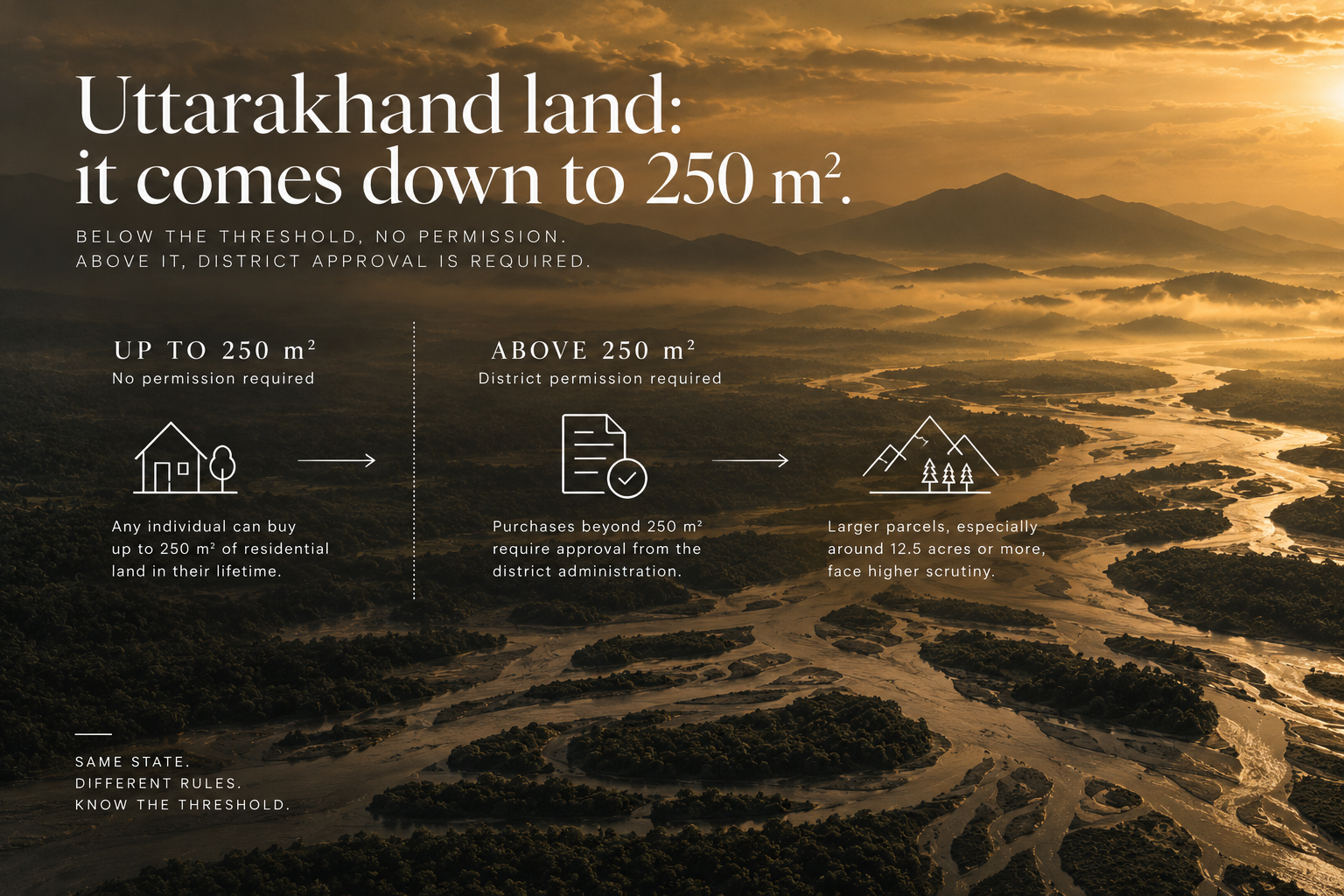
Under Section 154 of the U.P. Zamindari Abolition and Land Reforms Act, as adapted and amended for Uttarakhand, any person, including someone with no prior tenure or property holding in the state, can purchase up to 250 square metres of land for residential purposes in their lifetime without requiring special permission. Uttarakhand's Land Law for Outside Buyers: What Changed covers the wider tightening this specific threshold sits inside. It is only when a purchase exceeds this limit that Section 154's permission requirement is actually triggered, and a buyer purchasing a modest residential plot within that limit is not the buyer this permission process exists for.
What happens above the threshold
For land purchases beyond the 250 square metre residential limit, and specifically for outside buyers seeking larger parcels, the amended framework requires permission from the district administration before the purchase can proceed. This permission process examines the intended use of the land and, particularly for parcels approaching or exceeding roughly 12.5 acres, applies additional scrutiny reflecting the state's broader concern about large-scale land consolidation by non-resident buyers. A buyer planning a purchase at this scale should treat the permission process as a real, non-trivial step in the transaction timeline, not a formality that can be rushed through alongside the rest of the paperwork.
Why this rule exists in the first place
Uttarakhand's land law amendments in this area followed genuine political and public concern about the pace at which outside buyers, both domestic and occasionally with looser scrutiny, were acquiring large tracts of hill land, with implications for the state's demographic and agricultural character that go well beyond any single transaction. Understanding this context matters for a buyer navigating the permission process, since the administration reviewing an application is weighing considerations broader than whether the buyer can afford the land, and a permission request that reads as a purely speculative or large-scale acquisition faces meaningfully more scrutiny than one with a clear, modest residential or genuinely productive stated purpose.
What the intended use requirement actually means in practice
Where permission is granted, the land must be used in accordance with the purpose stated in the application, and a use that diverges materially from what was approved, converting agricultural land nominally purchased for farming into a resort development, for instance, is a genuine compliance risk rather than a grey area. A buyer whose actual intended use differs from what will realistically secure approval should treat that mismatch as a reason to reconsider the purchase, rather than assuming a stated purpose can simply be adjusted after the fact.
What actually needs confirming before signing
The specific area of the plot relative to the 250 square metre threshold, whether the buyer has already exercised any part of their lifetime residential allowance elsewhere in the state, and, for any purchase requiring permission, the realistic timeline for district administration approval, all need to be confirmed before a purchase agreement is signed rather than discovered afterward. A transaction timeline that assumes permission is a formality, when the actual approval process can run considerably longer, creates real risk for both the buyer and seller if the sale agreement's own timeline does not account for it.
How this interacts with the lifetime allowance specifically
The 250 square metre residential exemption is framed as a lifetime allowance per individual, not a per-transaction limit, which means a buyer who has already purchased residential land in Uttarakhand previously, even years earlier and even for a different property, may have already used up all or part of that allowance. This detail is easy to miss for a buyer assuming the threshold resets with each new purchase, and confirming whether any prior Uttarakhand land purchase exists in the buyer's own name is a necessary check before assuming a new purchase automatically falls under the exemption.
Joint purchases and family structuring
A common approach for buyers looking to acquire land beyond what a single individual's exemption allows is structuring the purchase jointly across family members, each within their own individual allowance, rather than a single buyer attempting to acquire the full area and triggering the permission requirement. This is a legitimate structuring approach where genuinely reflecting separate ownership interests, but a joint purchase structured purely to circumvent the permission requirement, where one party is effectively fronting for a single beneficial owner, carries real legal risk if the arrangement is challenged, since the underlying intent behind the exemption is individual residential use, not a mechanism for aggregating land through nominee holders.
What Avacasa recommends
Check the specific plot's area against the 250 square metre residential threshold before assuming permission is required at all, since a large share of individual residential purchases never actually trigger Section 154's permission process. Where permission is required, build a realistic approval timeline into the transaction and ensure the stated intended use genuinely matches what the buyer plans to do with the land. Buying Land in Uttarakhand: What the Law Allows covers the wider legal framework this specific permission threshold operates inside.
Before you commit
10 Questions to Ask Before Signing Anything and How to Verify a Developer's Track Record are relevant regardless of the permission question, and NA Plot vs Agricultural Land: Which Should You Actually Buy? is worth reading given how much Uttarakhand land trades in agricultural classification. How to Negotiate Land Price Like a Pro and Due Diligence When Buying Property in Another Country round out the practical checklist for an NRI buyer specifically. You Keep Going Back to Rishikesh. Should You Own There? is relevant for a repeat visitor to the state weighing whether to move from renting to owning.
Whatever the specific hill state, Himachal Pradesh, Goa and Coorg each carry their own distinct outsider-purchase restriction, and Uttarakhand's Section 154 threshold described above is specific to this state rather than a template shared across India's hill destinations.
Sources
- The 250 square metre residential purchase threshold under Section 154 of the amended Zamindari Abolition and Land Reforms Act
- Special permission requirements for outsider land purchases above the threshold, including the roughly 12.5 acre scrutiny point
Ready to find your next holiday home?
Browse our curated collection of vacation homes and managed farmland across India and beyond.