The Monsoon Experience in Karjat: Rivers, Waterfalls and Green Hills
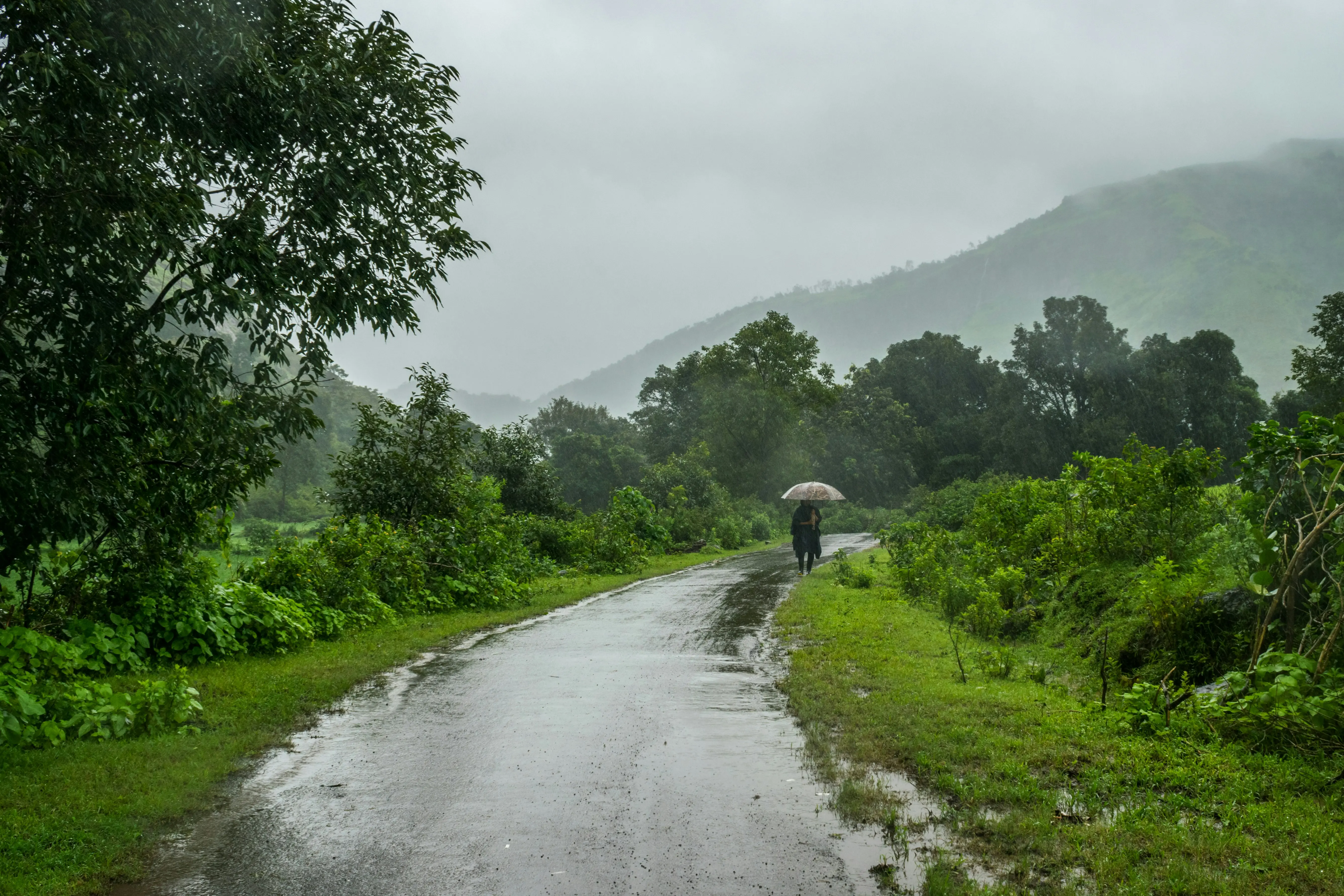
Karjat in monsoon is a different place from Karjat in March. Between mid-June and late September the basin fills with mist, the hills turn a green that does not photograph properly, and water comes off the plateau in a hundred places at once.
This is the season that sells Karjat, and it is worth understanding honestly, because it is also the season you will live through.
The green comes fast
The change is quick. A fortnight after the first rains, the brown scrub of April is gone and everything is soft and overgrown. The Ulhas fills. Streams that were dry gullies become noisy. Cloud sits low on Peb and Matheran and Rajmachi, and the ridgelines appear and disappear through the day.
Temperatures settle into the low twenties to around thirty degrees, which after a Mumbai May feels like a different country. The air smells of wet earth and vegetation. Mornings are grey and cool. This is the weather people are actually buying when they buy in Karjat.
For the full destination overview including geography and connectivity, see the Karjat location guide.
The water
The waterfalls are the headline. Bhivpuri and Zenith are the best known, and the falls around Kondana run hard through July and August. Ulhas Valley fills with seasonal cascades, and the rivers that are quiet ribbons in winter become the loudest thing in the landscape.
The riverside belt that frames these waterfalls is also some of the most sought-after land for weekend homes. Riverside plots in Karjat: pros, cons and pricing covers the premium and the trade-offs.
Two hours from Mumbai, this is a remarkable thing to have. On the Central Line, trains run frequently enough that a person can leave home after breakfast and be standing under falling water by lunchtime.
Walking in the rain
The Sahyadri trekking around Karjat comes into its own in monsoon.
Kondana Caves is the gentle one. The caves are Buddhist rock-cut work from around the first century BCE, sitting in forest below the Rajmachi plateau about fifteen kilometres from Karjat. The walk up from Thakurwadi takes roughly an hour on a well-marked trail, past streams and small falls, and it is manageable for most people with basic fitness. In monsoon there is water falling near the cave mouth, which is the whole reason to go then.
Garbett Plateau is the spectacular one. A kilometre-long grass plateau on the Matheran range where dozens of seasonal falls drop off the edge at once, reached from Bhivpuri Road station via Diksal village. It takes four to five hours up. Take a local guide, because cloud can cut visibility to under fifty metres with no warning and the plateau has no marked exit trail.
Sondai is the good first trek if you have never done one.
A word of correction, because plenty of guides get this wrong: the Neral to Matheran toy train does not run in the monsoon. Indian Railways suspends the narrow-gauge service from around mid-June to mid-October each year for safety. If an article tells you to take the toy train in July, it was written from a desk.
Some trails should simply be left alone in heavy rain. Dhak Bahiri, with its steep gradients and rope sections on wet basalt, is an expert-grade route in dry weather and a genuinely dangerous one in the wet. Forest advisories restrict entry to parts of several Sahyadri trails during heavy rainfall. Respect them.
The other monsoon things
Not everything requires a trek.
River rafting runs on the Kundalika near Kolad, one of the few Grade II to III stretches in this part of the country that operates reliably in season. Saguna Baug does paddy planting, which sounds twee and is actually good fun with children. There is birding at Karnala, the ISKCON Govardhan Eco Village for a quieter day, and a picnic at Morbe Dam. Imagica is the reliable answer for a family weekend when the rain has set in and nobody wants to be outside.
For a ready-made itinerary across these highlights, a perfect Karjat weekend: Imagica, Kondana and the Ulhas River maps out a two-day visit.
And there is the food, which in monsoon Karjat means hot bhaji, corn on the cob from a roadside stall, misal, and tea, eaten while watching water fall off a hillside. A private veranda, heavy rain on a metal roof, tea, and nothing that needs doing. That is the version of Karjat that makes people start looking at plots.
The Ulhas Valley is the heart of this experience. The Ulhas Valley neighbourhood guide covers what it is like to own here and what to expect across seasons.
The honest part
If you are thinking about owning here rather than visiting, you should know what three months of this actually means.
It rains hard, and it rains for a long time. Damp is a real and permanent adversary. Roofs, drainage and materials have to be chosen for it, which is a design discipline rather than an afterthought. See designing for heavy monsoon.
Access matters more than anything. A plot with a dirt approach road may be genuinely difficult to reach in August. Maintenance is a running cost, not a one-off, and a hillside house in heavy-rain country will ask for attention every single year.
None of this is a reason not to buy. It is a reason to buy the right plot and build it properly. The people who love their Karjat homes are, almost without exception, the ones who took the monsoon seriously before they bought rather than after.
Which is also the practical argument for seeing land in the rains. Read monsoon buying: should you visit plots in the rains, and if the idea of owning here is taking shape, start with the Karjat micro-market map.
The case for the season
Karjat's monsoon is not a drawback to be managed around. It is the asset. It is what a coastal market cannot replicate, it fills weekend rentals when beach destinations are struggling, and it is the reason the hill climate here is usable for most of the year.
Mostly, though, it is just extraordinarily good to sit in. Come and stand in it before you decide anything.
When you are ready to explore ownership options, browse Avacasa's Karjat listings for a curated view of what is available.
Sources
- Things to do in Karjat in monsoon (StayVista)
- Best time to visit Karjat (Staymist)
- Kondana Caves trek guide (The Freebird)
- Monsoon getaways in Karjat (Oleander Farms)
Ready to find your next holiday home?
Browse our curated collection of vacation homes and managed farmland across India and beyond.